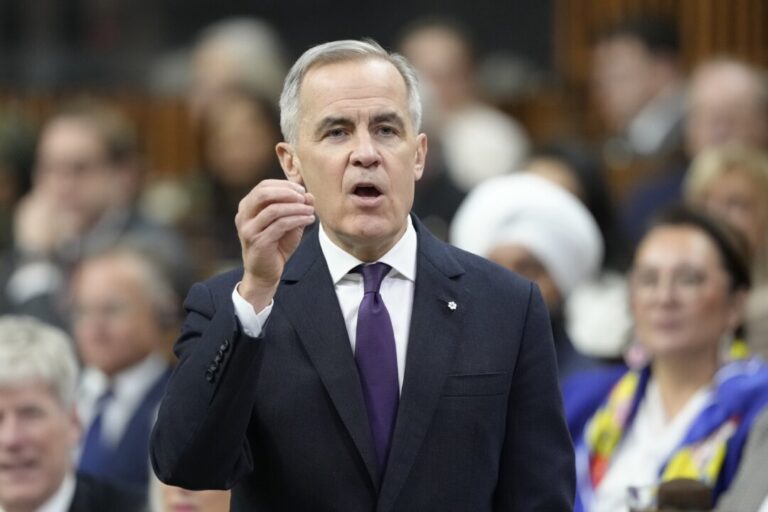

Prime Minister Mark Carney rises during question period on Parliament Hill in Ottawa on Feb. 10, 2026. The Canadian Press/Adrian Wyld
Prime Minister Mark Carney is heading to the Munich Security Conference this week, a prominent Western-led global gathering where leaders discuss defence and geopolitical policy.
The Prime Minister’s Office did not provide details on which bilateral meetings Carney may participate in during the conference, which runs from Feb. 11 to Feb. 15. Around 50 heads of state from countries around the world are expected to attend, including European Commission President Ursula von der Leyen, French President Emmanuel Macron and UK Prime Minister Keir Starmer.
U.S. President Donald Trump is not listed among the conference attendees.
Around 100 foreign and defence ministers, as well as more than 50 U.S. senators and members of Congress, are also expected to attend the key international security gathering, now in its 62nd year.
Amid ongoing trade tensions with the United States, Carney has pursued closer defence and economic ties with non-American partners, including China, Indonesia, South Korea and various European Union (EU) member states. In October of last year, Carney said Canada aims to double its non-U.S. exports by 2035.
Canada has pursued a number of agreements to deepen security and defence ties with Europe, including the signing of the Canada-EU Security and Defence Partnership last June, which pledges closer cooperation between Canada and EU member states.
In December 2025, Canada and the EU also finalized the Canada-EU SAFE Agreement, making Canada the first non-European country to join the 150-billion-euro defence procurement system. Under the agreement, Canadian companies will gain preferential access to bid on EU-funded defence projects, including the production of military technologies such as drone systems, missiles and ammunition.
At last June’s NATO summit in the Netherlands, Canada also agreed to a new Defence Investment Pledge, committing Canada to investing five percent of annual GDP in defence by 2035, with 3.5 percent allocated to core military spending and 1.5 percent to defence- and security-related spending. A review of Canada’s progress toward the goal is scheduled for 2029.
The Carney government’s first budget, introduced last fall, pledged to work toward the 5 percent target. The Parliamentary Budget Officer has noted that the government has not provided specific details on how it plans to reach the goal.
Canada’s defence spending as a share of GDP in the 2024–25 fiscal year was estimated at 1.3 percent by the Department of National Defence.
Matthew Horwood contributed to this report.