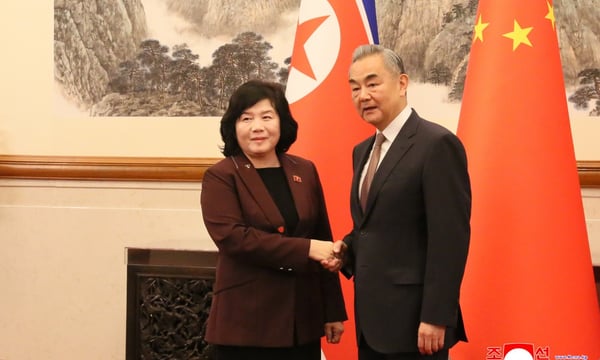
The recent, unexpected visit by China’s foreign minister, Wang Yi, to Pyongyang from April 9 to April 10 drew immediate attention across diplomatic and analytical circles. During the trip, Wang met not only with North Korean Foreign Minister Choe Son Hui but also with the country’s leader, Kim Jong Un.
In a region where signals are often as important as substance, the timing and opacity of the trip suggest that this was not routine diplomacy but a calibrated intervention at a moment of heightened uncertainty. Read against the broader strategic landscape, Beijing’s move appears to serve three interrelated purposes: managing escalation on the Korean Peninsula ahead of a potential meeting between the U.S. and Chinese presidents in May, reassuring an uneasy ally unsettled by Washington’s recent shows of force in 2026, and shaping the regional balance in Northeast Asia in China’s favor.
Containing Escalation on the Korean Peninsula Ahead of the Trump-Xi Summit
China has a clear interest in tempering North Korea’s recent pattern of high-profile weapons testing and saber-rattling. Over the past months, Pyongyang has intensified both the frequency and visibility of its military demonstrations, projecting resolve but also raising the risk of miscalculation.
For Beijing, such dynamics are double-edged. While North Korea’s strategic posture can complicate U.S. planning and thereby offer China indirect leverage, unchecked escalation threatens to destabilize China’s immediate periphery, something Beijing has consistently sought to avoid. In this sense, Wang’s visit likely carried a message of calibrated restraint: not an outright curtailment of North Korea’s capabilities, which would be unrealistic, but a call to lower the temperature and avoid actions that could trigger a spiral of retaliation.
This concern is magnified by the possibility of renewed high-level engagement between Presidents Donald Trump and Xi Jinping in May this year. Any such meeting would benefit from a relatively stable regional environment. A crisis on the Korean Peninsula would not only distract from broader China-U.S. agenda-setting but could also narrow Beijing’s diplomatic maneuvering space.
From this perspective, North Korea is not simply a neighbor but a variable in a larger strategic equation, one that Beijing prefers to keep within manageable bounds. Ensuring that Pyongyang remains responsive, or at least predictable, enhances China’s ability to use the peninsula as a lever in its wider relationship with Washington.
Reassuring an Uneasy Ally Amid Washington’s Recent Shows of Force
Wang’s trip can also be understood as an effort to reassure Pyongyang at a time of growing insecurity. A series of recent international developments including U.S. actions targeting Venezuelan President Nicolas Maduro and joint Israeli-U.S. strikes on Iran have likely reinforced North Korea’s long-standing perception of vulnerability. For a regime that places regime survival at the core of its strategic calculus, such events serve as cautionary tales. Pyongyang’s renewed emphasis on military signaling this year is thus not merely performative. It reflects a deeper anxiety about external threats and the reliability of deterrence.
Against this backdrop, China’s role as North Korea’s primary strategic backer becomes even more salient. By dispatching its top diplomat, Beijing is sending a clear signal that its commitment to the bilateral relationship remains intact. This is particularly significant in the context of the 65th anniversary of the “Treaty on Friendship, Cooperation and Mutual Assistance between China and North Korea,” a symbolic milestone that underscores the historical depth of the partnership.
For Kim Jong Un, such gestures are not merely ceremonial. They help anchor expectations about external support in an otherwise uncertain security environment. In effect, Wang’s visit can be read as an attempt to stabilize North Korea’s threat perceptions, reducing the incentive for excessive risk-taking while reinforcing the credibility of China’s backing.
Shaping Northeast Asia’s Balance in China’s Favor
Last, and perhaps most subtly, Beijing’s engagement with Pyongyang also reflects a concern with the broader regional balance, particularly the domestic political trajectories of South Korea and Japan. North Korea’s actions do not occur in a vacuum; they have direct implications for alliance politics and defense debates in both countries.
When Pyongyang escalates too aggressively, it tends to strengthen conservative and security-oriented factions in Seoul and Tokyo, groups that are generally more aligned with the United States and more skeptical of China. This, in turn, can accelerate military modernization, deepen trilateral cooperation with Washington, and harden regional alignments in ways that are unfavorable to Beijing.
From China’s perspective, therefore, there is a delicate balance to be maintained. A certain level of tension on the peninsula can be strategically useful, complicating U.S. force posture and keeping regional actors off balance. But beyond a certain threshold, escalation becomes counterproductive, consolidating opposing coalitions and narrowing China’s diplomatic options. Encouraging North Korea to exercise restraint is thus not only about crisis management. It is also about shaping the political and strategic environment in Northeast Asia in ways that preserve space for Chinese influence. By signaling both support and limits, Beijing is effectively attempting to guide Pyongyang’s behavior within a range that serves its own long-term interests.
Conclusion
Taken together, Wang Yi’s visit illustrates the inherently dual nature of China’s approach to North Korea: it is at once supportive and constraining, cooperative and managerial. Beijing does not seek to fundamentally alter North Korea’s strategic orientation, nor does it have the leverage to do so unilaterally. What it can do, however, is calibrate the parameters within which Pyongyang operates, offering reassurance when insecurity rises, and applying pressure when escalation risks spiral out of control.
In this sense, the trip is less about any single policy objective than about maintaining equilibrium in a fluid and often volatile regional system. It reflects a broader pattern in Chinese foreign policy: an emphasis on stability, a preference for indirect influence over overt control, and a constant effort to align peripheral dynamics with core strategic priorities. As tensions in multiple theaters from the Middle East to Eastern Europe continue to reverberate globally, managing the Korean Peninsula becomes not just a regional concern but part of a wider effort to navigate an increasingly fragmented international order.
Whether this balancing act will succeed remains uncertain. North Korea retains its own agency and strategic logic, and its interests do not always align neatly with those of its larger neighbor. Yet for now, Wang Yi’s surprising visit highlights Beijing’s multilayered calculations.