Commentary
Last June, the European Union gave itself and China until October to work out ways to remedy bilateral trade imbalances. Since then, the picture of huge Chinese surpluses has not changed, and Europe now has only weeks to set a new agenda.
The EU seems likely to follow the American lead and impose tariffs and other trade restrictions, but the exact nature of such restrictions will not be clear for a while longer.
Today’s trouble between Europe and China began in Washington about 18 months ago. It was around then that President Donald Trump, complaining that Chinese imports had hollowed out America’s industrial base, increased tariffs in general, especially on Chinese goods, and imposed other restrictions on trade with China.
As a result, China-based sales in the United States fell precipitously, by just about half between January 2025 and January 2026. China’s heavily export-dependent economy needed markets to replace America’s once-prominent presence, and Europe became one answer to that need.
Chinese exports to the EU rose more than 10 percent from the last quarter of 2024 to the second quarter of 2026, the most recent period for which data are available. That trend in itself was troubling to European officials and the continent’s business community, but even more troubling was that the growth occurred mostly in high-value products long associated with European production. By early 2026, complaints emerged across the continent about the damage China trade was doing to European business and industry.
A French government report from as early as February 2026 is illustrative. It worried that China trade threatened “the very core of Europe’s production system.” Its title spoke volumes: “The Chinese Steamroller.”
European Central Bank (ECB) President Christine Lagarde worried that China trade would erode the “pillar” of European economic strength, its mid-tech manufacturing. She noted that China now competes directly with some 40 percent of those areas where EU members claim a competitive advantage, up from 25 percent in the early 2000s.
She referenced an ECB report that singled out autos and semiconductors as areas in which Chinese products especially threatened Europe’s employment and industrial capacity.
European complaints against Chinese practice center on two areas.
One is that China’s central bank, the People’s Bank of China, keeps the exchange rate of its currency, the yuan, low, allowing Chinese producers to offer their products at a distinct price advantage in global markets.
The other is Beijing’s willingness to subsidize and otherwise give support to favored industries. Pointedly, the Europeans noted that the industries and companies exporting the most are those that receive Beijing’s greatest support.
Both European complaints came up last June in talks between Chinese Commerce Minister Wang Wentao and EU Trade Commissioner Maros Sefcovic, though the emphasis was on Beijing’s subsidies. Wang said little on either issue but offered to reduce China’s trade surplus through purchase agreements for European goods and by reducing Chinese tariffs on European products. It was at these talks that the Europeans set a three-month deadline for signs of improvement, one that ends in October.
The interim period has shown no signs of improvement. Indeed, the problems seem to have intensified. In July, the first month after the June negotiations and the most recent for which complete data are available, China’s surplus with Sweden, for instance, quadrupled from July of the previous year. Bilateral deficits between China and Finland and Romania rose by nearly 100 percent. China deficits rose by about 90 percent for Germany and 32 percent for Poland. Jumps were smaller for other EU members, but none showed any improvement.
European Commission President Ursula von der Leyen says that she is ready to use “all tools” at her disposal to address the situation. Any action, however, will take time.
In October, she will need to present her remedies before the national leaders of the union’s member states and manage what will no doubt be a difficult debate. And even after von der Leyen reaches an agreement, it will take time for any EU measure to take effect.
Among the inevitable back-and-forth among the Europeans, two issues will hang over the discussions. One is the fate of the EU’s imposition of duties on Chinese electric vehicles (EVs), which took effect in October 2024 to counter Beijing’s subsidies. The other concerns the fees Europe imposed last July on small packages coming from China.
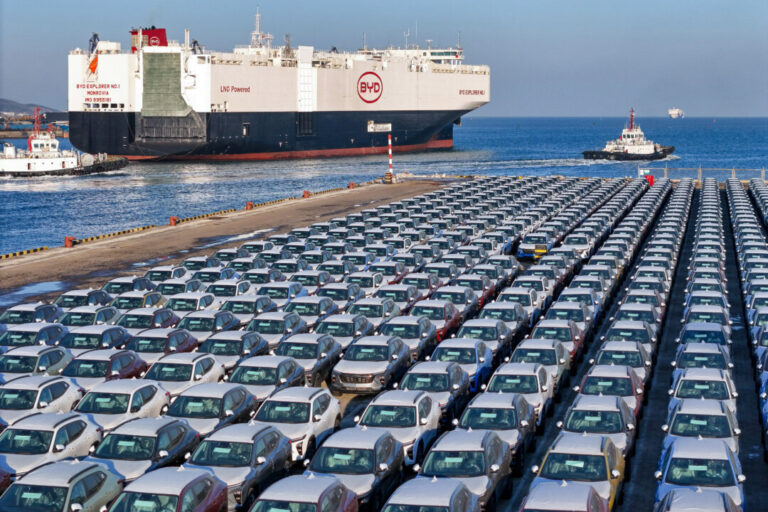
The EV duties failed utterly to either gain concessions from Beijing or stem the tide of Chinese imports. July’s data show that Chinese shipments of plug-in and hybrid EVs to the EU increased 118.3 percent over the previous year, with increases of more than 1,000 percent in France and over 300 percent in the Netherlands.
Germany, Europe’s largest auto producer and China’s main competitor, saw Chinese EV imports rise almost 41 percent over the year ended last July. In contrast, the fees on small packages prompted 30 to 40 percent declines in such imports since they went into effect.
This mix of results likely reflects economics, less than it does Beijing’s priorities. The Chinese regime minds the loss of small, low-value businesses far less than it does the loss of EVs, which are a major emphasis of Beijing’s “Made in China 2025” program. Doubtless, Beijing helped its EV producers overcome the impact of the EU duties but let the European fees affect trade in small packages. Such realities will greatly complicate the upcoming European deliberations.
Making matters even more complex is Beijing’s clear intention to resist whatever the Europeans decide to do. Already, Chinese authorities have blocked German efforts to investigate the takeover of a large German retailer by China’s JD.com, as well as the EU’s subsidy probe into the airport scanner producer Nuctech. Rather than conciliate, Beijing’s Ministry of Justice has criticized the EU for what it calls “improper extraterritorial jurisdiction.” The ministry has threatened retaliation.
Definitely, Europe and China are about to do a reprise of Beijing’s 2025 dance with Washington.
Views expressed in this article are opinions of the author and do not necessarily reflect the views of The Epoch Times.