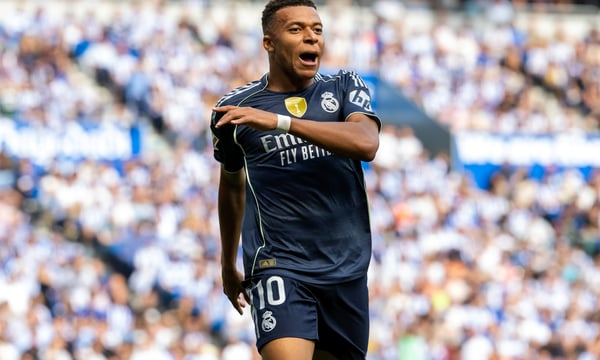
A footballer’s joke about an internet meme has become a demonstration of China’s ability to influence speech far beyond its borders. During a casual interview, French football star Kylian Mbappé described a meme depicting his face superimposed onto Mao Zedong’s body as showing a “Chinese dictator.” The joke was directed at himself, playing on fans’ perceptions of his influence over the teams he plays for. Yet within days, three Chinese sponsors had terminated their partnerships with him, Chinese broadcasters had suspended football coverage, and Mbappé, La Liga, and Real Madrid had all issued apologies.
Whether these apologies will restore their commercial relationships in China remains uncertain. Chinese authorities and businesses may eventually decide that resuming cooperation serves their interests. What is already apparent, however, is the precedent established for freedom of expression. A French athlete, speaking in a non-political context outside China, has publicly apologized for referring to a historical political leader as a dictator. The incident illustrates how China’s economic influence enables political censorship to operate across national borders without necessarily requiring direct government orders. Foreign individuals and institutions need not be subject to Chinese law for their speech to be constrained by Beijing’s political expectations. Their commercial dependence on the Chinese market can be sufficient.
Following the circulation of Mbappé’s remarks, Chinese beverage company Dongpeng announced the termination of its partnership with him. Dairy companies Mengniu and Milkground soon followed, issuing similarly worded statements condemning remarks that “hurt national sentiment.” Chinese media platforms and broadcasters imposed further restrictions. The responses unfolded rapidly, even though the original controversy concerned neither the products these companies sold nor the services they provided.
There is no solid evidence that Chinese authorities individually instructed these companies to terminate their agreements. In China’s political and commercial environment, however, businesses have incentives to anticipate official sensitivities and demonstrate loyalty before being asked. Once one company publicly takes a position, others may perceive a need to respond with comparable or greater severity. Silence, or a comparatively restrained response, can become a reputational liability.
This creates a system of competitive political loyalty in which businesses and public institutions reinforce one another’s responses. Political conformity becomes part of commercial calculations. The immediate cost of abandoning a lucrative endorsement may be outweighed by the perceived risks of political disapproval, consumer backlash, or accusations of insufficient patriotism. The resulting pressure is particularly effective because it is decentralized. The state need not supervise every act of censorship when institutions have strong incentives to enforce political boundaries themselves.
China’s Foreign Ministry subsequently elevated the controversy into a matter of national dignity. “Any rhetoric or action that hurts the feelings of the Chinese people will naturally be rejected across the sectors in China,” spokesperson Guo Jiakun declared. What began as a footballer’s description of an internet joke was transformed into an alleged offense against a nation.
Such rhetoric presents the Communist Party’s preferred interpretation of history as inseparable from the feelings of the Chinese population, leaving little room for disagreement among Chinese citizens themselves. Yet Chinese society is neither politically nor historically homogeneous. Views of Mao’s legacy differ across generations, communities, and personal experiences. By framing the controversy as an affront to “the Chinese people,” the Foreign Ministry gave an unfolding commercial backlash the authority of a national grievance.
The historical irony is that the Chinese Communist Party has itself repeatedly adjusted its interpretation of Mao’s legacy. Its 1981 historical resolution held Mao chiefly responsible for the Cultural Revolution and criticized his increasingly arbitrary exercise of power, while preserving his revolutionary standing. Under Xi Jinping, the 2021 resolution continued to acknowledge Mao’s responsibility for launching the Cultural Revolution, but placed greater emphasis on the continuity and achievements of Communist Party rule. While the party reserves the authority to reinterpret its own history, a foreign footballer’s casual reference to Mao as a dictator can become grounds for commercial punishment. The controversy thus concerns not only historical interpretation, but also who is permitted to express it.
Real Madrid’s apology emphasized its “deep respect for China, its history, its culture, and its citizens.” Such language may be commercially expedient, but it also accepts the premise that a footballer’s personal remarks about a historical leader require institutional contrition. Respect for Chinese people does not require agreement with the Chinese government’s interpretation of history. Nor should maintaining friendships and commercial relationships entail allowing the CCP’s political sensitivities to determine what foreigners may say about Chinese political figures.
Now that apologies have been made publicly, the significance of the controversy extends beyond those directly involved. Other athletes, entertainers, businesses, and media organizations may begin avoiding historical references, political subjects, or even casual jokes, because the potential commercial consequences are difficult to predict. Such anticipatory self-censorship is difficult to measure.
Chinese authorities and commercial institutions can unilaterally decide what “hurts the feelings of the Chinese people.” They also have the power to determine when a controversy has been sufficiently addressed, whether an apology is acceptable, and when normal business relations should resume. Foreign individuals and organizations have little influence over these shifting standards, and compliance offers no guarantee against future punishment. Even if the original dispute is eventually resolved, the precedent it establishes may continue to influence the decisions of others.
China’s influence over international speech therefore cannot be understood solely by counting canceled contracts, suspended broadcasts, or public apologies. Its more enduring effect lies in the ability of political restrictions originating in China to shape the conduct of institutions and individuals operating in societies that do not formally recognize those restrictions.
Real Madrid may eventually recover its commercial standing in China, but the consequences for freedom of expression are far harder to undo.