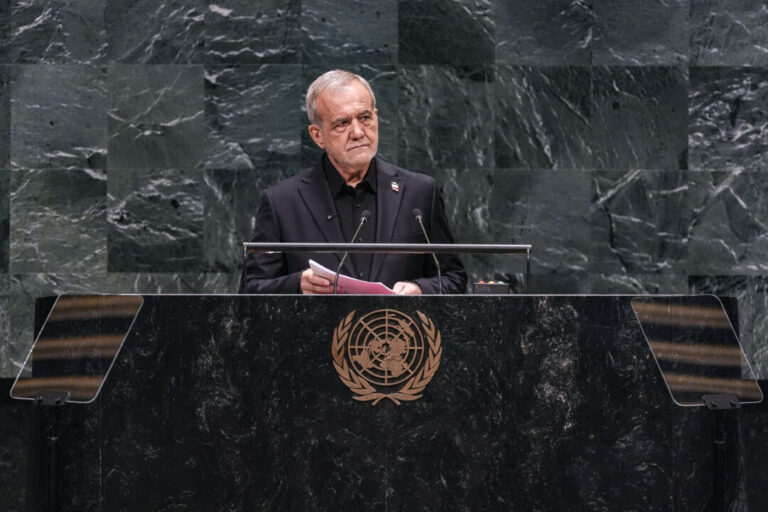
Iranian President Masoud Pezeshkian said on Sept. 24 that the United States, not Iran, must decide whether to end the ongoing conflict, while denying that Tehran seeks a nuclear weapon.
“We do not wish to continue. It’s America that must choose whether it wants to end this or not,” Pezeshkian said on Fox News’ “Special Report with Bret Baier.”
The comments came two days after President Donald Trump, in a Sept. 22 address to the U.N. General Assembly, said he could “annihilate the Islamic Republic” if Tehran did not agree to end the fighting. Trump also suggested in comments to reporters on the same day that a deal could come soon.
Pezeshkian used his own address at the U.N. on Wednesday to vow that Iran would not back down under U.S. pressure.
Diplomatic efforts are ongoing, as Washington and Tehran engaged in talks via mediators this week, according to U.S. envoy Steve Witkoff.
Asked about Iran’s nuclear ambitions, Pezeshkian denied Tehran was seeking a bomb.
“Not at all. Not at all,” he said, adding that Iran was willing to dilute its stockpile of uranium enriched to 60 percent, a level of purity that is
away from reaching the 90 percent threshold required to produce a nuclear weapon.
Commenting on why Iran needed uranium enriched to that level in the first place, Pezeshkian said diluting the material would not be difficult, calling it “not a big deal.”
He said Iran would give up the stockpile “within the framework of international law” and under the nuclear Non-Proliferation Treaty, which Tehran cites as guaranteeing its right to develop nuclear technology for peaceful purposes.
Under the June 17 Memorandum of Understanding (MOU), Iran agreed not to procure or develop nuclear weapons. However, the deal collapsed the following month, when Trump said Iran was attacking ships in the Strait of Hormuz.
Baier noted that Iran’s Revolutionary Guard fired on three ships and set fire to a Qatari gas tanker in the weeks after the memorandum was signed.
Pezeshkian attributed the breakdown to a lack of coordination between Washington and Tehran, saying the two governments never established a promised communication channel to prevent misunderstandings.
The U.S. military has enforced a naval blockade on Iranian ports since earlier this summer. The U.S. Central Command said that as of Sept. 23, at least 115 ships had been redirected to enforce compliance.
Nuclear Obligations
Pezeshkian said Washington’s decision to abandon the original nuclear agreement, the Joint Comprehensive Plan of Action, lies at the heart of Iran’s wariness toward the Trump administration.
“You see the problem that we face is that there is a deep mistrust that has formed between us,” he said. “The reason for it is that prior in the JCPOA, we did reach an agreement under the JCPOA that your president tore that up.”
The U.N. Security Council passed unanimously a resolution in support of the JCPOA agreement with Iran in 2015. It provided for a snapback mechanism, which would restore full U.N. sanctions against Iran in the event of Tehran failing to fully comply with the terms of the agreement.
Trump withdrew the United States from the JCPOA in 2018, arguing it failed to sufficiently limit Iran’s missile programs, did not address Tehran’s support for designated terrorist organizations, and allowed key nuclear restrictions to expire within 15 years.
His administration then reimposed economic sanctions, and Iran responded by enriching and stockpiling uranium beyond the levels the agreement had permitted.
In June 2025, the International Atomic Energy Agency declared Iran noncompliant with its Non-Proliferation Treaty obligations. Israel began bombing Iranian nuclear sites and other targets within hours, a campaign that lasted 12 days.
Iran suspended talks with Washington after U.S. forces bombed the underground Fordow uranium enrichment plant in June 2025.
France, Germany, and the UK invoked the snapback mechanism in August 2025 to reinstate sanctions when they sent a letter to the Security Council saying that Iran was in “significant non-performance” of its commitments under JCPOA.
New Ayatollah
Addressing the health of Iran’s new leader, Mojtaba Khamenei, Pezeshkian said he met him in person about a month earlier. Pezeshkian said that the new leader is healthy and able to govern the country.
Mojtaba Khamenei was named to the position in mid-March after his father, Ayatollah Ali Khamenei, was killed in a Feb. 28 airstrike at the start of the war.
Mojtaba Khamenei has not been seen publicly since, including an absence in July from his father’s funeral.
Asked why Khamenei has not appeared publicly on video since taking the position, Pezeshkian attributed it to security concerns stemming from what he called actions by foreign aggressors.