British maritime authorities said on Monday that commercial traffic through the Strait of Hormuz has stabilized following last month’s U.S.–Iran memorandum of understanding (MOU), but shipping volumes remain well below pre-war levels, and the recovery is showing little sign of accelerating amid persistent security threats.
The assessment was made after a fleet of 10 Japan-linked commercial vessels, including six very large crude carriers loaded with some 12 million barrels of Middle Eastern crude, finally exited the strategic waterway after being stranded in the Persian Gulf for months during the Iran conflict.
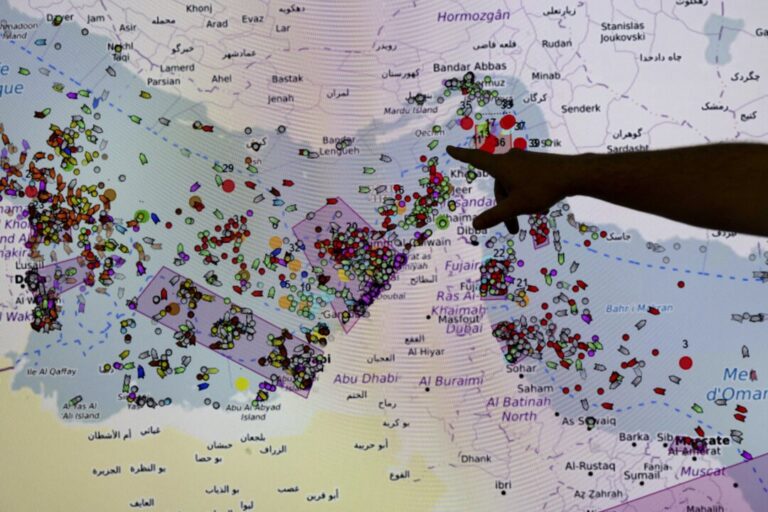
The United Kingdom Maritime Trade Operations center said in a July 5 update that vessel movements through the strait remained “steady” over recent days, with commercial traffic continuing to use both the southern Omani shipping corridor and the northern Iran-controlled route.
The maritime authority added, however, that there was no evidence of a sustained increase in traffic along the U.S.-supported southern corridor, suggesting the shipping rebound remains gradual despite the MOU that formally reopened the Strait of Hormuz to commercial traffic.
“Risk remains lower than during the pre-MOU period,” UK Maritime Trade Operations said, adding that navigation interference “persists” and that the threat from naval mines laid by Iranian forces in the waterway remains “relevant.”
“Iranian intent and capability to conduct intentional hostile action remain, and the environment continues to warrant heightened vigilance despite the absence of recent escalation,” the British maritime authority said, while labeling the Hormuz threat level as “substantial.”
Meanwhile, the latest Joint Maritime Information Center advisory, published by UK Maritime Trade Operations on July 6, noted that the southern Omani route remains open and available to shipping vessels seeking passage in and out of the Gulf.
“Mariners are reminded that the southern route of the SoH has been expanded and remains available for all traffic,” the Joint Maritime Information Center said, adding that while ships are “strongly encouraged” to maintain engagement with U.S. Naval forces that are present in the region to assist with freedom of navigation, coordination with American forces to ensure safe passage is not mandatory.
U.S.-assisted commercial transits have continued without interruption, UK Maritime Trade Operations said in the July 5 update, noting smooth transit irrespective of ongoing mine-clearing operations and despite the fact that Iranian Islamic Revolutionary Guard Corps forces have maintained radio hailing and surveillance of merchant shipping and a “continued intent to assert presence in the area.”
Iran’s military command warned last week that any tankers passing through Hormuz must use Tehran’s approved routes or face the prospect of a “powerful response.”
However, the latest updates from UK Maritime Trade Operations—and other vessel-tracking data—suggest that shipping flows through the Strait of Hormuz continue unimpeded despite the uncertain security outlook.
Japan-Linked Fleet Finally Departs
Shipping data compiled by LSEG showed that a convoy of 10 Japan-related vessels was exiting the Strait on July 6 after being delayed for months by the conflict.
The fleet included six very large crude carriers carrying crude loaded in Saudi Arabia, the United Arab Emirates, and Qatar during late February and early March, along with two chemical tankers, a vehicle carrier, and a container ship.
Most of the vessels are managed by Japanese shipping company Mitsui O.S.K. Lines, which has repeatedly said it would prioritize the safety of its crews and ships when navigating the strait.
Separately, South Korean refiner S-Oil said its chartered VLCC Long Wind, carrying approximately 2 million barrels of Saudi crude loaded in early March, successfully exited the strait on July 4.
The departures represent another sign that oil exports from the Gulf are gradually resuming after months of disruption, although industry officials say shipping patterns remain far from normal.
According to UK Maritime Trade Operations data released on Sunday, only 80 merchant vessels transited the Strait under U.S.-led escort during the 72-hour period from Thursday through Saturday. That compares with a pre-conflict daily average of roughly 138 ships.
The number of U.S.-coordinated transits also declined over the three-day period, from 33 vessels on Thursday to 29 on Friday, then to 18 on Saturday.
Writing in Lloyd’s List on Monday, editor-in-chief Richard Meade said that the consensus view in the shipping industry is that “nobody yet knows what the new normal looks like” for vessel traffic in the Strait of Hormuz.
Meade said that the best-case scenario is the continuation of the gradual reopening of Hormuz that is currently underway, a situation that would be marked by a recovery in volumes despite the persistence of some inefficiencies.
“Such an outcome would avoid wider damage to the global economy,” Meade wrote. “The bigger question may be how much trade never fully returns to Hormuz” as exporters continue investing in alternative routes that bypass the narrow waterway.
Saudi Arabia has continued routing significant volumes through its East–West Pipeline to the Red Sea port of Yanbu, while the United Arab Emirates has expanded exports through Fujairah outside the Gulf.