Beijing is transforming its military pressure on Taiwan into an Indo-Pacific threat, but experts say the strategy will ultimately backfire by strengthening defense cooperation among the United States, Japan, and the Philippines.
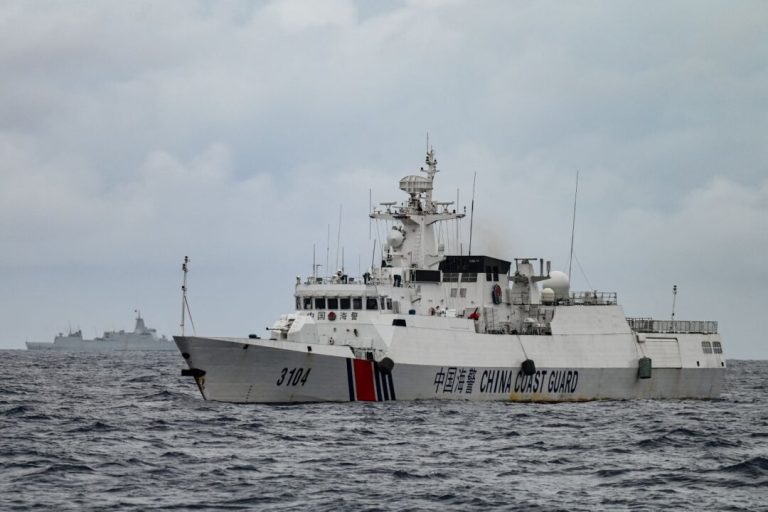
The China Maritime Safety Administration abruptly announced on July 22 that 12-hour live-fire drills would take place each day on July 23 and 24, spanning two areas in the Taiwan Strait and the East China Sea.
Liang Wen-chieh, spokesperson and deputy head of Taiwan’s Mainland Affairs Council (MAC)—the government body that handles cross-strait affairs—said on July 23 that the exercises were primarily centered near China’s Dongshan Island in Fujian Province and were being closely monitored by relevant authorities, per Taiwan’s Central News Agency.
Taiwan’s Ministry of Foreign Affairs strongly condemned the maneuvers that same day, stating the Chinese regime blatantly violated international norms while posing “serious risks to regional aviation and maritime navigation.”
The Chinese military activity came shortly after U.S. Secretary of State Marco Rubio
China’s operations during talks with Chinese Foreign Minister Wang Yi on the sidelines of the Association of Southeast Asian Nations (ASEAN) foreign ministers’ gathering in Manila on July 22.
“We’re never going to accept that international waterways are somehow under the control of other countries,” Rubio said, according to remarks from the U.S. State Department.
On July 19, Taiwanese President Lai Ching-te also
of the Chinese threat, urging officials of the country’s ruling Democratic Progressive Party to unite against China’s “red terror” and ensure democratic Taiwan is never turned into “China’s Taiwan.”
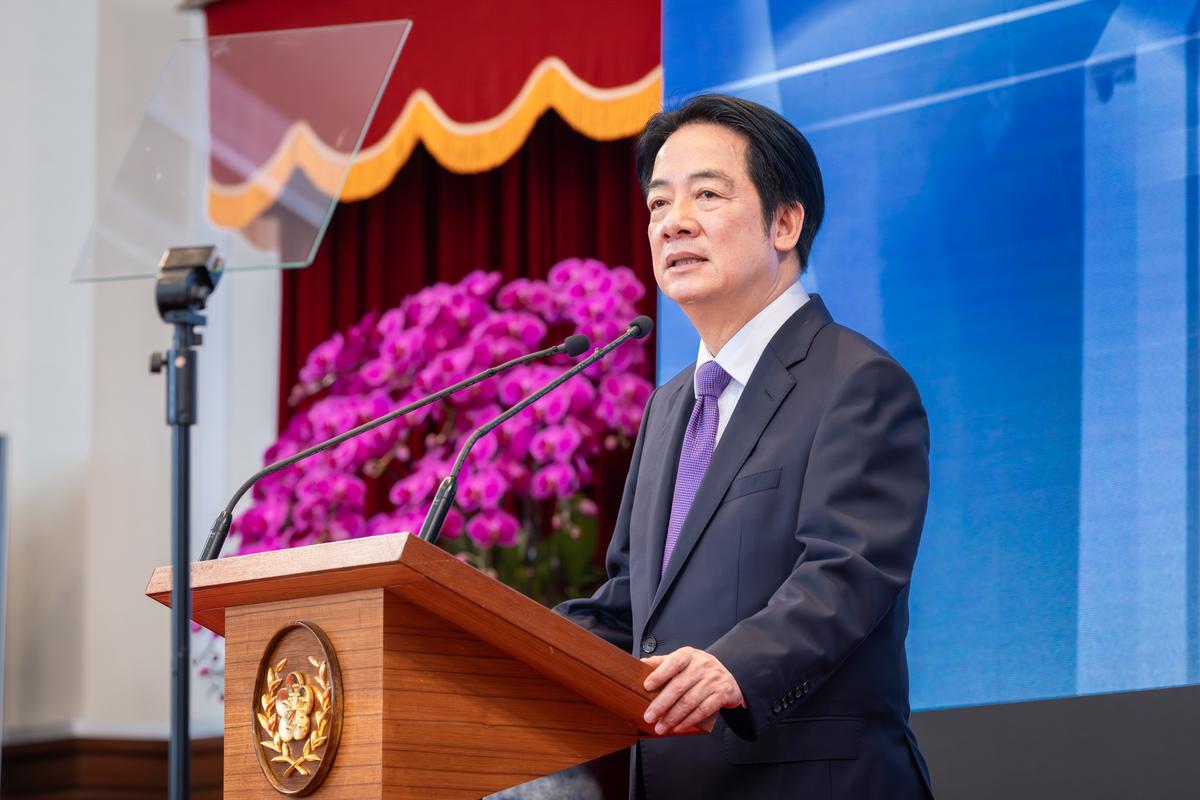
Taiwanese President Lai Ching-te delivers his address on the second anniversary of taking office in Taipei, Taiwan, on May 20, 2026. Wang Yu Ching/Office of the President
The Chinese Communist Party (CCP) has never ruled Taiwan, and it refuses to renounce the use of military force to
the self-governed democracy. The CCP has also stepped up military drills around Taiwan since then-U.S. House Speaker Nancy Pelosi’s 2022
to Taipei.
Dual Warnings
Tzeng Wei-feng, an associate research fellow at the Institute of International Relations at National Chengchi University, said Beijing intends its latest live-fire drills as a stern warning to Taipei.
“The goal is to internalize the Taiwan Strait, reinforcing its sovereignty claims and gradually creating a fait accompli,” Tzeng told The Epoch Times.
“The implicit signal is that any Taiwanese statement the regime finds objectionable will invite retaliation through military intimidation.”
Bonnie Yushih Liao, a senior research fellow at the Japan Forum for Strategic Studies in Tokyo, said the CCP’s objective regarding Taipei is political.
“Beijing is trying to convince Taiwan that closer alignment with democratic partners will inevitably produce greater military pressure,” Liao told The Epoch Times.
“This reflects a broader strategy that combines military, political, and psychological coercion into a long-term campaign of strategic signaling.”
Liao said the Chinese regime’s actions were carefully timed to respond to Washington as well.
“Beijing is attempting to demonstrate that stronger U.S. support for Taiwan will carry increasing operational costs,” she said.
“China seeks to normalize a higher level of military activity around Taiwan, making coercive operations appear routine rather than exceptional.”
Regional Coercion
Taiwan’s secretary-general of the National Security Council, Joseph Wu, said in a July 24 post on X that the CCP’s military exercises not only threaten Taiwan but are also designed to coerce Japan and the Philippines simultaneously.
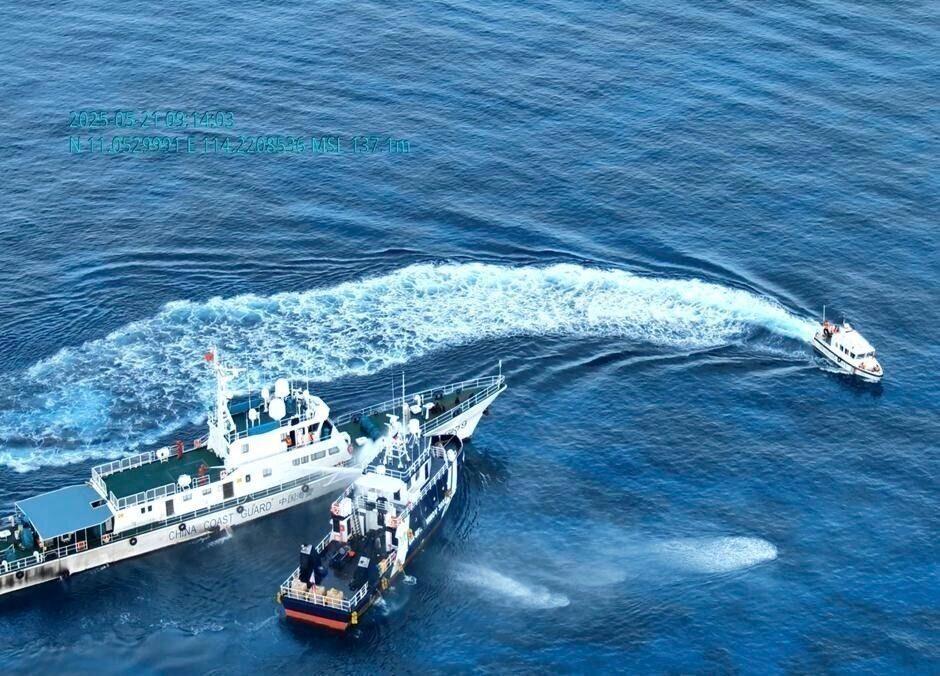
In this handout photo grabbed from a video provided by the Philippine Coast Guard/Bureau of Fisheries and Aquatic Resources (PCG/BFAR), a Chinese Coast Guard ship (left) uses a water cannon and sideswipes a Philippine fisheries vessel on a research mission near one of three sandbars called Sandy Cay in the disputed South China Sea on May 21, 2025. PCG/BFAR via AP
“When leaders of China say ‘strategic stability,’ they behave the opposite way,” he said, referring to Chinese leader Xi Jinping’s use of the term during a May 15 summit with U.S. President Donald Trump.
Liao said Beijing no longer treats Taiwan as an isolated issue, but as part of a single strategic theater
the first island chain—a regional buffer encompassing Taiwan, Japan, and the Philippines that limits China’s military projection into the Pacific.
“For Japan, repeated exercises challenge not only maritime security but also Tokyo’s credibility as a key contributor to a free and open Indo-Pacific,” she said.
“For the Philippines, these drills reinforce the reality that Taiwan Strait stability and South China Sea security are becoming strategically interconnected.”
The Chinese regime is
of launching three aggressive maritime incidents against the Philippines in the disputed South China Sea within a week in July.
Separately, Japan said on July 21 that it had lodged a diplomatic protest with China over the latest live-fire drills on July 19 within its exclusive economic zone.
The actions are part of a months-long escalation between Beijing and Tokyo after Japanese Prime Minister Sanae Takaichi
in November that Japan would be justified in activating its Self-Defense Forces if Taiwan were to come under attack.
Liao said the pattern of successive military activities around Taiwan, Japan, and the Philippines reflects Beijing’s overarching strategy.
“That is one reason why defense cooperation among the Philippines, Japan, and the United States has continued to expand,“ Liao said.
Tzeng said the drills pose severe economic risks to neighboring nations by jeopardizing critical transit routes.
“Twenty percent of global maritime trade passes through the Taiwan Strait, meaning any military action there would have a massive impact on Japan and the Philippines,” he said.
Strategic Miscalculation
Tzeng said the CCP could also be using the war games to gain an edge ahead of the Trump–Xi summit on Sept. 24.
“Beijing wants to show the U.S. that Taipei’s rhetoric provoked the military drills, in an effort to deflect blame,” Tzeng said.
“The regime aims to influence Trump’s perception and secure favorable negotiating conditions before the meeting.”
Liao concurred but said this strategy carries significant risks.
“Coercive diplomacy often reinforces rather than weakens security cooperation among the United States and its regional allies,” she said.
“As military activities become more frequent, the likelihood of operational accidents or unintended escalation inevitably increases.“
U.S., Japanese, and Philippine forces
a five-day maritime exercise in the South China Sea on July 25 to strengthen “regional and international cooperation in support of a free and open Pacific region,” according to a July 28 U.S. War Department news release.

U.S. Navy’s F-35C stealth fighter jet and crew prepare for takeoff for a flight demonstration during the Annualex 23 joint naval exercise, from aircraft carrier USS Carl Vinson off the Japanese coast, on Nov. 11, 2023. Mari Yamaguchi/AP Photo
Liao said if Washington concludes that Beijing is using pressure to shape the summit agenda, this strategy could ultimately backfire by making concessions less likely.
“In the short term, Beijing may succeed in raising the political stakes,“ she said.
“Over the long term, however, it risks strengthening the very regional security alignment that it is seeking to weaken.”