On October 23, 2025, the Fourth Plenary Session of the 20th Chinese Communist Party Central Committee concluded with approval of the 15th Five-Year Plan, covering the period from 2026 to 2030. Chinese leaders have described this plan as a “crucial link” in the country’s long-term goal of achieving fundamental modernization by 2035. Yet beneath these ambitions lies a structural challenge that threatens to erode many of its gains.
Amid rapid economic growth and ambitions for a highly modernized industrial system, China’s population is aging at a faster pace than that of most major economies. Statistics show that registered births fell below 8 million in 2025 reaching the lowest level since the founding of the People’s Republic. These shifts are placing intense pressure on its pension system and the broader economy. A 2019 report by the Chinese Academy of Social Sciences warned that the state pension fund could face insolvency by 2035 if current trends persist, with reserves projected to peak in 2027 before rapidly declining.
While the pension system remains technically sustainable at the national level, widening disparities across provinces and regions are creating growing financial imbalances.
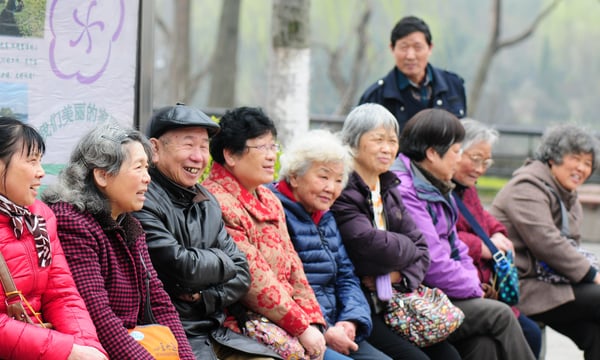
By 2040, roughly 402 million people in China are expected to be over the age of 60, more than a quarter of the population. By comparison, the total population of the United States is expected to reach around 379 million by that time. This shift marks a turning point for China, signaling the erosion of its long-standing advantage in abundant and affordable labor while presenting a formidable financial challenge in caring for an aging society.
These demographic pressures prompted China to begin a gradual adjustment of its statutory retirement age in 2025, the first such change in more than seven decades. The retirement age for men will gradually increase from 60 to 63 over a 15-year period while the retirement age for women will rise from 55 to 58, with adjustments varying by occupation. While delaying retirement may ease fiscal strain, it does little to alter the underlying demographic arithmetic driving the crisis.
The pension system was built under very different conditions. It was established in the early years of the People’s Republic in 1951, where state-owned enterprises guaranteed lifetime employment and retirement benefits under the so-called “iron rice bowl.” Workers made no individual contributions and enterprises bore full responsibility with state backing. But as China transitioned toward a market economy in the late 1980s, this model proved unsustainable.
A new system emerged in 1986 that combined social pooling with individual accounts, shifting part of the responsibility for retirement security to both employers and workers. Today China operates a three-pillar pension system. The first pillar is the basic public pension, which remains the primary source of retirement income for most citizens. The second pillar consists of enterprise annuities, mainly available to employees of large and financially stable firms. The third pillar includes individual retirement accounts (IRAs), introduced in 2022 to encourage voluntary personal savings.
At the core of China’s pension dilemma is a shrinking workforce as efforts to boost fertility have yielded limited results. Local governments offer cash incentives but these pale against the expenses of raising children. The average cost of raising a child to age 18 in China is estimated at 538,000 RMB (around $78,000), more than 6.3 times the country’s GDP per capita – and the cost rises further to 667,000 RMB in urban areas. Relative to income, this burden is heavier than in both the United States and Japan, discouraging family formation and reinforcing persistently low fertility.
Many young and middle-aged Chinese lack both the income and the confidence to commit to decades of saving. Urban youth unemployment among 16 to 24 year olds (excluding students) stood at 16.5 percent in December 2025, and job prospects remain fragile despite a modest improvement. For them, long-term tax incentives mean little amid immediate economic uncertainty. As stable employment grows scarcer, some young adults reportedly pay for office space rather than remain unemployed at home.
On paper, coverage is extensive with more than 1.07 billion people enrolled in basic old age insurance in 2024, and social security funds recording a total balance of 10.2 trillion RMB in 2025. Yet broad coverage does not ensure adequacy. The basic pension system operates largely on a pay- as-you-go basis and functions as an implicit defined benefit scheme, guaranteeing retirement income as a percentage of pre-retirement wages.
Benefit levels also vary sharply by region and employment status with retirees in Tier 1 cities such as Shanghai receiving far higher benefits than rural residents and participants in voluntary schemes. In 2023, retired urban salaried workers received an average monthly pension of 3,742 RMB, while participants in the voluntary pension system received only 223 RMB per month. By comparison, rent for a one bedroom apartment in a Tier 2 city can reach around 3,000 RMB, underscoring how pension adequacy remains limited for most retirees despite high enrollment rates.
These disparities reflect deeper structural divides as the household registration system (hukou) has long separated citizens into urban and rural categories shaping access to jobs, education, health care, and social protection. Rural household incomes increasingly rely on remittances from migrant workers in urban areas with flows reaching nearly $51 billion in 2022. Official data highlight the scale of the divide as urban per capita disposable income reached 41,183 RMB in the first three quarters of 2024 compared with 16,740 RMB in rural areas. This gap translates directly into unequal access to and benefits from social insurance, including pensions.
China has recently made reforms aimed at improving pension sustainability, but these same changes risk worsening inequality. Beginning in 2030, the minimum contribution period required to qualify for monthly pension benefits will rise from 15 to 20 years. While fiscally rational, the change disproportionately affects rural workers, migrants, and informal employees with fragmented careers. For many, meeting the new threshold may be unrealistic, effectively excluding them from meaningful retirement support.
China now faces three major fiscal demands competing for limited resources. Aging drives rising costs for pensions, health care, and social services. Security and resilience require sustained spending on defense, energy, and supply chains. Industrial upgrading demands long-term investment in advanced manufacturing and strategic technologies. None of these priorities can be deferred, leaving policymakers with limited room to maneuver.
In response, authorities have made elderly care a national priority, pledging to build a comprehensive service network covering both urban and rural areas by 2029, with further improvements through 2035. But improving the sustainability of the pension system will require broader funding sources and a determined effort to narrow regional disparities. Average monthly pensions for residents remain very low and are widely regarded as insufficient to meet basic living expenses. Redirecting a greater share of state-owned capital toward pension financing, particularly in poorer regions, would strengthen redistribution and reduce inequality.
Hong Kong’s 1997 pension reform offers a useful reference point. By moving from a narrow, civil-servant-based model to a more comprehensive system, the city established a structure that has remained broadly stable for more than two decades without major overhaul. The challenge, however, is compounded by a fragmented and highly decentralized system that weakens national risk sharing. Policymakers are caught in a bind, with higher contribution rates raising costs for firms and lower replacement rates undermining retirement security. Without stronger central coordination and a more equitable financing framework, incremental reforms are unlikely to resolve the system’s underlying vulnerabilities.
Yet even these proposals reveal the limits of available solutions. Greater national coordination could reduce disparities, but it cannot reverse demographic decline. China’s pension crisis is not the result of a single policy failure but the product of decades of demographic, economic, and institutional change.
The choices made in the coming years will shape fiscal sustainability, social stability, and public trust. Aging may be inevitable, but how China manages its consequences will determine whether its next phase of development rests on solid ground or fragile foundations.