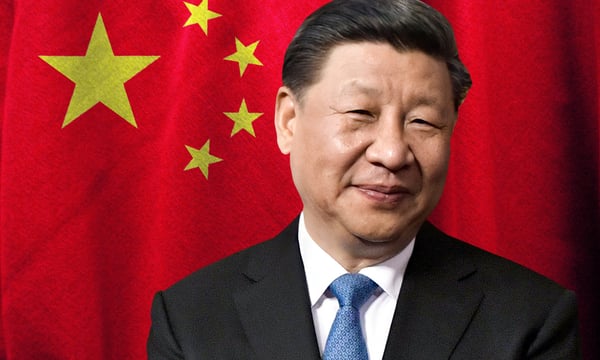
Attention in China is gradually shifting toward the post-Xi Jinping era. This is not because Xi is expected to step down anytime soon from his posts as general secretary and president. Rather, it reflects the fact that even as Xi is widely expected to enter a fourth term, discussion of the post-Xi Jinping era has begun. This discussion is being driven by expectations that potential successors may be appointed at the 21st Party Congress in 2027 to the Politburo Standing Committee of the CCP or to the Politburo. One of these candidates is expected to succeed Xi at the end of his fourth term in 2032 (when he will be 79), or in 2035 (or later).
Xi has the goal of “building China into a great modern socialist country in all respects” by 2049, through the “great rejuvenation of the Chinese nation,” with 2035 positioned as the midpoint on the path toward that goal. For this reason, some believe that he may continue to maintain political control until 2035, when he will be 82. Notably, 82 was also the age at which Mao Zedong exited the political stage (with his death).
What will happen to the remaining six Standing Committee Members of the Politburo in 2027? Aside from Premier Li Qiang, who will turn 68 in 2027, and Ding Xuexiang, a member of the Standing Committee and a key figure in the Xi administration who will be 65, the other four members of the Standing Committee will be over 70. Even if Xi remains in power, if the longstanding “seven up, eight down (age 67 to stay, age 68 to retire)” continues to apply, then all but Ding would be expected to step down. However, this “seven up, eight down” principle has in recent years become largely nominal, and it remains unclear how many Standing Committee members and Politburo members will actually be replaced.
The Xi Jinping administration, which was already remarkable for having a third term, is generally expected to move into a fourth term in the autumn of 2027, the primary reason being the absence of an appointed successor. At present, both the members of the Politburo Standing Committee and the Politburo are almost entirely people promoted by Xi, and there are essentially no visible political struggles or internal divisions within the Party’s top leadership. While there is strong discontent toward the Xi administration across society and at the local level, under China’s surveillance society, the likelihood that such dissatisfaction will evolve into an anti-government movement remains low. The People’s Liberation Army (PLA), meanwhile, is facing a highly situation with the downfall of Zhang Youxia, the top uniformed officer, but the PLA itself does not seem likely to turn on Xi. In this sense, it can be said that there are few forces capable of preventing Xi from enjoying a fourth term.
Some argue that Xi may need to demonstrate tangible achievements in order to secure a fourth term. With 2027 marking the 100th anniversary of the founding of the People’s Liberation Army (PLA), there are predictions that China could take military action against Taiwan. However, failure in the Taiwan Strait poses a greater risk for Xi as he seeks a fourth term.
It is not easy to identify a successor under a long-term regime. As for the personnel changes in the PLA and foreign affairs sectors, which had been expected to take place in 2027, Zhang’s downfall has already occurred. Zhang was known as a close ally of Xi, and the two had effectively led the PLA together. It was already unusual that his term was extended at the 20th Party Congress in 2022, despite him being 72 at the time and expected to retire in 2027. With Zhang’s removal, the Central Military Commission is now left with only Xi and the newly promoted Zhang Shengmin, making the trajectory of personnel appointments even more unclear. Zhang Shengmin, born in 1958, also serves as Deputy Secretary of the Central Commission for Discipline Inspection, placing him at the center of China’s anti-corruption efforts. It remains unclear whether Zhang Youxia’s fall signifies the further consolidation of Xi’s power over the military, or instead a rift between the theater commands and the Central Military Commission. Thus far, however, no unusual developments have been observed among the theater commands, making it difficult to conclude that Xi’s authority over the armed forces has weakened.
Even in the realm of diplomacy, Wang Yi, who was born in 1953, the same year as Xi, will be 74 in 2027, suggesting a possible retirement. However, both Qin Gang and Liu Jianchao, who were seen as potential successors, have fallen from favor to varying degrees. As a result, succession planning for Wang Yi in diplomatic service is also facing difficulties.
It is thus proving extremely difficult to appoint successors to top positions in both the military and diplomatic service. This suggests possible challenges in determining who will come after Xi in 2032 or beyond.
So what, then, will happen with the succession? If Xi were to step down in 2027, Ding Xuexiang, a member of the Politburo Standing Committee who would be 65 at the time, might emerge as a successor. However, as noted earlier, Xi is widely expected to begin a fourth term in 2027. Looking ahead to 2032, 2035, and beyond, what kind of candidates are being envisioned?
If someone were to assume responsibility for governing for a decade beginning in 2032 or 2035, it would be better for the individual to still be in their sixties. Those born in 1972 will be turning 60 in 2032, while those born in 1967 will be 65. However, individuals born in the late 1960s were university students at the time of the 1989 Tiananmen Square protests and massacre, and are therefore likely to be viewed critically by the Xi administration as having been influenced by Western ideas.
For this year, “younger” politicians from the 1970s are seen as more likely candidates. This would explain why lists of so-called deputy secretaries of the Post-70s (deputy secretaries of provincial party committees who were born in the 1970s) have been circulating in China. Examples include Zhuge Yujie (born 1971, Deputy Secretary of Hubei Provincial Party Committee), Shi Guanghui (born 1970, Deputy Secretary of Inner Mongolia Autonomous Region), Yang Jinbai (born 1973, Deputy Secretary of Hainan Province), Liu Hongjian (born 1973, Deputy Secretary of Yunnan Province), and Zhu Zhongming (born 1972, Deputy Secretary of Shanghai). Within both the party’s top leadership and the central government, there are also numerous vice minister-level officials born in the 1970s, including Vice Minister of Foreign Affairs Hua Chunying (born 1970) and Miao Deyu (born 1971).
In 2027, potential successors are likely to be selected from among this group of second-tier figures born in the 1970s. Observers will be watching closely to see if this process will also be marked by a series of downfalls, as seen in recent military and diplomatic appointments.
Regardless, it is worth noting that the focus in 2027 is likely to be less on whether Xi stays for a fourth term and more on the selection of potential successors.