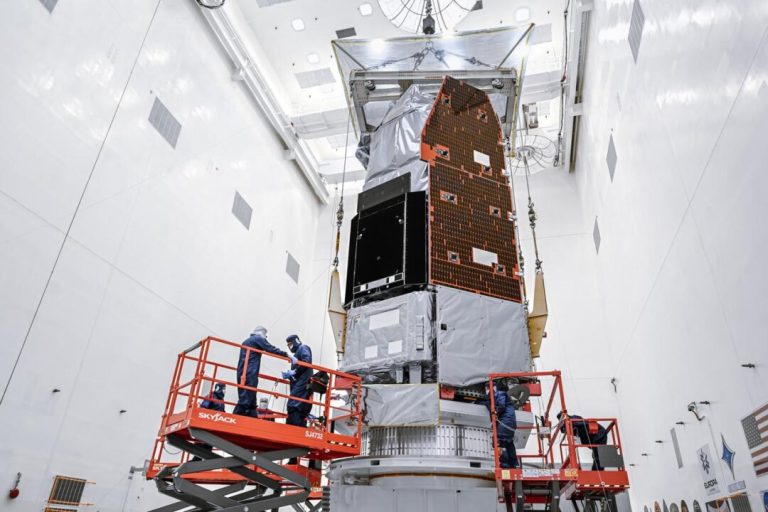

Technicians and engineers inside the Payload Hazardous Servicing Facility at NASA’s Kennedy Space Center in Florida use a crane to lift the agency’s Nancy Grace Roman Space Telescope to a specialized work stand on June 26, 2026. Courtesy of NASA
NASA and its partners are about to dive deeper into their understanding of the universe than ever before as they prepare to send their most capable space telescope yet on a five-year mission 1 million miles away from Earth.
Based on now-modified optical systems provided by the National Reconnaissance Office, the Nancy Grace Roman Space Telescope—or “Roman” for short—will set new observational standards at macro and micro levels, doing the same amount of work within a month that the Hubble Space Telescope would need a century to complete.
On the macro side, the telescope will capture panoramic cosmic surveys of an unprecedented scale, capturing several celestial events happening simultaneously, from supernovae to the emergence of new black holes. It will also look to the center of its own galaxy to survey millions of stars and the super-massive black hole at its core, as well as attempt to look beyond it.
“This survey will contain over 2 billion galaxies and will enable us to study how the structures in our universe—stars, the galaxies, clusters of galaxies—grew and evolved,” senior project scientist Julie McEnery said at a news conference on July 29. “We’ll also measure how our universe has expanded over time, and these are the keys that will allow us to unlock the fundamental nature of dark matter and dark energy and the fabric of the universe itself.
“We’re probably not going to confirm the standard model of how the universe works. We’re very likely to demonstrate that our standard model is wrong and to set ourselves on a path to figuring out how does our universe really work.”
According to McEnery, Roman has the power to survey and detect half of the stars in the Milky Way in only a month. This main cosmic survey will take more than a year, and the data collected will be astronomical in its own right.
A daily downlink of 11 terabytes is anticipated to be sent back to Earth, with one image being so large that more than half a million 4K televisions would be needed to fully display it.
On the micro side, it will pioneer new and improved methods for detecting planets outside our solar system called exoplanets. Equipped with a tool called a coronagraph, Roman will test out technology that deflects previously blinding starlight to better observe planets orbiting them.
If that technology is successful, astronomers will be able to move on to the next project, the Habitable World Observatory, which will use the then-proven technology to not only identify exoplanets, but also look long enough to detect signs of habitability and life.
Scheduled to launch aboard a SpaceX Falcon Heavy rocket from Florida no earlier than 7:20 a.m. EDT on Aug. 30, Roman will embark on a 100-day journey to its station point 1 million miles away from Earth. Once there, it will undergo a three-month commissioning process to ensure that all systems are operating as they should.