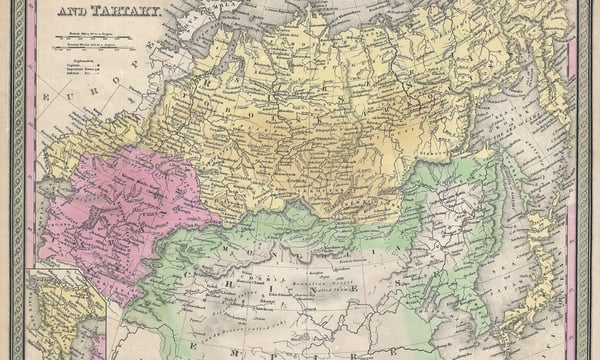
In March 2023, a talent show host Zhou Libo had his account on the Chinese social media platform Weibo suspended after sharing a post suggesting that China should, as a part of its “Great Rejuvenation of the Chinese Nation,” annex territories of today’s Russian Siberia. Formerly part of the Qing Empire, these lands had been ceded to the Russian Empire through unequal treaties in the second half of the 19th century.
The idea of China “taking back” by force what the Qing Empire lost during the so-called Century of Humiliation may seem intuitive, particularly in light of China’s growing assertiveness and Russia’s engagement in its imperialist war in Ukraine. Such arguments continue to crop up on social media. Nevertheless, such forceful territorial revisionism is unlikely to happen.
In the latter half of the 19th century, the Qing imperial court in Beijing was compelled to sign a series of unequal treaties with European powers, Japan, and the United States, resulting in significant violations of China’s sovereignty. Tsarist Russia was quick to take advantage of the growing disorder.
The 1689 Treaty of Nerchinsk, the first treaty between Imperial Russia and the Qing dynasty, which delineated the boundary between the two empires in the Amur River basin, was repeatedly violated. From 1854 to 1856, Russia sent settlers down the Amur River to set up colonies along the riverbank. Two years later, the Qing court was forced to sign the 1858 Treaty of Aigun, by which the northern bank of the Amur River – an area of approximately 150,000 square miles – was transferred to Russia. The land between the Ussuri River and the East Sea, which included today’s city of Vladivostok – in China called Haishenwai – was placed under joint administration of the two empires.
Two years later, in 1860, the Treaty of Beijing confirmed the Treaty of Aigun and added a further 100,000 square miles to the area granted to Russia in the earlier treaty. Chinese nationalists’ revisionist desires usually refer to the 250,000 square miles that today form Russia’s Far East – occasionally referred to as Outer Manchuria – as the other territories ceded by the Qing court to Imperial Russia during this period do not lie within the present-day Russian Federation.
The late 19th-century arrangement of the China-Russia border largely shapes the present-day eastern boundary between the two states, with only minor adjustments in small, disputed areas that were settled through agreements and protocols in 1991, 1999, and 2004.
Although the border question has been largely solved, the dynamics of interaction along it have continued to evolve to this day. Today, China has assumed the role of both an investor and a source of cultural influence in East Siberia, a region distant from Moscow, but not much farther from Beijing than the city of Shanghai is.
Since the 2022 Russian invasion of Ukraine, China’s footprint in the region has grown even more. Moscow started to depend on Chinese companies to replace the European ones that have left Russia as a consequence of the aggression. Despite Russia being rather hesitant prior to 2022 to promote cross-border trade in Outer Manchuria, the war has notably constrained Russia’s options, and border choke-points in the Far East have become busier than ever.
Moscow has set up a number of Advanced Special Economic Zones and Special Administrative Regions in Siberia, particularly in the region of Outer Manchuria, exclusively for Chinese investments. Since 2022, the Chinese yuan has recorded massive increased use in trade, finance, and payment systems inside Russia, replacing the ruble for all economic activities Chinese companies conduct in Siberia.
Furthermore, the Russian Far East is increasingly functioning as a resource hinterland for China, with Chinese state-owned or subsidized companies extracting raw materials – such as timber, coal, and minerals – and developing infrastructure primarily for Chinese needs. In some local schools, Chinese cultural influence is becoming apparent through newly introduced intensive Chinese language lessons, such as the case of Russian-Chinese border city Blagoveshchensk. Russian President Vladimir Putin himself said in the past that some of the young members of his family speak fluent Mandarin.
Does the growing Chinese presence in Siberia, combined with a perceived historical grievance, provide a rational basis for planning territorial annexation given the opportunity? Rationally, the answer is no.
The territory of Outer Manchuria is not – unlike Hong Kong, Macao, and Taiwan – China’s core interest. Since 1949, China has settled 17 of its 23 territorial disputes, often motivated by domestic or international political pressures, which led the government to offer significant compromises. The territorial disputes where China did not offer a compromise – including the Paracel Islands and the Spratly Islands in the South China Sea, the Senkaku/Diaoyu Islands in the East China Sea, and again Taiwan – may be designated as core interests as well, as M. Taylor Fravel noted.
China – as the world’s leading crude oil importer and one of the leading natural gas and coal importers – is actively pursuing diversification of its energy sources. Some present this as a rational justification for annexing Siberia, with its vast reserves. The territory of Outer Manchuria, however, does not possess significant oil or gas deposits. Those resources are primarily located in Western Siberia and along the Arctic coast. Russia is currently China’s top crude oil supplier, and, despite the non-liberal nature of both regimes, the logic of liberal trade peace applies – China is better off pursuing energy partnership with Russia that is “mutually beneficial and truly strategic,” as Xi himself stated in a conversation with Putin in February of this year.
Besides, let’s not omit that China has long faced criticism for its treatment of ethnic minorities. Annexing and incorporating another large territory with a predominantly non-Han population could intensify Beijing’s border insecurities and a fear of separatism, making the supposed economic rationale for annexation both geographically and politically weak.
Regardless of the fact that we currently live in what many call the break-up of the rules-based order, international law still applies, and even great powers have to face the scrutiny of the international community following an illegal territorial annexation. Russia, following its illegal annexation of Crimea in 2014, continues to face the reality that the vast majority of the international community does not recognize Crimea as a part of the Russian Federation, including China. Even Belarus – Russia’s closest ally – did so only in 2021.
Furthermore, China-Russia relations, despite being more a marriage of convenience than a strategic alliance, are thriving. Russia is by far the most frequently visited destination by Chinese officials, and total bilateral trade volumes have been rising since 2022. The frequency of joint military exercises has also increased, peaking with 11 exercises in 2024. And regardless of the obstacles, both countries still plan the construction of the Power of Siberia 2 pipeline, which should carry up to 50 billion cubic meters of natural gas from Russia to China annually once constructed.
In February 2022, Russia became China’s “partner with no limits,” and while this bilateral partnership clearly has its limits, the shared vision of a multipolar world order decentralized from U.S. dominance is not going to fade away – and certainly not over a territorial dispute over Outer Manchuria.
The Kremlin, however, remains skeptical of China and may even perceive China’s influence in its Far East as a threat, as leaked F.S.B. documents suggest, and probably rightfully. Rather than resorting to kinetic warfare, China is more likely to continue expanding its economic and cultural influence in Siberia, conducting what it has been accused of along the Indian border and in the South China Sea: a creeping annexation through the gradual and informal assertion of control and influence, while deliberately avoiding conflict.
Possible evidence of this strategy surfaced in 2023, when China’s Ministry of Natural Resources released the new standard map of China. Bolshoy Ussuriysky Island, or Heixiazi Island in China, located at the confluence of the Amur River and Ussuri River forming the border between Russia and China, was previously divided between the two countries. The 2023 map, however, depicted the island entirely as Chinese territory. While not an official doctrine, this example illustrates what a strategy of creeping annexation could look like in practice.
With increasingly unequal relations between Beijing and Moscow, we may see the partnership evolve in a way that would grant China even greater operational space in Outer Manchuria. One example happened already – in 2023 Russia opened the Port of Vladivostok for China’s disposal as a cross-border transit hub for domestic trade. As long as Putin and Xi can maintain their partnership, Beijing doesn’t need to exercise formal sovereignty over Russia’s Far East to fully benefit from it.