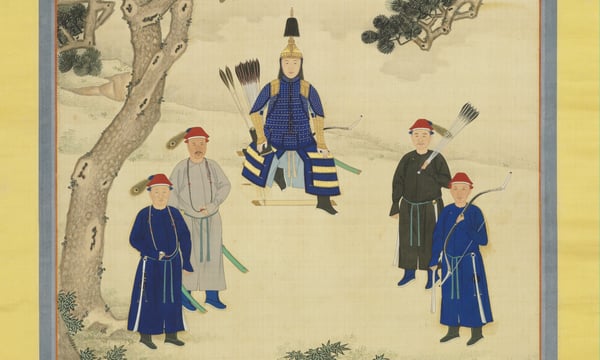
On May 22, a trailer for the film “The Belief” (also known as “Peng Hu” – its Chinese title means “Battle of Penghu”) was released on Chinese social media, announcing its release date of July 25. This date corresponds to the outbreak of the First Sino-Japanese War in 1894, after which China was forced to cede Taiwan to Japan.
The film primarily depicts the 1683 battle in Penghu between the Qing Dynasty navy and the Kingdom of Tungning (also known as the “Ming Zheng regime”), which was a regime ruled by Han Chinese in Taiwan. Notably, the Kingdom of Tungning was loyal to the Ming Dynasty, the Han empire ousted by the Qing rulers. The Qing Dynasty ultimately won the battle, forcing the Kingdom of Tungning to surrender.
Like most “main melody” films – meaning movies promoting the official ideology of the Chinese government – promotional materials for “The Belief” have also been released by some Chinese state media outlets. However, the film immediately sparked a wave of criticism on Chinese social media.
Most comments believe “The Belief” actually depicts the process of the Manchus, an “outsider ethnic group,” conquering a Han Chinese regime. Although the history of the Kingdom of Tungning is filled with bloody infighting and chaos, public opinion often romanticizes it as a resilient Han Chinese regime fiercely resisting foreign invasion. This has led to the state media’s support for the film being interpreted as an ideological failure promoting surrender.
The Chinese government had a different message in mind. It hopes to demonstrate its determination to (re)unify Taiwan through this film. The film’s slogan – “The trend of the world is coming with the wind” – is strikingly similar to the Chinese government’s claim that “the reunification of the motherland is an unstoppable historical trend.” Beijing apparently hopes to project the Qing Dynasty’s recapture of Taiwan onto its future (re)unification with the island. If the Taiwanese government, like the 17th century Kingdom of Tungning, rejects the conditions proposed by mainland China, Beijing will have the capability to achieve its goals by force.
In fact, this is the second time the film has sparked such a strong public debate. On October 25, 2025 – the 80th anniversary of Taiwan’s retrocession – the film released its posters and trailer, which also drew widespread criticism on social media. The announcement of its release date, despite the public pressure, is seen by some netizens as a further “provocation.”
The backlash to “The Belief” reflects a strong anti-Qing sentiment in contemporary Chinese society. Where is this mood coming from?
The Qing Dynasty ended over a century ago, making it unlikely that contemporary Chinese people possess a deep collective memory of living under Qing rule. Furthermore, the Manchus in China today have been highly assimilated by the Han Chinese, and their language has almost become extinct. This means that a serious cultural conflict between the Han Chinese and Manchus is also unlikely. These factors make this question particularly perplexing.
This anti-Qing sentiment is reminiscent of Han chauvinism, which has long existed in China. However, its influence has been limited since the founding of the People’s Republic of China in 1949. For decades, it was more of a topic of discussion within a small circle than a mainstream public opinion. For example, contrast the reception of “The Belief” with the surge in popularity of palace dramas and romance dramas set in the Qing Dynasty in mainland China during the 2010s. Some of these dramas achieved extremely high ratings during this period.
However, in recent years, films and television series set in this dynasty have faced more severe questioning and criticism regarding their political and nationalist implications. This represents a new wave of Han chauvinism, which has clashed with official discourse.
Under the Han chauvinistic narrative that has gained strength in recent years, the Qing Dynasty is often seen as a dark age for the Han people, bringing entirely negative consequences to Chinese history. This dynasty is frequently associated with massacres, national humiliation, monarchical autocracy, and cultural control. Some even compare it to the Japanese invasion of the 1930s and 1940s, arguing that the Qing Dynasty was a successful conquest of China, while Japan was a “defeated Qing.” In fact, these accusations are often one-sided and exaggerated.
This sentiment can be primarily explained as a result of rising nationalism among China’s younger generation. But more importantly, it stems from a socioeconomic narrative that has gained traction in Chinese public opinion in recent years, where the Manchus and the Qing Dynasty are assigned a class identity.
In recent years, due to the widening gap between rich and poor and the solidification of class structures, a “class narrative” is spreading among Chinese people, especially the younger generation, driven by pessimism and discontent with society. This narrative aims to explain the collective hopelessness and anxiety in Chinese society. Under this narrative, those in power and the wealthy are often portrayed as “exploiters” and the source of suffering for contemporary Chinese people.
Although sometimes accompanied by misinformation and conspiracy theories, this “class narrative” has combined with a more pervasive nationalist sentiment and spread to historical understanding. This has led to today’s anti-Qing sentiment.
Looking at history, the Manchus, who conquered China with a relatively small population, did enjoy certain privileges during their rule. These privileges have led to a deliberate distinction between the Manchus and Han Chinese in today’s sentiment, equating the Manchus with the “ruling class” and portraying them as “oppressors” of the Han. This reminds people of the rigid class system in today’s Chinese society. Viewed through this lens, the rise in anti-Qing sentiment is essentially a collective historical imagination, used to provide catharsis for contemporary Chinese dissatisfaction with reality.
While this sentiment may seem to contradict the Chinese government’s policy of ethnic unity, in the context of the People’s Republic of China’s new “Law on Promoting Ethnic Unity and Progress,” it may be used to advance Beijing’s more Han-centric ethnic policies. However, despite the possibility of exploiting this sentiment for the government’s ends, Beijing must recognize that the underlying collective pessimism and anxiety could become a potential destabilizing factor for society.
More importantly, if Han chauvinism gets out of control, it could threaten the stability of China, a multi-ethnic country, in its efforts to further achieve its goal of “national unity.”