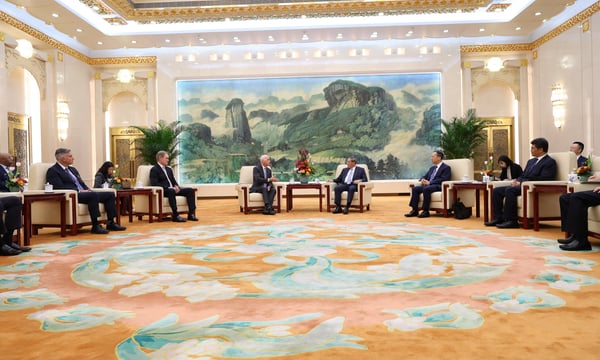
As the planned summit between Presidents Donald Trump and Xi Jinping slides further into uncertainty, Jing Qian and Neil Thomas, both affiliated with the Asia Society Policy Institute’s Center for China Analysis, argued in the New York Times that American policymakers urgently need to restore regular travel to China. They are right that the collapse of official exchanges since 2020 is a problem. They are right that navigating a rivalry without firsthand exposure to the rival is dangerous. But their argument rests on an assumption that deserves scrutiny: that visiting China and understanding China are the same thing. They are not.
The gap between the two is purposeful. Beijing has spent decades perfecting the art of showing foreign visitors a China that is real enough to be impressive and yet controlled enough to be harmless. I know this because I have been on both ends of the arrangement.
I grew up in a small Chinese city that no foreign delegation has ever visited. I studied international relations at a Chinese university where the professors privately held views about Chinese politics they could never express in the classroom. I have seen how the system looks from the inside – not from a guided tour of a Shenzhen megafactory, but from a dormitory in Guangzhou where students competed over GPA rankings in a major that society had no structural use for.
I have also been on the receiving end of the curated experience. Last year, I participated in a delegation visit to a cross-border data transfer industry outpost in suburban Shanghai – a development zone far from the city center that felt less like a thriving hub than a ghost city. The skyline was impressive in the way that Chinese development zones always are: gleaming towers, wide boulevards, almost no observable human activity. We were guided through a vast, empty exhibition hall by a single employee who could not speak English, requiring members of the delegation to interpret the scene for each other. The tour consisted almost entirely of digitalized promotional videos, the kind that anyone who grew up in China instantly recognizes: no particular aesthetic sensibility, set to stirring music, heavy on statistics and slogans. The company’s videos were identical in form to the videos played at school assemblies and corporate retreats whenever leadership needed to project competence and vision. I wanted to ask why, in this supposedly thriving data industry park, there was exactly one employee present – and whether she, too, had been specifically brought in for the occasion. I did not ask.
This experience was minor, forgettable, and entirely typical. And it is precisely the kind of experience that Qian and Thomas’s argument fails to reckon with.
What a Visit to China Won’t Show
Consider the standard itinerary of a Western policymaker, think-tanker, or scholar visiting China. They fly into Beijing, Shanghai, or Shenzhen – likely the only Chinese cities they could name. They are received by well-mannered university students who volunteer as interpreters and speak fluent English. They attend an internal briefing at a prominent think tank where Chinese scholars, operating under institutional constraints the visitors may not fully appreciate, deliver talking points that closely track the official line – and where the two sides fail to genuinely engage with each other’s thinking. They speak at a high-level forum and receive enthusiastic applause but little substantive pushback. They visit a top technology company and are shown a polished presentation – data, market projections, a narrative of inevitable Chinese ascendancy rendered in PowerPoint. They return to a five-star hotel, often subsidized by the Chinese hosts. They fly home and write a column about how China broke their expectations.
There is a reason some Western hawks accuse these visitors of walking into an influence operation. The environment they encounter is genuinely disconnected from the China that ordinary Chinese citizens inhabit. The gleaming exhibition halls, the English-fluent student volunteers, the immaculately organized factory tours – these are real. But they are a small slice of China, and a curated one.
The China I grew up in was not the opposite of this image – it was not a dystopia to set against the utopia of the guided tour. As always, reality is harder to cram into a clear narrative.
I grew up in a small city whose economy ran on two industries that no official brochure would place side by side: a state-owned heavy industrial enterprise on the public ledger, and a thriving pyramid-selling scam economy on the private and illegal one. Both employed thousands. Both were understood by residents as facts of life. The city’s brightest young people studied 12 to 13 hours a day with a single ambition: score high enough to get into a university somewhere else and never come back. The education system’s greatest product was escape from the place that funded it.
In university and afterward, I moved through worlds that existed in parallel in the same country but shared almost no social reality. I sat in conferences in Beijing and Shanghai where students from wealthy families rehearsed the language of global leadership, debated climate governance, and introduced themselves with the polished ease of people who had always assumed the world would make room for them. I also ordered food delivered by young people my own age who were locked into gig work with no floor beneath them – riders who sprinted between orders in a system that penalized them by the minute, whose prospects were shaped not by talent or effort but by a social structure that had sorted them before they were old enough to understand the sorting.
I knew both worlds. I did not experience them as a contradiction to be resolved. China contains many such paradoxes that never strike people as odd. A classmate could be genuinely patriotic and desperate to emigrate, holding both convictions without irony. The state-authorized textbook and the actual teaching coexist on the same syllabus like two parallel sentences that never meet.
Moving Beyond Visits to Understanding
I am not arguing that American policymakers should stop visiting China. Nor am I accusing the scholars and practitioners who accept these invitations of political naïveté. The dominant institutional channels for exchanges – the China Development Forum, the Boao Forum, the bilateral think tank dialogues – serve a function and cutting them off would be worse than maintaining them.
What I am arguing is that these channels, on their own, produce knowledge of China’s curated surface and nothing more. Uncorrected by other inputs, this leads to misjudgment rooted in incomplete information – the same analytical failure that Qian and Thomas warn will happen if Americans don’t visit China. The difference is that this misjudgment comes dressed in the authority of firsthand experience, which makes it harder to challenge.
What is needed is not more visits of the same kind but a fundamentally different approach to engagement – one that accepts the complexity and messiness of China rather than seeking a clean narrative to bring home. This requires, above all, a willingness to encounter the China that the institutional channels do not show.
Go to a third-tier city that does not appear in any tourist guide. After the guided tour of Tencent’s headquarters in Shenzhen, visit the Sanhe labor market, where migrant workers wait for day jobs – a place that tells you more about China’s political economy than any corporate presentation. When visiting a university, do not only meet with the president and the senior professors. Sit in on a lecture in a random classroom. Eat in the student canteen. Talk to the 20-year-olds who are actually living inside the system, not the administrators who manage it.
Lean on decentralized, transnational intellectual exchange that is not structured or incentivized by institutional settings. The most honest conversations about China happen not at bilateral forums but in the spaces where Chinese people operate outside the visibility of institutional oversight – in a city McDonald’s at midnight, in a bar after the official dinner is over, in the shared enthusiasm for a new video game or a K-pop release that turns out to be a more reliable bridge between strangers than any Track II dialogue. They happen in the growing ecosystem of independent Chinese-language analysis that exists outside state media and its authorized critics alike – podcasts, newsletters, social media accounts run by people with no institutional affiliation and no incentive to perform a position.
The infrastructure for understanding China already exists. It is just not where the delegations are looking.
Make full use of your own country’s Chinese diaspora. They are an extraordinary and underutilized resource – people who carry firsthand knowledge of how the system works, who maintain personal networks inside China, and whose perspective is shaped by the experience of navigating both worlds. Engage them not through formal consultations but through sustained, unstructured conversation, especially with the younger generation, who left China recently enough that their knowledge is current and who are freer to speak candidly than anyone inside the system.
And above all, subscribe to what Peter Hessler – whose books on China remain the gold standard for a reason – practices as a method: thick description, grounded in long immersion and context-based understanding of the country’s contradictions. A single visit produces a single narrative, but a sustained engagement accepts that China is not one story. It is many stories, most of them more complicated and more interesting than the one the exhibition halls are designed to tell.
Qian and Thomas are right that American policymakers need to see China. But to really do that, they need to see past the performance.