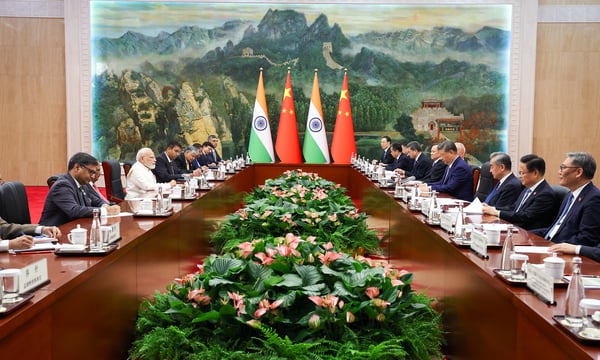
Just over a year ago, India and China reached an agreement on patrolling arrangements along the Line of Actual Control (LAC), covering legacy friction points in Depsang and Demchok. The deal effectively brought an end to years of military tensions on the border, which flared to life after a Chinese military operation in eastern Ladakh in 2020.
For Beijing, the recent diplomatic thaw with New Delhi – evidenced by the late 2024 border agreements and subsequent high-level dialogue – is not a sign of softened strategic intent, but rather a pragmatic, tactical maneuver designed to navigate a period of acute geopolitical stress. From a Chinese domestic perspective, the decision to manage the India relationship is largely viewed through the lens of China-U.S. strategic competition and economic interests. Within China, the discourse frames the current outreach not as genuine friendship, but as a cautious and conditional rebalancing aimed at preventing India from becoming an irreversible strategic partner of the United States while leveraging economic opportunities.
In 2024, the prospect of Donald Trump’s return to the White House prompted China to consider a strategic recalibration with India aimed at stabilizing relations. When Trump’s trade war policies materialized in 2025, they supplied the concrete economic pressure needed to sustain and deepen the resulting diplomatic thaw. Reducing friction with India allows Beijing to conserve diplomatic and military resources and focus on its primary strategic rival and priority theaters. Additionally, the tariff war with the United States gives China incentives to seek alternative markets for its products, including in India.
This diplomatic thaw, however, presents New Delhi with a complex paradox: while Beijing seeks economic stability, its core military posture and regional activities remain demonstrably aggressive. Chinese military developments along the LAC and its support to Pakistan during the India-Pakistan conflict in May suggest that sources of China-India competition have intensified over the past year. New Delhi should recognize this reality even as Indian businesses push to do more with China economically. Pain points will continue to flare up that will threaten to derail the relationship.
Drivers of Chinese Engagement
Zhang Jiadong, the director of the Center for South Asian Studies and professor at the Center for American Studies at Fudan University, has argued that the thaw in China-India ties stemmed from global systemic shifts. According to him, China perceives the current international order as unstable – with U.S. trade wars unresolved, the Ukraine conflict continuing, and Indo-Pacific tensions rising – and thus sees regional stability with India as a strategic priority.
Another important driver for Beijing’s rethink on its India strategy may have been the prospect of economic benefits. China’s economy has faced economic headwinds since the COVID-19 pandemic from a variety of domestic and international sources, prompting President Xi Jinping to approve a stimulus package in late 2024. This rationale, especially with the prospect of hardline economic policies under the second Trump administration, may have pushed China to first adopt a conciliatory posture toward India on the boundary agreement and later push for an economic thaw in the relationship.
As evidence of this theory, Chinese diplomats in India are pushing the narrative that Chinese equipment and technicians are indispensable for Indian economic progress and pressuring India to ease restrictions on visas and travel by Chinese nationals, permit imports of Chinese goods, and resume air flights.
An additional significant source of movement in the China-India relationship is the changing India-U.S. dynamic under the second Trump administration. Lin Minwang, professor at Fudan University’s Center for South Asian Studies, argues that this played a key role in the recent “restarting” of China-India relations. In his analysis, the turnaround is the result of China’s steady diplomatic patience and India’s eventual strategic recalibration, not of any softening of China’s own principles. Indeed, China may have sensed an opportunity to deepen ties with India to pull it away from Washington’s orbit and responded positively to New Delhi’s outreach in response.
Bones of Contention: The Border and More
Despite this more positive turn in the relationship, New Delhi would do well to tread carefully. It is noteworthy that the dominant narrative in China is still one that regards India as a country that needs to be subdued in order to realize Beijing’s ambitions to become a global power. China’s continuous military build-up on the LAC and its open diplomatic and logistical military support to Pakistan during the May 2025 conflict with India should be seen in that context.
Accordingly, Chinese state media portray the 2020 China-India border standoff as a moment when China established a new normal over India. A CCTV article, considered to provide China’s official interpretation of the October 2024 border patrolling agreement, claimed that the PLA never retreated from front-line positions on the LAC, breaking India’s “illusion that China would yield.” This firmness, according to Fudan scholar Lin Minwang, reset the rules of border interaction and forced New Delhi to recognize the new equilibrium – creating the basis for compromise.
Further, the attention being paid by Xi to the PLA Western Theater Command should be a cause for concern in New Delhi. The largest of China’s five theater commands, it exercises operational jurisdiction over the country’s borders with Afghanistan, Pakistan, India, Nepal and Myanmar.
According to a report by China’s National Defense University, Beijing has upgraded military and security forces in Tibet, increasing high-altitude combat capabilities and border defense effectiveness. According to the “History of the Development of China’s Military Districts,” published by the National Defense University in 2024, the Tibet Military District – previously a full army-level unit – was upgraded to deputy theater level during this reform. This adjustment means that the commanders of the Tibet Military District now hold higher ranks and broader authority, allowing direct participation in higher-level military decision making and coordination. Additionally, the Tibet Corps of the Armed Police expanded personnel by 32 percent, modernized 85 percent of its force with new technologies such as unmanned reconnaissance systems, and achieved broader patrol coverage, strengthening their border control.
These actions are being perceived in New Delhi as China enhancing its military presence in Tibet and are likely to hamper any attempts to restore a degree of normalcy to the fragile China-India relationship.
Another issue of serious concern for New Delhi and one that has already received significant attention, including at the highest levels of the Indian armed forces, is the direct support given to Pakistan by China during the May 2025 conflict. Lin, deputy director of the Centre for South Asian Studies at Fudan University, went a step further and warned India that before considering military action against Pakistan, it should factor in China’s presence near Kashmir since 2020. This reaffirms Delhi’s two-front war fears and has implications for India’s force posture on its borders.
The warning also does not bode well for a strategy of economic dependence on China. India continues to rely heavily on Chinese imports, despite having the capacity to produce many of these goods itself. This dependence has allowed China to saturate the Indian market with cheap products, weakening local industries and discouraging homegrown manufacturing. India’s reliance on China for items such as electronics, chemicals, machinery, toys, children’s books, and even human blood highlights its vulnerability – despite the potential to manufacture these products domestically with adequate investment.
Evaluating the “Thaw”
For now, the China-India relationship appears to be in a phase of temporary repair. However, the signals from China’s leadership and policy community as well as military activities in the Western Theater Command suggest this is merely a truce. India should be prepared for continued pressure from China, particularly along the Line of Actual Control.
On the Tibetan issue, the eventual succession of the Dalai Lama could become a flashpoint in the Sino-Indian relationship. Chinese Ambassador to India Xu Feihong warned in a recent interview that India should not support the Dalai Lama and reiterated that the reincarnation issue is an “internal matter.”
The recent pattern of China leveraging economic dependence (via controlled exports of crucial resources like fertilizers and rare earths) and diplomatic tools (like invalidating passports of Indian citizens from Arunachal Pradesh) for coercion suggests India needs to continue being vigilant. The coming year will reveal whether the fragile thaw survives the challenge of geopolitical brinkmanship, or if the two Asian giants are condemned to an era of deepened hostility over the Himalayan frontier and the Tibetan question.