
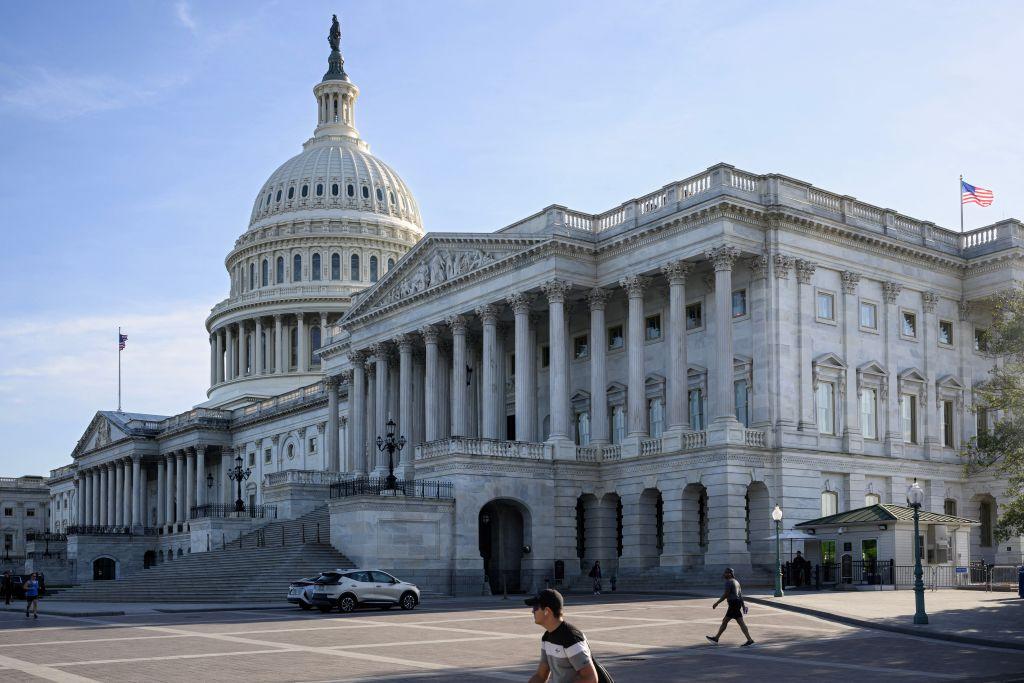
The U.S. Capitol is seen in Washington, D.C., on April 23, 2024. Mandel Ngan/AFP via Getty Images
Commentary
As the federal debt climbs to record levels, public trust in government is scraping the bottom.
Those two trends should concern every member of Congress. Lawmakers should restore credibility by sending good government reforms to the president’s desk. One place Congress could start is by reforming earmarks.
After a decade-long moratorium, Congress revived earmarks in 2021. The ban was in place for good reasons. Instead of allocating taxpayer dollars through competitive processes based on merit, agency review, and national priorities, earmarks direct funds to projects at the request of individual lawmakers.
Before the moratorium, earmarks exploded in number and cost, peaking at nearly 16,000 projects costing more than $29 billion in 2010.
High-profile corruption scandals that sent Reps. Randy “Duke” Cunningham (R-CA) and Bob Ney (R-OH) to prison and growing concern over wasteful spending like the infamous “Bridge to Nowhere” ultimately pushed lawmakers of both parties to end earmarks.
Supporters of restoring earmarks said Congress should reclaim its power of the purse over federal spending. They also argued that it would help bolster bipartisanship, making it easier to enact laws. Upon their revival, earmarks were given the more respectable-sounding name of “community project funding.” Supporters promised a transparent system with guardrails to prevent abuse.
Unfortunately, transparency and accountability fell short. My organization, National Taxpayers Union Foundation, tracked more than 7,600 earmarks totaling roughly $14 billion across seven appropriations bills this year.
The problem is not simply the quantity and cost. This year’s earmarks were listed across inconsistently formatted PDFs tied to each of the appropriations bills. This made it exceedingly difficult to identify total requests from members, recipients, and overall funding levels. It took many hours to go through the hundreds of pages of earmark requests and format them into a user-friendly spreadsheet to tally up the requests.
While the previous moratorium was established via the rules of each chamber, Rep. Ralph Norman (R-SC) introduced H.R. 7041, the Earmark Elimination Act, to statutorily end this process. Without earmarks as bargaining chips to help secure support for legislation, lawmakers would be encouraged to evaluate proposals on their overall merit.
Short of restoring the ban on pork-barrel projects, it should at least be far easier than it is now to determine how members of Congress are directing taxpayer dollars. Real earmark transparency means clear, timely, and accessible disclosure, allowing the public to easily see how much each member requests for each recipient. Data reporting should be standardized so that transparency empowers taxpayers.
Restoring public confidence in Congress also requires ethics reforms. Members are often seen as enriching themselves through well-timed stock trades while in office and collecting generous retirement benefits after leaving.
Bipartisan reforms to restrict congressional stock trading have gained renewed attention and were highlighted during President Donald Trump’s recent State of the Union address. Some proposals would ban members of Congress from holding individual stocks outright, while others would allow lawmakers to place their holdings in qualified blind trusts. The latter approach may offer a sensible balance that limits conflicts of interest while avoiding restrictions that could discourage successful individuals from running for office.
This reform could be bolstered by expanding the list of crimes that would strip the pensions of lawmakers who engage in insider trading and other corruption. After Rep. Corrine Brown’s (D-FL) initial corruption conviction was overturned on a technicality regarding the jury, she struck a plea deal to a lesser offense that left her estimated $71,000 pension intact.
The Office of Personnel Management should implement greater transparency for existing pension forfeiture laws, including the Honest Leadership and Open Government Act (HLOGA) of 2007, the Stop Trading on Congressional Knowledge (STOCK) Act of 2012, and the No CORRUPTION Act of 2024.
Yet, OPM provides little information about how these laws are enforced. Dozens of inquiries from me have gone unanswered. The last time the agency publicly responded to inquiries was in 2020, when it reported that no one had lost a pension under these provisions—even though former Rep. Chaka Fattah (D-PA) was then serving a 10-year prison sentence for covered corruption offenses and had no appeals. Lawmakers and taxpayers deserve to know whether corrupt officials are still receiving taxpayer-funded retirement benefits.
Although there are privacy concerns for those enrolled for the benefit, Congress should require OPM to annually report whether any congressional pensions have been revoked under these laws, without disclosing personal information.
These reforms reinforce the principle that members of Congress should be held to the highest standards of transparency and accountability.
That principle is especially important while the federal government is running massive deficits. Americans expect lawmakers to spend their money carefully and make decisions regarding expenditures from the Treasury transparently and in the public interest. Public trust will return only when Congress proves it will hold itself accountable.