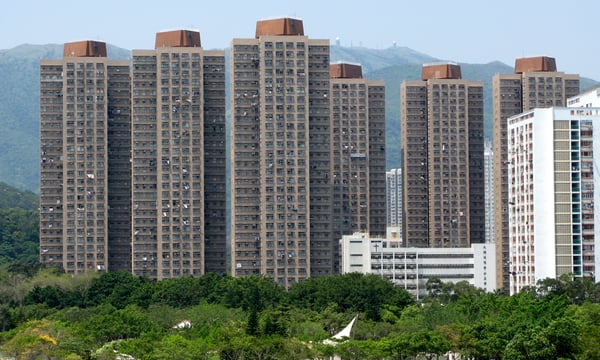
Weeks after the fire in Hong Kong’s Tai Po district, questions on the path forward loom large. By the time firefighters were able to quell the flames, at least 159 lives had been lost. For those affected, it has been a harrowing experience of lost family, friends, neighbors, belongings, and homes.
Hong Kong is home to an incredibly large population for its size, and the idea of “home” in Hong Kong is closely tied to its scarcity. For survivors of the fire in Wang Fuk Court, it is especially devastating that the fire broke out in a public housing complex, and is inextricably linked to how they might move on. Most bought their homes there through government subsidies. In light of the fire, the Hong Kong government, alongside a number of private NGOs, has pledged both temporary housing and long-term assistance.
What this long-term assistance will look like, however, remains entrenched within a broader housing crisis. Moving residents into alternative public housing may seem like the most direct, immediate option. Yet as of September 2025, the composite waiting time for subsidized rental housing was already around five years. Survivors of the fire need a place to go first and foremost, but beyond that, they need a place to live.
The question of where has been brought into sharp focus. This is, of course, most urgent for the survivors themselves. For the city as a whole, however, the question is equally important for its connection to broader concerns over affordable housing supply and the regulation of existing homes.
Public housing in Hong Kong dates back to 1954, originating with another fire. On Christmas Day 1953, a fire broke out at a squatter shelter in Shek Kip Mei, leaving over 50,000 people homeless. The Hong Kong government constructed resettlement blocks in response, creating the Hong Kong Housing Authority to oversee management.
Since then, the program has expanded to shelter over 2 million people — around 30 percent of Hong Kong’s population as of 2025. In a city consistently ranked among the most unaffordable, such housing schemes provide essential shelter for those priced out of the market. Its two main wings, public rental housing and subsidized home ownership, serve as a way to bridge inequality.
The program is not without challenges. Hong Kong’s Social Welfare Department reported 1,564 registered “street sleepers” as of 2022, with other NGO estimates placing the number far higher. For public housing complexes themselves, systemic abuse poses a real threat to residents who would otherwise claim homes. The Hong Kong government has long battled tenants exceeding the maximum income limit, taking advantage of the scheme — most recently investigating residents with suspiciously luxurious cars.
In spite of challenges, the lived reality of those 30 percent of Hong Kongers necessitates the continuation and success of the program. Affordable housing is a city-wide concern, with its implications spanning the political, economic, and social realms. Both the local and national governments have cited the lack of affordable housing as a source of political grievances. The most striking example took place in 2019, when many “vented their discontent in prolonged street protests,” according to Xinhua — discontent that covered “often-mentioned problems relating to housing and land supply.”
Economically, the Chinese General Chamber of Commerce has stated that the inadequate supply of land “has become the biggest bottleneck to Hong Kong’s continued economic growth,” affecting business costs and Hong Kong’s appeal to overseas investors and talent. And among young people, many of whom live with their families due to cost and culture, home ownership seems increasingly like a dream their generation has aged out of.
Each of these issues has once again come to the forefront as Hong Kong underwent its 2025 Legislative Council election, widely acknowledged as having taken place in the shadow of the fire in Tai Po. And while turnout in some respects was higher than in 2021, numbers were still low — under 32 percent of voters overall, and fewer in number than in 2021.
The idea that the fire drastically affected this outcome, however, is a mistake. While headlines are correct to point out the fire in Tai Po was a focal point for the city leading up to the election, it did not meaningfully alter the political landscape. Housing and any subsequent concerns, stances, or voting inclinations existed well before the fire. Framing the election itself as dependent on the fire or subsequent responses misreads the tragedy, and the myriad of other conditions that contributed to relatively low turnout, of which dissatisfaction with city-wide housing is just one part.
Instead of serving as any sort of turning point in politics, the fire in Tai Po is best understood as a case study on Hong Kong’s governance. Residents of Wang Fuk Court have largely secured alternative housing, for the time being. And while the system they will need to navigate in the coming weeks, months, and years is fraught, it is no more fraught than the housing system most of Hong Kong navigates year-round. The goal must be to build resilience in the housing system as a whole, such that it can accommodate crises when they arise.
Housing represents a fundamental if somewhat overlooked opportunity for alignment between virtually all facets of Hong Kong’s public and civil life for the government and private companies, as a contributor to the economic and viable productivity of the city. And most importantly, for Hong Kongers themselves.
Hong Kong’s government continues to outline plans for housing, using a rolling 10-year housing supply target to formulate the split between public and private housing, the target number of public housing units, and land sales. With this system, some successes can be found. The Hong Kong government unveiled a “Light Public Housing” program in 2022 for public housing applicants with pressing needs, designed to address the “short-term gap of public housing supply.” The Housing Authority has also approved funding to assist public rental housing tenants to climb the housing ladder via subsidized sale flats.
The fire in Tai Po, however, demonstrates the need to expand on these programs. Wang Fuk Court residents are among the latest and most urgent recipients of public housing, but the uncertainty of their future and housing plans reflects an ongoing, citywide struggle to house its residents, not a crisis-specific problem.
In a city where housing is already a scarce resource, it is rattling to reckon with the fact that even existing housing may not be stable. The fire ties into this broader wound. Conversations on how to move forward, in both governance and public discourse, must treat housing insecurity as a symptom of a city still establishing its plan amidst a shifting economic landscape and national priorities — and the questions of Hong Kong residents as people familiar with dealing with housing insecurity, now in the wake of a tragedy.
For now, both governments and civilians will rightfully focus on supporting those immediately affected by the fire. Beyond immediate responses, however, is an opportunity for the Hong Kong government to demonstrate its commitment, and perhaps more importantly, its capability to enact long-term plans for the security of housing, both existing and future.
The goal then would be to use the resilience already shown in light of this tragedy to build on this work, and strengthen the faith of Hong Kongers in their home. In the best case scenario, the fire in Tai Po will evolve into a catalyst for a broader reckoning of affordable housing and its regulation.