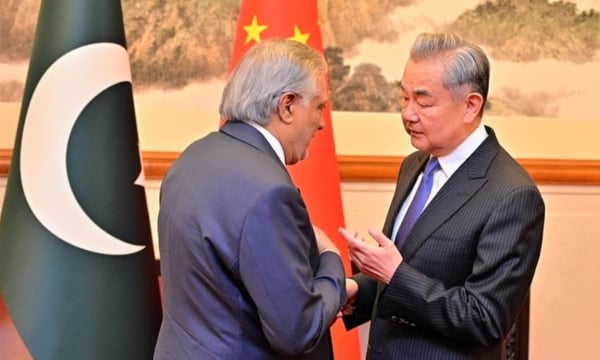
Pakistan’s Foreign Minister Ishaq Dar arrived in Beijing on March 31 to meet with China’s Foreign Minister Wang Yi, a day after chairing a meeting with his counterparts from Turkiye, Saudi Arabia, and Egypt as part of efforts to mediate the ongoing Iran-Israel-U.S. war. The timing of the visit was deliberate, positioning Beijing as an important stakeholder and not a distant observer. China chose that moment to release its five-point proposal on the crisis, signaling entry into a diplomatic space it had, until recently, approached with caution.
On paper, the proposal is difficult to disagree with. It calls for an immediate ceasefire, protection of civilians, humanitarian access, and a return to dialogue under a United Nations framework. It places particular emphasis on ensuring safe navigation through the Strait of Hormuz, warning against disruptions to global energy flows. There is little that is controversial here, and that appears to have been precisely the point.
The document is structured to avoid friction altogether. It does not assign responsibility, neither does it identify triggers and nor does it prioritize one concern over another. Everything is framed in general terms, addressed to “all parties,” and placed within an abstract commitment to stability.
Peace proposals are judged as much by what they leave out as by what they demand. China and Pakistan’s proposal calls for de-escalation without defining the conditions under which de-escalation would hold. It asks for dialogue without indicating what that dialogue must address. Civilian protection is emphasized, but without reference to conduct by the warring parties. Even the call for multilateralism is framed as a return to process rather than an outline of outcomes.
By keeping the language broad, Beijing and Islamabad avoided taking positions that would impose diplomatic costs. This is of course a familiar strategy for nations trying to remain in the middle. But China is not merely issuing a statement – it seems to be attempting to position itself as a shaping force in regional diplomacy.
The only part of the proposal that moves beyond abstraction is its emphasis on the Strait of Hormuz. Safe passage through the strait is the most clearly articulated priority in the document.
Roughly 20 percent of the petroleum liquids consumed around the world passes through the Strait of Hormuz, averaging between 15 to 20 million barrels per day. China is the largest importer of this flow, with a majority of its crude oil imports transit through the strait. Its energy security is directly tied to the stability of this corridor. In parallel, China is Iran’s largest oil buyer, importing over a million barrels per day through a mix of formal and indirect channels.
For Beijing, this has created a clear hierarchy of concerns. Disruption in the Strait of Hormuz has directly translated into price volatility, supply uncertainty, and downstream economic effects. For China, however, the political and strategic disputes that produced the disruption in the first place remain one step removed from these immediate costs. By foregrounding the Strait of Hormuz, Beijing has indeed signaled what it is actually trying to stabilize. China’s peace proposal is not an attempt to resolve the conflict; it’s an effort to manage its most consequential externality.
Beijing had, until recently, maintained a cautious distance from direct involvement in the Iran-Israel-U.S. war. The release of the proposal now allows China to enter the diplomatic space at a moment when calls for mediation are increasing, but before expectations of delivery have hardened. China wants to be seen as part of the solution, while avoiding commitments that would require follow-through.
Mediation, in its substantive form, requires leverage. It requires the ability to offer incentives, impose costs, or at the very least structure negotiations in a way that alters behavior. None of these elements are visible here. There are no enforcement mechanisms, no timelines, and no indication of consequences if the proposal is ignored. In that sense, the plan performs a diplomatic function without assuming diplomatic risk.
The proposal seeks to establish China as an actor that is present, constructive, and aligned with the language of stability. It does so without entangling Beijing in the consequences of failure. For other states, the calculation is different. Endorsing the proposal would not reduce uncertainty nor would it clarify pathways to de-escalation. The proposal says enough to be taken seriously, but not enough to be tested.
In that sense, the China-Pakistan peace plan has little to offer on conflict resolution, but reveals much about how Beijing intends to manage its exposure to war.