Commentary
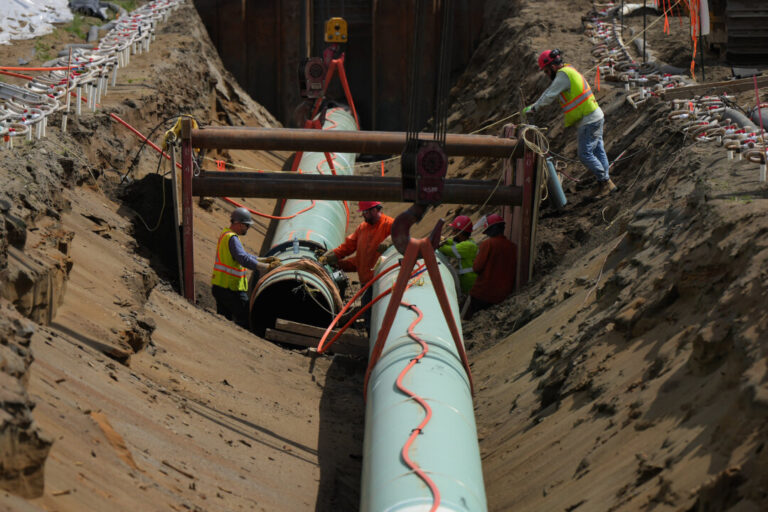
The Pacific Link pipeline is rightly being called a nation-building project. With a capacity of more than one million barrels per day, a route of roughly 1,200 kilometres, and an estimated cost of $35 billion to $44 billion, it would be among Canada’s largest infrastructure projects.
Encouragingly, Canadians appear to be waking up to a basic economic reality: a major energy-producing country needs pipelines and ports to get its resources to world markets. After years of political paralysis, that change is overdue.
But Canadians may still be getting the second half of the equation wrong. Recognizing that we need pipelines does not mean governments need to finance them.
We have the “what.” The problem remains the “how.”
Trans Mountain offers a warning. TMX was proposed as western Canadian oil production was running up against pipeline capacity. By 2018, those constraints had contributed to Alberta imposing production curtailments. Producers wanted access to markets beyond the United States.
A private company, Kinder Morgan, stepped forward to build it. But after years of political and regulatory uncertainty, the company concluded it could no longer adequately assess the project’s risk. Ottawa bought it.
What started as a privately financed expansion became a taxpayer-owned megaproject costing roughly $34.5 billion to build, on top of the $4.4 billion purchase price.
Government now points to TMX as a success. Completing it certainly was important, but another lesson is harder to celebrate: government ownership became necessary after private capital walked away from Canadian political and regulatory risk.
Pacific Link could be considerably more complicated.
Scotiabank estimates the pipeline could cost $35.2 billion to $43.7 billion, potentially rising to $65.6 billion if construction is delayed. Ottawa has also pledged to support $10 billion in upgrades at the Roberts Bank port and says it is working with British Columbia on a future marine terminal to export Pacific Link crude.
And unlike the situation with TMX, government ownership isn’t a fallback this time: it’s the plan. Ottawa and Alberta plan to split government ownership equally, with indigenous communities offered at least a 10 percent stake. Pembina Pipeline Corporation is expected to take a 10 percent interest during construction, with an option to increase it later.
And the pipeline is only part of the financial picture.
The Pathways Alliance carbon capture project would capture and permanently store emissions from oilsands operations. Originally estimated at $16.5 billion, the project could now cost $20 billion to $30 billion. Unlike a pipeline, carbon capture does not generate conventional transportation revenue, so its economics depend heavily on carbon policy, tax credits, and government support.
Add Pacific Link, Roberts Bank, and Pathways, and the combined estimated capital costs reach roughly $65 billion to $84 billion under the lower-cost pipeline scenarios, assuming those estimates do not overlap. That figure could rise substantially if pipeline construction costs escalate.
And we still haven’t produced the additional oil.
Some existing production could be redirected from U.S. markets, but filling another million-barrel-per-day pipeline over the long term would almost certainly require substantial new oilsands investment.
There is also the overlooked question of diluent.
Oilsands bitumen generally must be blended with lighter hydrocarbons such as condensate for pipeline transportation. Depending on crude specifications and blending ratios, diluent can represent roughly 20 to 30 percent of diluted bitumen.
Canada already relies substantially on U.S. condensate imports. There is some irony in building a pipeline partly intended to reduce dependence on the U.S. while potentially requiring more U.S.-supplied petroleum products to move Canadian bitumen.
But the larger problem is investment certainty.
Oilsands producers contemplating billions of dollars of new production investment need confidence that Pacific Link will be completed. They need predictable regulatory timelines and reasonable assurance that fiscal and environmental rules won’t change after they make investment decisions.
That is where government should concentrate its efforts.
Government has an essential role in establishing environmental standards, fulfilling indigenous consultation obligations, ensuring safety, and making timely regulatory decisions. But there is a fundamental difference between government enabling investment and government replacing investment.
Canada should be creating conditions that attract private capital, not repeatedly putting taxpayers in the position of assuming risks private investors cannot quantify.
Canadians are right to rediscover the importance of pipelines. TMX has demonstrated the strategic value of reaching international markets, and Pacific Link could take that much further.
But nation building should not be measured by how much public money governments can spend. It should be measured by whether Canada can establish clear rules, predictable timelines, and competitive fiscal policies that convince investors to risk their own money building projects the country needs.
Canadians increasingly understand the “what”: we need pipelines. Governments still haven’t convincingly provided the “how.”
Until they do, all the talk about Pacific Link as a nation-building project rings hollow.
Chris Bloomer is a board member of the FCPP and the former president and CEO of the Canadian Energy Pipeline Association. He has held senior executive positions in the energy industry in Canada and internationally.
Views expressed in this article are opinions of the author and do not necessarily reflect the views of The Epoch Times.