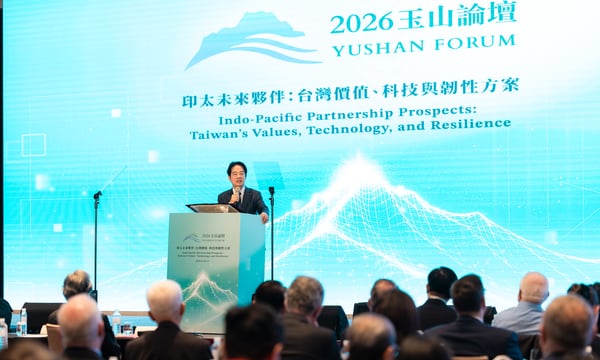
On March 16, at the 2026 Yushan Forum in Taipei, President Lai Ching-te signaled that Taiwan’s New Southbound Policy is no longer merely an economic diversification initiative. Framed around this year’s theme of values, technology, and resilience, the policy is increasingly being presented as something larger: a broader Indo-Pacific strategy linking trade realignment, technological cooperation, democratic coordination, and regional deterrence.
The Yushan Forum has long served as a platform for Taiwan to connect with political, economic, and strategic elites from across the region and beyond. This year’s forum brought together more than 70 political and economic leaders from 22 countries, making it the largest gathering in the forum’s history. Participants included Chair of the Japan-ROC Diet Members’ Consultative Council and Chair of the House of Representatives’ Commission on the Constitution Furuya Keiji, Paraguayan Minister of Information and Communication Technologies Gustavo Villate, South Korean Reform Party leader and National Assembly member Lee Jun-seok, former U.K. Secretary of State for International Trade Liam Fox, former Chair of the Munich Security Conference and former German Ambassador to the United Nations Christoph Heusgen, former Canadian Ambassador to the WTO Jonathan Fried, and former Philippine Vice President and current Naga City Mayor Leni Robredo, along with former ministerial-level officials from Bulgaria, Czechia, Lithuania, Malaysia, and New Zealand.
Both the New Southbound Policy and the Yunshan Forum debuted under Lai’s predecessor, Tsai Ing-wen. Originally, the policy targeted 18 specific countries in Southeast Asia, South Asia, and Oceania. This year, Lai used the forum to send a clear message: Taiwan intends to deepen and broaden its partnerships not only with New Southbound partner countries, but also with democratic partners across the world.
This is an important shift in emphasis. It suggests that Taipei increasingly sees its southward outreach not as a geographically limited policy, but as part of a wider diplomatic and strategic realignment. Taiwan seeks to present itself as an active player in Indo-Pacific affairs rather than a passive object of cross-strait tension.
One of the most important themes in Lai’s speech was Taiwan’s reduced dependence on China. For decades, critics questioned whether the New Southbound Policy could genuinely loosen the structural pull of the Chinese market. However, Taiwan’s economic figures suggest that a measurable shift is underway.
In 2010, 83.8 percent of Taiwan’s outbound investment went to China, yet last year that figure had dropped to just 3.75 percent, a historic low. Over the same period, Taiwanese investment in EU countries increased by 650 percent.
Moreover, since 2025, the United States has become Taiwan’s largest export market, with exports to the U.S. up 78 percent. Taiwan’s exports to New Southbound partner countries rose 30.5 percent.
These are not just numbers about market adjustment. Taiwan is gradually rebuilding the geographic foundation of its economic security. For a long time, Taiwan’s economic dependence on China has created strategic vulnerability by giving China potential leverage over Taiwan’s commercial environment. Therefore, reducing that asymmetry is not just a trade policy objective, but a core part of Taiwan’s broader effort to protect its political and strategic autonomy.
Across the Indo-Pacific, governments are increasingly concerned with de-risking supply chains, reducing overreliance on authoritarian markets, and building more resilient economic relationships. Taiwan is now positioning itself within that wider trend. By expanding commercial ties with the U.S., Europe, Southeast Asia, South Asia, Australia, and New Zealand, Taipei is trying to convert diversification into greater room for strategic maneuver.
In that sense, the New Southbound Policy is no longer only about finding alternative markets. It is about using economic diversification to strengthen Taiwan’s freedom of action in a region where economic exposure and geopolitical pressure are increasingly intertwined.
In addition to trade, Taiwan’s technology is now becoming central to the way how Taiwan defines its relevance to the world. Taiwan already occupies a pivotal position in the global semiconductor supply chain, especially in its advanced manufacturing and chip design. Taiwan’s next-generation sectors, such as silicon photonics, quantum technology, and robotics, suggest a wider ambition: Taiwan wants to remain indispensable not only in today’s technological landscape, but also in tomorrow’s.
In an era when technology, national security, and industrial policy are deeply intertwined, Taiwan’s value to its partners lies not only in what it produces, but also in the kind of trusted ecosystem it can help sustain. Therefore, Taiwan is trying to ensure that its technological strength translates into deeper long-term cooperation with democratic economies, especially as supply chain resilience becomes a defining issue in international politics.
Moreover, peace and stability in the Taiwan Strait are not only a regional concern, but also a prerequisite for global security and economic prosperity. With rapidly evolving geopolitics, rising nontraditional security threats, and intensifying gray-zone coercion, Taiwan has demonstrated a clear commitment to maintaining regional peace and stability.
Taiwan has also expressed a policy orientation toward closer coordination with democratic partners, with the aim of strengthening collective deterrence and preserving peace through strength, thereby contributing to regional order and stability in the Indo-Pacific. At the Yushan Forum, Lai repeatedly framed Taiwan’s outreach in the language of democratic cooperation and coalition-building, arguing that Taiwan and its partners should leverage the combined strengths of “our democracies, economies, and technologies.” He also called for the formation not only of “national teams,” but also of “international teams.”
In terms of defense policy, Taiwan will further expand its defense spending. To meet NATO’s new spending target, in 2026, Taiwan will expand its national defense budget to approximately 3.32 percent of GDP, with plans to raise it to 5 percent by 2030 – if, of course, the Lai administration can overcome roadblocks to defense spending in the opposition-controlled legislature. Meanwhile, Taiwan will shift its national security policy priorities to focus on accelerating the development of asymmetric warfare capabilities while systematically strengthening whole-of-society defense resilience, to further improve its capacity to respond to a broad range of security threats and challenges.
Overall, these developments point to a larger transformation in Taiwan’s statecraft. The New Southbound Policy has outgrown its original identity as a development-oriented or market-diversification initiative. It is becoming an organizing framework for Taiwan’s emerging grand strategy.
Taiwan is now using the policy to serve multiple strategic ends at once: reducing dependence on China, integrating more deeply with democratic partners, strengthening supply chain resilience, and reinforcing its place in the political economy and security architecture of the Indo-Pacific. At the 2026 Yushan Forum, Taiwan signaled its intention to turn the policy into something more ambitious: a geopolitical project aimed at helping the whole Indo-Pacific reduce its reliance on China.