China Power | Politics | East Asia | Oceania
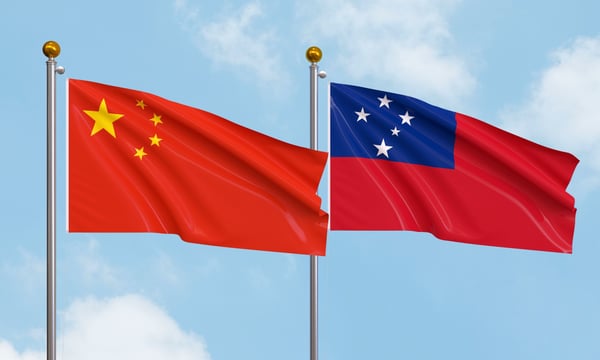
China’s influence operations in Samoa have been patient, persistent, and, as the election proved, profoundly effective.
When Samoa turned red at the ballot box in August 2025, it wasn’t just a political swing – it was a geopolitical shockwave. Susuga Laʻaulialemalietoa Leuatea Polataivao Fosi Schmidt (Laʻaulialemalietoa), despite facing ten criminal charges and having been recently expelled from his own government, swept to victory with 40 percent of the vote. It was a win for Laʻaulialemalietoa, but it was a win for China too.
Laʻaulialemalietoa’s ties to Beijing are neither casual nor new. He serves as president of the Samoa-China Friendship Association and represents Samoa on the board of the Pacific China Friendship Association – an organization built to court Pacific elites and normalize China’s dual-use activities across the region. Within this network, Laʻaulialemalietoa is the most senior and politically engaged figure. These associations are part of the Chinese Communist Party’s “united front” system – Beijing’s global mechanism for guiding local leaders and elite networks toward China’s strategic interests.
China’s advance in Samoa was not a blitzkreig. It was a long cultivation – patient, persistent, and, as the election proved, profoundly effective. In a paper just published, we trace the evolution of China’s united front operations in Samoa from the 1970s to today. The story that emerges is one of systematic influence: elite capture, political division, and economic leverage. China’s political impact saturates Samoan society, yet China is a surprisingly modest contributor of aid and a negligible trade partner.
The previous government, led by Fiame Naomi Mataʻafa (2022–2025), sought to rebalance relations with Beijing, publicly voicing concern over foreign interference and refusing to join a security pact centered on China. Her successor has reversed course. Prime Minister Laʻaulialemalietoa has pledged to “deepen cooperation” with China. He is promising to reinstitute the Sasina cryptocurrency scheme, which the International Monetary Fund labeled as at risk of being used for “money laundering and financing of terrorism.” He is restarting dual-use infrastructure schemes like Asau Port and pitching for a new long-haul plane for Samoa Airways – presumably to ply the China-Samoa route.
Samoa’s fiscal vulnerability makes this shift especially perilous. Debt repayments to China already consume 2.6 percent of GDP – the third highest proportion in the world. The Fiame government paid down the debt while lifting economic growth to between 2.7 and 3.2 percent in 2025. Laʻaulialemalietoa’s proposals threaten to undo those gains at a time when the government is struggling to cover the costs of basic health care. These investments may not make financial sense for Samoa, but they make perfect strategic sense for China, which has steadily expanded its Pacific footprint through infrastructure with military potential. Previous China-funded ventures, like the Faleolo Airport expansion – which operates at half of its capacity – and Samoa’s National Broadband Project have already proven to be “white elephants,” as the IMF once predicted.
Behind the glossy rhetoric of political “friendship,” money has flowed quietly into Laʻaulialemalietoa’s home district, Gaga‘ifomauga No. 3. Chinese firms linked to united front interests have funnelled millions into land leases and joint ventures in his rural electorate, including his own village, Sasina. Corporate records reveal Laʻaulialemalietoa’s family’s involvement in cryptocurrency and blockchain startups financed by these investors. These are carefully targeted investments to embed China-aligned actors within Samoa’s grassroots and political fabric.
Laʻaulialemalietoa’s ascent marks an authoritarian turn for Samoan democracy. He has appointed himself minister of police and prisons; minister of foreign affairs and trade; minister responsible for the Samoa Law Reform Commission; the Office of the Ombudsman; and the Public Service Commission. This makes him effectively judge and jury in key aspects of government and societal supervision. It remains to be seen whether he will take China-Samoa policing cooperation even further than his predecessors’ cautious approach.
Laʻaulialemalietoa has barred the Samoa Observer from access to Cabinet. He has announced a total ban on paid government advertising in Samoan private media – a move that cripples press revenues and ensures a compliant news environment. The government’s new media policy, now in draft, would introduce ideological vetting of journalists, foreign and domestic alike. It looks remarkably like China’s own media controls.
Samoa’s strategic position in the Pacific makes this moment more than a local story. Samoa occupies a pivotal location at the center of a cross-Pacific island chain linking the United States and Australia. It is also in the North-South Pacific Third Island Chain. It is just a short flight from U.S. territory in American Samoa. Thus, its orientation carries global implications. Around it, Kiribati, Solomon Islands, Vanuatu, and the Cook Islands have already signed security-related agreements with China. Until now, Samoa has resisted joining that list. That may soon change.
Samoa does, of course, need more investment, trade, and aid. Australia and Aotearoa New Zealand remain its largest donors, but their support barely scratches the surface of Samoa’s development challenges. The question is whether likeminded partners – Japan, India, South Korea, the European Union, United Kingdom or the United States – will step up in time. Because if they don’t, Beijing will.
As Samoa’s 2025 election shows, influence in the Pacific is no longer won by warships or trade deals. It is won in the quiet courtships of friendship associations, campaign donations, and infrastructure projects – one small island at a time. The situation we have detailed in our paper look dire, but it is not irredeemable. Now is the time to use all available levers of Samoa’s democracy to hold the FAST 2 government to account. Samoa must rebalance its relationship with China so it can return to its rightful place as a stable and resilient democracy in the Pacific.
This article was originally published in the Samoa Observer on December 17 and is republished with permission.