Authoritarian powers are increasingly collaborating to scale repression across borders, and Russia and China together account for nearly half of 72,000 such events since 2024, according to a new dataset.
Nonprofit Action for Democracy has published the Authoritarian Collaboration Index, which collates global authoritarian activity in near real-time. A recent report on events from 2024 to 2026 found that Russia and China “sit at the center” of global authoritarianism, building out infrastructure and routine events for collaboration between authoritarian powers to grow.
“Authoritarian cooperation is becoming institutional: recurring forums, media alliances, and training platforms are hardening ad hoc coordination into durable infrastructure,” the report reads. “It is also becoming routinised — practices like reciprocal sham election monitoring and cross-border dissident deportation now operate as low-friction, self-reinforcing defaults.”
These partnerships are not based on ideological or other shared values, but instead transcend traditional divides, such as religious differences, with regimes placing the goal of holding authoritarian power above any other worldviews, according to the report.
The index tracks seven categories of authoritarian collaboration: financial; diplomatic legitimization of regimes; alliance building, such as through regular forums; propaganda; military cooperation and sharing technological tools for repression; diffusion of authoritarian governance and repression methods; and transnational repression, or the persecution of dissidents and other targets beyond their borders.
This collaboration is generating “compounding returns” for the regimes that, if left unchecked, risks “producing a world in which repression scales across borders while democratic responses remain fragmented and reactive.
“Surveillance infrastructure exported to one regime becomes a template for the next; legitimization exchanged between two actors normalizes the practice for a dozen more; legal toolkits tested in one jurisdiction travel to others within months,” the report adds.
The top 10 actors involved in tracked collaboration events are Russia, China, Iran, Turkey, Saudi Arabia, Egypt, India, Kazakhstan, Azerbaijan, and Pakistan.
“This produces a hub-and-cluster structure: two global anchors, a mid-tier of major regional powers, and a long tail of smaller states and parties that appear in narrower sets of contexts,” the report reads.
Authoritarian Summits
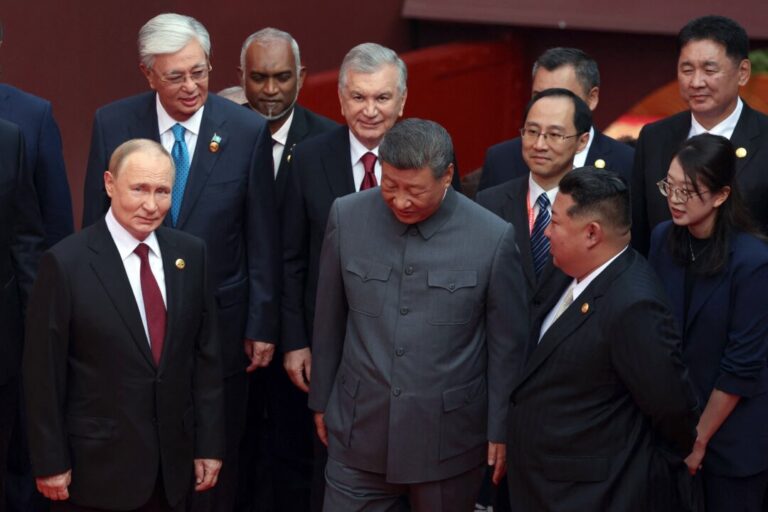
These nations have formalized cooperation at a high-level with international summits such as the Shanghai Cooperation Organization, bringing together experts, think tanks, and government agencies for knowledge exchange, or “the diffusion of ‘best practices’” of authoritarianism, and to coordinate language around these strategies.
The Chinese regime also has a recurring International Forum on Democracy, which in 2024 gathered nearly 300 participants from 70 countries, according to the report, as a “clear example of counter-norm entrepreneurship at scale.” This forum utilized a “curated ecosystem of officials, academics, and state-linked voices” to “normalize the claim that liberal electoral competition is neither universal nor superior,” instead promoting the authoritarian regimes under the name of “whole-process people’s democracy.”
These forums have been framed publicly as counters, or alternatives, to established international gatherings and, according to the report, signal a “durable” international community capable of fostering “revised, authoritarian-friendly versions of ‘democracy.’” These authoritarian states have formed a community that expects and routinely offers “acts of mutual preservation”—for example, offering shelter to the ousted politicians of another regime.
These events are supported by a network of state-run media promoting aligned propaganda. They include outlets like CGTN, TeleSUR in Venezuela, Iran’s IRNA, and Vietnam New Agency. Russia-based TV BRICS facilitates content partnerships between these state media. This infrastructure is a physical one, with projects such as the BRICS+ Information and Cultural Media Center established in Moscow and the BRICS Global Media Tour.
Growing Transnational Repression
In one example, Turkey assisted Beijing’s persecution of Uyghurs, a Muslim and Turkic ethnic minority group in Xinjiang, by promoting the Chinese regime’s narrative and cooperating with its transnational repression.
Turkey had for a long time been a “safe haven” for Uyghurs, according to Human Rights Watch, due to cultural and religious ties. Turkey, home to about 50,000 Uyghurs, also had preferential policies allowing immigrating Uyghurs to become long-term citizens and residents.
But as Turkey grew its alliance with the Chinese regime, immigration has become less safe for Uyghurs, according to the report, which highlights a 2024 collaboration event when Turkish Foreign Minister Hakan Fidan visited Xinjiang to announce closer “counter-terrorism” cooperation with Beijing. The Chinese regime has framed its persecution of Uyghurs, which the United States has designated a genocide, as “counter-terrorism” efforts. Reports of Uyghurs being interrogated in Turkey after the visit surged, and some have been labeled “public security threats” by Turkish authorities, which can expedite a deportation process.
Transnational repression has become an increasing concern, with G7 leaders condemning the practice in a joint statement last year.
The report cites cases of Turkish refugees being abducted in Kenya and deported to Turkey to face treason charges, Kenyan opposition supporters being kidnapped by Ugandan security operatives, Gabonese police arresting a Cameroonian social media activist criticizing the Cameroonian government before handing him over to Cameroonian security forces, who reportedly tortured him and later charged him with terrorism and insulting the head of state before a military tribunal.
Exporting Repressive Technology
China and Russia are also leading the adoption of surveillance technology among authoritarian states.
For example, the Chinese regime has hosted tech and cybersecurity seminars in Xinjiang for officials from the Middle East, Africa, and other countries. The regime publicly touts its “Digital Silk Road” initiative to export governance technology, and a massive online leak last year revealed a single Chinese tech company had built out repression networks for five governments, including tools to help identify political “threats” and stop gatherings before they occur.
“These capabilities often arrive via vendor contracts, ’smart city’ bundles, and surveillance standards marketed as cybersecurity or public-service modernization, but are rapidly deployed to identify opponents, disrupt organizing, and scale political exclusion,” the report says.
In Venezuela, Chinese tech company ZTE helped build the “Fatherland Card” system that ties personal data to program access, which human rights advocates have warned can enable coercion by linking access to food, pensions, and services to political loyalty.
Russia has also exported to countries including Belarus, Kazakhstan, Kyrgyzstan, Uzbekistan, Cuba, and Nicaragua technology that can capture calls, messages, emails, and social media activity, as well as intercept at scale telecom and internet traffic.
“Autocrats don’t act alone,” the report states.