In 2016, if an analyst had suggested that within a decade China would serve as the economic and logistical lifeline enabling Russia to wage full-scale war against Ukraine, most observers would have laughed it off. If that same analyst had added that Beijing and Moscow would cooperate with Tehran to mass-produce lethal drones to kill thousands of Ukrainians, the prediction would have seemed similarly far-fetched.
The notion that North Korean troops would be fighting alongside Russian forces in Europe, learning crucial lessons of modern warfare, would also have been outlandish, as would the Chinese leadership affording Russian forces secret military training, including on “radiological, biological, and chemical warfare,” as Reuters reported on July 1.
Yet as of mid 2026, these scenarios have come to pass as part of the sustainment of the longest and most horrific land war in Europe since World War II. It grinds on in no small part due to the support of an axis of authoritarian powers that democracies world failed to take seriously enough.
Western policymakers convinced themselves that economic interdependence would moderate Beijing’s behavior, that sanctions would cripple Moscow, and that the frictions between Russia and China were too great to permit meaningful cooperation. This assessment was wrong – a failure of both political will and imagination.
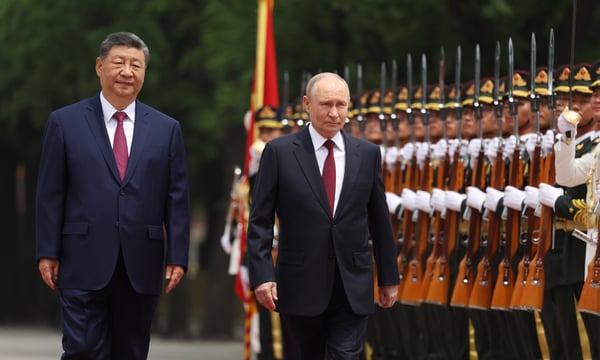
Since Xi Jinping consolidated power in late 2012 – the same year Vladimir Putin returned to the Russian presidency – the bilateral relationship has matured in important ways. What was once a pragmatic and somewhat distant association has evolved into a sustained partnership built around personal chemistry and shared authoritarian purpose. Over the past decade and a half, Xi and Putin have met, in person or virtually, some 60 times.
This matters because authoritarian systems react and adapt to the gravitational pull of their leaders’ personal bonds. As Putin was engineering the occupation of Crimea in 2014, Xi was simultaneously adopting a more aggressive posture in the South China Sea, one that has intensified since that time. Xi is also pursuing a far more belligerent approach toward Taiwan.
Russia launched its full-scale invasion of Ukraine in February 2022, days after Xi and Putin declared a friendship with “no limits.” By that time, their bureaucracies had already spent years quietly expanding cooperation in trade, military affairs, media, and governance.
The West expected sanctions to bring Russia to its knees. Instead, China provided an economic lifeline. Bilateral trade between Russia and China grew by roughly 70 percent over the five years from 2021, equipping Moscow to prosecute the war despite unprecedented international pressure.
In March 2023, Xi and Putin met in Moscow and pledged to drive global changes “the likes of which we haven’t seen for 100 years.” By May 2024, they were announcing a “new era” in their partnership, with deepened military ties and expanded defense cooperation.
China and Russia are not two powers simply tolerating each other. They are two regimes with a shared strategic vision: to dismantle the U.S.-led international order and replace it with one organized around a China-Russia axis.
The arrangement that has emerged between China and Russia does not fit neatly into to democratic observers’ familiar conceptions of a NATO-style military alliance or a European-style economic union backed by wide-ranging institutional integration. Instead, it is highly conditional and designed to serve the distinct and shifting interests of each party, which results in both strengths and weaknesses.
Among those weaknesses, the economic relationship is deeply asymmetric. Putin is mortgaging the future of Russia, which has become a supplier of raw materials to China and a buyer of its manufactured goods. Parts of the Russian elite are uneasy about China cementing its role as a dominant partner in the relationship.
On military cooperation, neither side wants a formal alliance. Both Moscow and Beijing jealously guard their strategic flexibility and are cautious about binding security commitments that might constrain their freedom of maneuver.
In global governance, too, there are divergences. China wants to reshape and ultimately lead a new international order; Russia, more narrowly, wants to blow up the existing one. The ultimate effect of these approaches, though, is to undermine the role of the United States and its allies.
It would be imprudent, however, to take comfort in these frictions. Beijing and Moscow have already cooperated in ways that seemed unthinkable not long ago. They have shown a consistent ability to subordinate their differences when the strategic stakes are high enough.
The same instinct that led Western decision makers to underestimate the China-Russia partnership a decade ago must now be resisted. Democracies cannot afford another decade of miscalculating the depth of the China-Russia axis. The only prudent assumption is that Xi and Putin, both of whom place regime survival above all else, will continue to adapt, deepen their cooperation, and challenge democratic interests wherever they find an opening.
Rather than dismissing what some call the Sino-Russian “marriage” as a loose bond of convenience, democracies should regard it as profoundly dangerous for all those who value freedom, security, and prosperity, and prepare their policy responses for the longer haul accordingly.