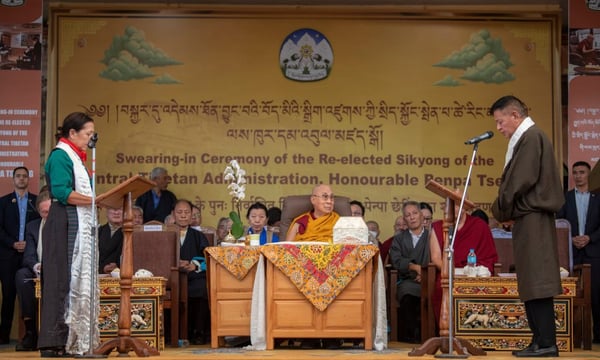
On May 27, Penpa Tsering, who was re-elected in the election held by the Tibetan exile community, was sworn in for a new term as Sikyong of the Central Tibetan Administration (CTA).
Formal Sino-Tibetan dialogue has remained stalled since January 2010. Although Penpa Tsering’s re-election may not open a new window for formal negotiations with Beijing, it reveals a deeper historical turning point facing the Tibetan movement: whether Tibetan exile politics can transform a political cause long dependent on the personal moral authority of the Dalai Lama into one sustained by institutional continuity.
The CTA’s elections are usually viewed as a democratic practice within the exile community or as a symbolic protest against Beijing’s rule in Tibet. But what these elections actually test is whether a political community without statehood and territorial sovereignty can maintain its legitimacy through procedures, representation, and transnational participation.
From a Movement Centered on a Spiritual Leader to an Institutional Movement
For decades, the visibility of the Tibetan issue in international politics has depended heavily on the spiritual stature of the Dalai Lama. He has been both a religious leader and a moral symbol. He has unified the exile community while translating the Tibetan question into the language of nonviolence, human rights, and religious freedom familiar to the international community. It is precisely this spiritual leadership that has allowed the Tibetan movement to retain international attention for so long, despite the absence of statehood or formal diplomatic recognition.
But as the post-Dalai Lama era approaches, the question is not only who will confirm the next reincarnation of the Dalai Lama, but also who will maintain the coherence of the Tibetan movement when religious authority, political representation, and international recognition are contested by different forces. Beijing certainly knows this. For the Chinese government, the Dalai Lama’s reincarnation is a good opportunity for state power to enter the institutional structure of Tibetan Buddhism. In 2007, China’s State Administration for Religious Affairs issued the Measures on the Management of the Reincarnation of Living Buddhas of Tibetan Buddhism, requiring reincarnations of living Buddhas to go through application and approval procedures, with review and approval by religious affairs departments from the local to provincial or autonomous-region levels. This means that Beijing has long sought to transform the reincarnation issue from Tibet’s internal religious process into part of national administrative management.
For the Tibetan exile community, the reincarnation issue involves religious continuity, national identity, political representation, and the future of the international movement. However, once Beijing and the exile community develop competing narratives over reincarnation, the international community, even if sympathetic to the exile position, may find it difficult to intervene directly in judgments over religious legitimacy. Many countries may continue to express concern over human rights and religious freedom while avoiding open involvement in disputes over who is the “true” reincarnated child. Hence, whether the Tibetan movement can continue to maintain cohesion will increasingly depend on the institutions of the CTA.
In this sense, elections of an exile community are not ordinary political activities, but an institutional rehearsal for the upcoming post-Dalai Lama era. Penpa Tsering’s new five-year term is the fourth direct election of the Tibetan exile leadership since the Dalai Lama formally ended his role in administrative governance in 2011. The 2025-26 Tibetan exile elections also included elections for the 18th Tibetan Parliament-in-Exile, with preliminary and final rounds held on February 1 and April 26, 2026, respectively, and voting spanning 27 countries.
For a political community without statehood, this kind of transnational electoral procedure per se is evidence of institutionalized political existence. Although it cannot replace the spiritual leadership of the Dalai Lama, it can ensure exile politics continues functioning.
This is also where the deeper significance of Penpa Tsering’s second term lies. His task is to help the Tibetan movement complete a difficult transformation of institutional authority: from global moral mobilization dependent on a spiritual leader to a long-term political presence sustained by institutions, procedures, representation, and transnational networks. For an exile community, institutional continuity itself is a political resource.
The Value of the “Middle Way”
Penpa Tsering’s continued emphasis on the “Middle Way Approach” is regarded as a moderate position. Instead of advocating Tibetan independence, it seeks genuine autonomy within the framework of Beijing’s political control. The strategic value of the “Middle Way” exists in increasing the translatability of Tibetan claims within the international system. It allows the Tibetan movement to be rearticulated in different political contexts. In Washington, Tibet can be framed as human rights, religious freedom, and minority rights. In New Delhi, it can be outlined as a sensitive variable and strategic buffer in relations with China. In Europe, it can be incorporated into frameworks of cultural preservation, minority rights, and transnational repression.
This translatability is the key to the long survival of the “Middle Way” strategy, allowing the international community to support Tibetan autonomy, culture, and religious rights without bearing the diplomatic cost of recognizing Tibetan independence. In other words, the “Middle Way” strategy is not only a negotiating posture toward Beijing, but also a political language directed at the international community.
This also explains why, despite the long stagnation of Sino-Tibetan dialogue, the “Middle Way” strategy has not completely lost its function. In terms of negotiation, it may be temporarily ineffective, since Beijing has shown no willingness to restart substantive dialogue. But in terms of international mobilization, it remains effective. It preserves a form of political expression for the Tibetan movement that can be accepted by democratic states, mobilized by human rights organizations, and cautiously accommodated by India.
Dharamshala as a Managed Political Space
India’s role is especially delicate. The CTA is based in Dharamshala, and the Dalai Lama has long resided in India. This makes India the most important provider of space for Tibetan exile politics, religion, and cultural life. The existence of Dharamshala shows that sovereignty politics does not operate only through formal diplomatic recognition, but also through decisions about who is allowed to organize, who is allowed to speak, who is allowed to hold elections, who is allowed to preserve archives, and who is allowed to maintain institutions.
Although India has not granted the CTA formal government status, it allows it to maintain administrative institutions, hold elections, continue educational and religious networks, and maintain contact with the international community from Indian territory. This contradiction is the core of India’s policy: although New Delhi officially recognizes Tibet as part of China, it continues to host the Tibetan exile administrative system in Dharamshala.
This arrangement per se is a managed political space. It allows Tibetan exile politics to continue existing while also allowing New Delhi to preserve room to manage the risks of China-India relations. Although this space will not change China’s actual control over Tibet, it will continue to prevent the Tibetan issue from being fully absorbed into Beijing’s sovereignty narrative. As long as Dharamshala continues to exist, the Tibetan issue will remain shaped by the interaction of a transnational community, religious authority, international advocacy, and regional politics.
This is the dual meaning of political activity in Dharamshala. For Tibetans in exile, it is the hub of institutional continuity and identity preservation. For India, it is a political space with both moral and strategic significance. New Delhi may not openly use the Tibetan issue as a tool against Beijing, but as China-India competition continues over borders, security, trade, and regional influence, the Tibetan community, the Dalai Lama’s religious leadership, and the political controversies that may arise from the future reincarnation issue all make it impossible for India to remain detached.
As the post-Dalai Lama era approaches, Dharamshala will become a key site for determining whether Tibetan exile institutions can endure, how religious autonomy will be understood by the international community, and how China-India relations will manage the Tibetan variable.
In the future, the key question is whether the CTA can maintain political cohesion and international visibility after the Dalai Lama. More specifically, it will need to respond to Beijing’s intervention in the reincarnation narrative, keep younger generations of Tibetans in exile politically engaged, and prevent the Tibetan issue from being marginalized amid a growing number of global crises.
In this sense, Penpa Tsering’s second term is not merely a continuation of his personal political career. It is also a stress test of the institutionalizing capacity of Tibetan exile politics. The message it sends to the world is that the Tibetan issue remains a political issue that continues to exist through institutions, memory, transnational networks, and international norms.
In the post-Dalai Lama era, the most important challenge is how to make the Tibetan movement continue through strong institutions.