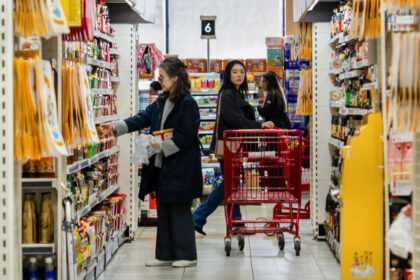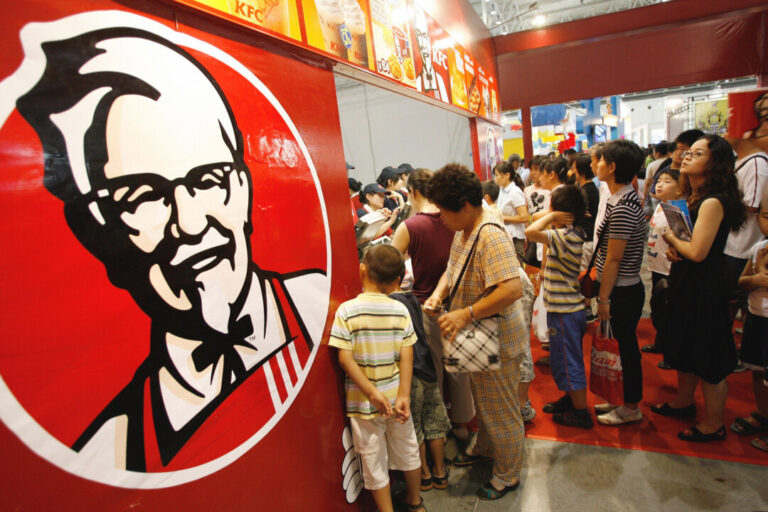
KFC China’s sales have jumped because of China’s booming delivery business during a persistent sluggish economy. Analysts said that this is a paradox that shows a weak economy under pressure in multiple areas and that the growth of KFC and other similar businesses in China is built upon the final extraction of China’s cheap labor and will soon be restrained by internal purchasing power shrinkage.
Delivery sales at KFC China grew by 33 percent year-on-year and contributed about 55 percent of total sales in the first quarter, up from 43 percent last year, according to its parent company Yum China’s report released on April 29.
Spun off from the U.S.-based Yum! Brands, Yum China is dual-listed company that holds the exclusive operating rights in mainland China for American fast-food brands such as KFC and Pizza Hut; as such, it is required to pay royalties to Yum! Brands. It’s the largest restaurant company in China, operating more than 18,000 restaurants, primarily KFC and Pizza Hut.
In addition to KFC’s sales, Pizza Hut’s delivery sales grew by 25 percent year-over-year, accounting for about 51 percent of Pizza Hut’s total sales, up from the 42 percent in the same period last year.
Although the deliveries drove up sales, they squeeze profit margins because Yum China subsidizes them in an arrangement with the online food delivery platforms in China. The company said that margins would have shrunk by 190 basis points because of higher costs paid to delivery riders, but about half of the margin impact was mitigated through improvements to store operations elsewhere.
Food delivery has been a huge business in China in recent years. It has become intensely competitive over the past year as China’s sluggish economy persists, and e-commerce giants aggressively pursue market share by offering coupons and discounts on products across menus. Chinese regulators implemented restrictions on the subsidies offered by the food delivery platforms and some extreme sales measures.
Who Is Buying the Food?
In recent years, the Chinese economy has been mired in a real estate market collapse, shrinking domestic demand, a persistent high unemployment rate, trade frictions with the West, and geopolitical tensions, which stem from the Chinese communist regime’s fundamental structural issues and its increasingly aggressive foreign policies.
The real economy in China is seeing more and more restaurants and stores close down or become empty. Yet the food delivery sector is booming.
Reports in the media have documented Chinese people across the board—from new college graduates to middle-aged white collar workers to actors—who can’t find employment or lost their jobs and have become food delivery riders as a last resort to make a living. Amid falling pay rates and what they described as exploitative platform practices, some food delivery riders have also staged protests.
The massive surge in food delivery services in China is the result of a complex interplay involving consumption downgrading, platform subsidies, employment pressures, and the pace of urban life, Sun Kuo-hsiang, a professor of international affairs and business at Nanhua University in Taiwan, told The Epoch Times.
“This does not necessarily signify that the Chinese economy is in robust health; rather, it appears to be a novel form of low-cost economic cycle emerging under economic pressures,” he said.
The fact that many people are ordering food delivery is not a symbol of a high “standard of living” but is rather for “mere subsistence,” the commodification of life itself, Davy J. Wong, a U.S.-based independent political economist, told The Epoch Times.
China’s food delivery boom is sustained not by the wealthy, but by working people—those who have not yet lost their jobs but are utterly exhausted and trapped in a spiral of existential involution, such as the “996” demographic in the IT and related sectors who work from 9 a.m. to 9 p.m. six days a week, Wong said.
“When people lack the funds to dine out and pay the premium for restaurant service, food delivery becomes the cheapest means of sustaining life,” he said.
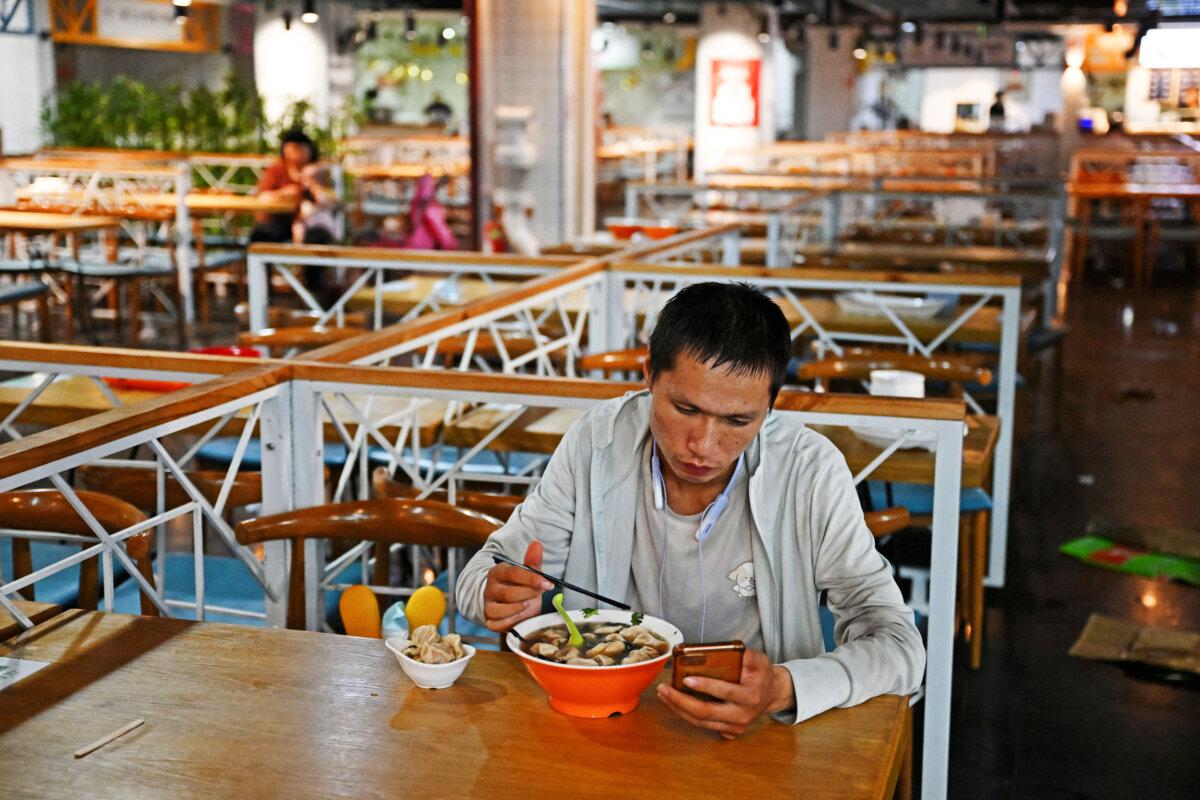
A man checks his phone while eating in a food court at a mall in Beijing on Aug. 15, 2023. Greg Baker/AFP via Getty Images
“This does not represent ‘consumption upgrading,’ but rather a textbook example of the ‘substitution effect’—trading one’s health and quality of life for the sake of productivity.”
“The massive wave of food delivery we are witnessing in China is not a source of fresh economic vitality, but rather the peripheral circulation of a stagnant, stock-based economy,” Wong said.
Sun said that the primary consumers of food delivery services are urban residents who, while maintaining a stable income, have become more cautious in their spending.
“This demographic includes white-collar workers, students, young professionals, single renters, those who frequently work overtime, small families, and certain city dwellers who simply prefer not to cook—particularly those residing in big cities,” he said.
He said that subsidies provided by food delivery platforms play a crucial role in attracting individuals who might otherwise not have ordered delivery, while also creating the appearance of robust order volume.
Wong pointed out that the profit growth enjoyed by KFC China and the like is built upon the final extraction of the “demographic dividend,” cheap labor in China.
A massive influx of unemployed university graduates and white-collar workers into the food delivery sector has driven delivery costs down to the absolute limit, he said.
“Even more critically, platforms operating through collusion between business and government are utilizing algorithms to ruthlessly exploit workers to the breaking point,” he said.
The explosive boom in food delivery services in China is, “in essence, a mechanism that exploits the cheap physical labor to serve employed workers who are themselves trapped in a different form of exploitative involution,” Wong said.
“It is a vicious cycle in which those at the bottom of the social hierarchy end up harming one another,” he said.

A food delivery worker rides his bike amid snow at a residential compound in Beijing on Feb. 6, 2020. Reuters
As consumer spending undergoes severe downgrading—to the point that even a 19.9-yuan ($2.91) bucket meal begins to seem expensive—this delivery-fueled prosperity will inevitably crash because of internal purchasing power limitations, he said.
The Chinese economy is currently exhibiting a classic paradox, Sun said.
“Overall confidence is weak, yet everyday essential demand persists,” he said. “High-end consumption is sluggish, while budget-friendly chain brands are thriving. White-collar workers are anxious about their incomes, yet they will still purchase a discounted cup of coffee. A significant number of people are unemployed, yet digital platforms are able to transform this surplus labor into a readily available supply of riders.
“Consequently, the fact that American dining brands are turning a profit does not signify that the Chinese economy is all right; rather, it indicates that they have successfully capitalized on the demand for low-cost convenience that remains even amidst consumption downgrading in China.”
Identity Ambiguity
The identity of KFC China, Pizza Hut China, and the like is blurred because they are run by Yum China.
Wong said that the ambiguity in their identity has built legal and financial firewalls for these companies to operate in China in an attempt to mitigate risks, especially those that stem from geopolitical tensions.
Yum China’s spin-off from Yum! Brands to list as an independent entity is known as “risk isolation,” Wong said. Should extreme sanctions erupt between China and the United States, the U.S. parent company would stand to lose only its “royalty fees,” rather than the entirety of its physical assets within the Chinese market, he said.
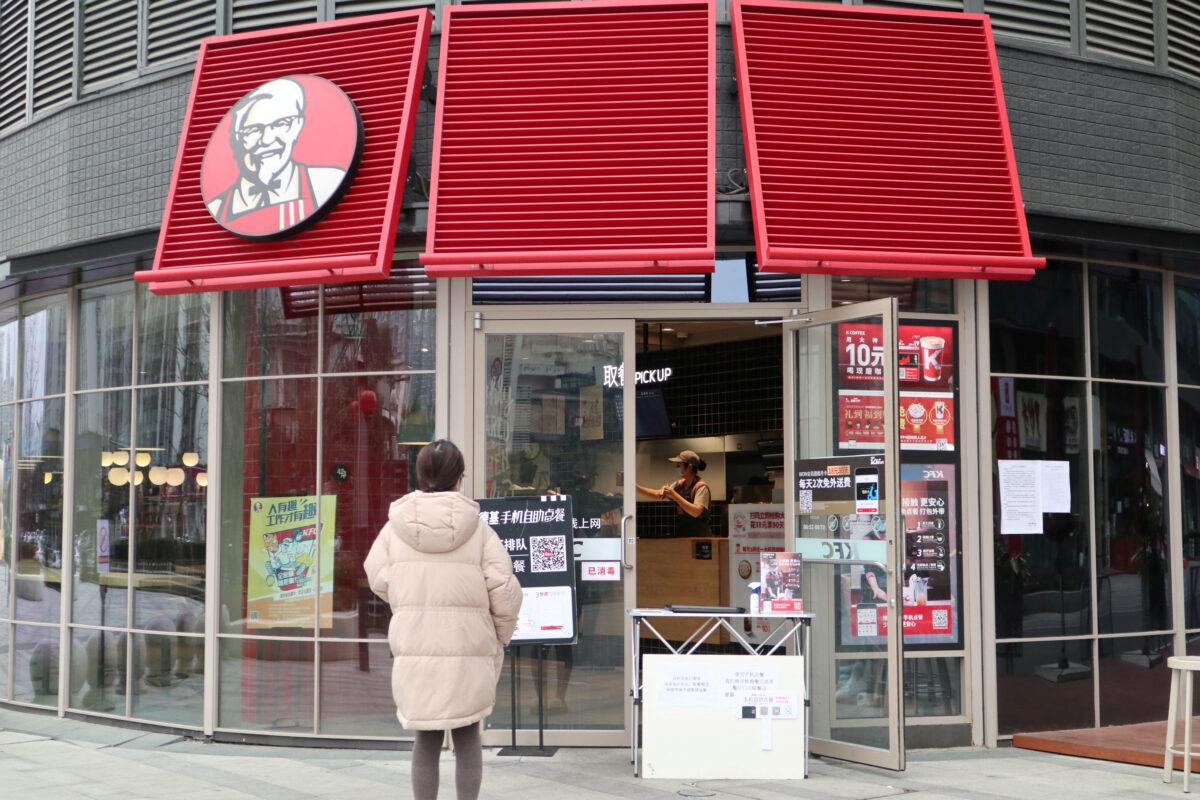
A customer waits to pick up her order outside a KFC restaurant in Chengdu, Sichuan Province, China, on Feb. 14, 2020. cnsphoto via Reuters
It now operates as a homegrown Chinese enterprise—“managed by Chinese nationals, listed in New York, and paying licensing fees for an American brand,” he said.
“This hybrid identity allows it to position itself as a ‘major local employer’ when China’s nationalist sentiments run high, while simultaneously maintaining the image of an ‘American brand’ when seeking a market premium,” he said.
The identity ambiguity helped such companies successfully sidestep most of the risks associated with a hard decoupling between China and the United States, Wong said.
“However, it could not escape the squeeze on its gross margins,” he said. “When forced to wage a price war against local Chinese brands selling for just 9.9 yuan ($1.45), its American heritage—ironically—became a costly ‘brand burden.’”
Still Expanding
Leveraging the “Gemini” model—a dual-brand combination featuring KFC and Pizza Hut—Yum China opened nearly 80 new stores during the quarter, primarily operated by franchisees in lower-tier cities, according to the company’s report.
Meanwhile, in order to expand business in China, Starbucks signed a deal in early April with Chinese company Boyu, whose founders include the grandson of former Chinese Communist Party (CCP) leader Jiang Zemin. According to the deal, Boyu will hold a 60 percent stake in Starbucks stores in China, while Starbucks will retain the remainder and will continue to license the brand and intellectual property to the venture, Starbucks announced.
These companies’ expansion in China represents a gamble—specifically, a bet on the final harvest of the “existing market” and on the efficacy of “political insurance,” Wong said.
It’s counter-cyclical expansion—or “bottom fishing.” With commercial office rents in China sitting at historic lows, this presents a prime opportunity for cash-rich giants such as Starbucks and KFC to “secure prime locations at minimal cost,” Wong said. The strategy is to outlast and eliminate competitors as long as “they achieve sufficient scale to drive their operational costs even lower than that of small local brands,” he said.
Meanwhile, foreign enterprises are forging deep alliances with local entities that possess significant political clout, thereby securing a form of “immunity” amid the turbulence of policy shifts, he said.
Future of Delivery Boom
The massive wave of food delivery is likely to unfold in three distinct stages, Sun said.
“The first stage is the ‘subsidized expansion’ phase, during which platforms burn through capital to acquire customers, onboard merchants, and secure delivery capacity,” he said.
“The second stage is the ‘low-price normalization’ phase: Consumers have now become accustomed to food delivery, yet the average order value declines, and merchant profit margins begin to thin.
“The third stage is the ‘consolidation and regulation’ phase, characterized by platforms scaling back subsidies, raising commission rates or service fees, and weeding out smaller merchants—a period during which the income of delivery riders will also become increasingly unstable.”
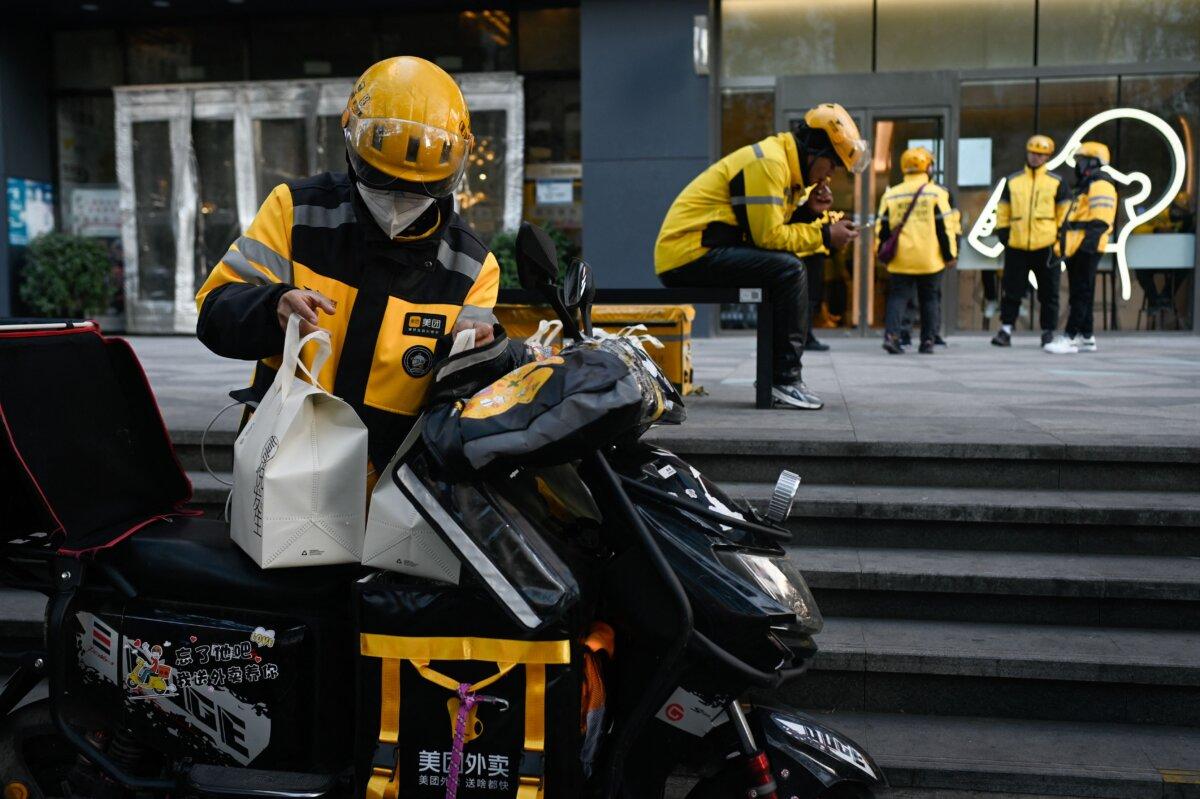
A group of delivery men of Meituan prepare to deliver food in Beijing on Nov. 16, 2023. Wang Zhao/AFP via Getty Images
Sun concluded that the food delivery sector will stay but that its capacity to sustain an ever-growing unemployed population will decline.
The bubble will burst, Wong said, “when platforms cease providing subsidies; when the unemployed become so destitute that they can no longer afford to work as delivery drivers (whether due to a lack of funds to rent an electric scooter or treat illness, or other factors), or when this ‘mobile workforce’ is incorporated into the CCP’s political management system—such as the establishment of Party branches within delivery services—thereby causing operational costs to skyrocket.”
Luo Ya and Reuters contributed to this report.
Correction: A previous version of this article misspelled economist Davy J. Wong’s name in one instance. The Epoch Times regrets the error.