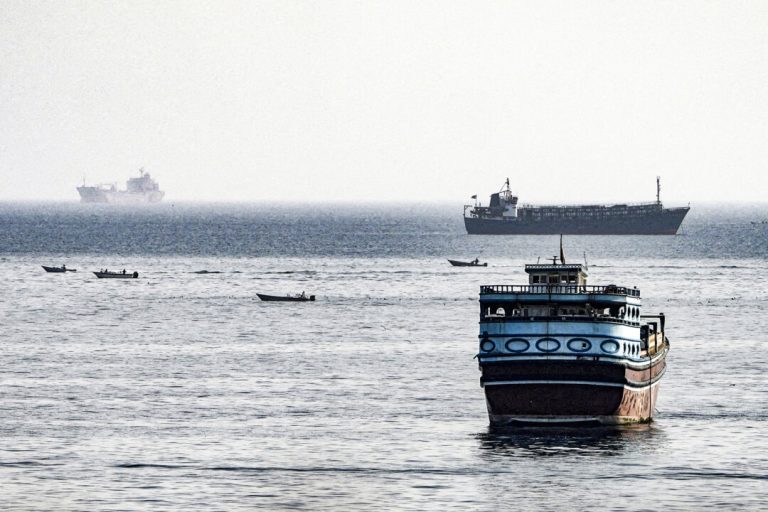

Vessels in the Strait of Hormuz, as seen from Musandam, Oman, on Aug. 3, 2026. STR/Reuters
Iran and Oman are in the final stages of establishing a new maritime route in the Strait of Hormuz, but the Iranian regime insisted that the waterway won’t reopen until the United States agrees to six demands.
“Talks with Oman do not mean the Strait of Hormuz will be reopened,” Iranian Foreign Minister Abbas Araqchi said on Sunday, according to state-run media. “An agreement may be reached, but reopening the strait depends on other conditions conveyed through intermediaries.”
The Iranian regime threatened on Saturday to keep the strait closed until the United States agreed to comply with a list of six demands, which include ending its strikes, stopping its naval blockade, and lifting sanctions.
Despite progress with Oman, Iran denied that peace talks were underway with the United States in a statement released by state media on Aug. 9.
“We are not currently engaged in negotiations with the U.S., but messages are being exchanged through intermediaries,” Araqchi said.
Araqchi said “negotiations cannot resume until the U.S. ends its violation of the Islamabad MoU and takes steps to make up for the violations it has committed.”
The foreign minister is referring to the interim framework agreement between Iran and the United States that collapsed in July, causing U.S. President Donald Trump to order forces to restart the naval blockade of maritime traffic entering and exiting Iranian ports.
On Aug. 3, Trump told reporters in the Oval Office that talks to end the war were “going on right now.”
“This is a last chance for them [Iran] to sign a good document,” Trump warned.
The United States has not publicly responded to the Iranian regime’s list of conditions revealed by Iran’s Supreme National Security Council secretary Mohammad-Bagher Zolghadr on Saturday.
The Epoch Times contacted the White House for comment but did not hear back by time of publication.
The Strait of Hormuz was previously used to transport one-fifth of the world’s traded oil before the war with Iran heavily slowed operations beginning on Feb. 28.
Since the conflict began, use of the crucial waterway has been plagued with uncertainty as the Iranian regime has targeted commercial vessels passing through it.
The military operations that have disrupted the oil and gas industry caused prices at the pump to surge across the world, including in the United States, where the average price for a regular gallon of gas in America rose by roughly an additional $1.
As of Aug. 9, the average price for a gallon of gas was $4.01, according to the American Automobile Association. The same gallon cost $2.98 before the conflict started in late February.
Trump has promised that gas prices will drop significantly when the war ends. The U.S. Energy Information Administration predicts gas prices won’t drop to pre-war levels in 2026 or 2027.
Reuters contributed to this report.