Commentary
By cancelling Shen Yun’s remaining shows in response to what police deemed “non-credible threats,” Toronto’s Four Seasons Centre for the Performing Arts—a partially publicly funded institution built on land donated by the province of Ontario and with public funds from all three levels of government—has handed Beijing proof that transnational intimidation is effective on Canadian soil.
Shen Yun, a New York-based performing arts company celebrating its 20th anniversary of reviving classical Chinese dance and culture, has received more than 150 similar bomb threats over the years on its global tours, including one made to the Living Arts Centre in Mississauga on March 15 that resulted in a delayed performance. Mounting evidence compiled by the Falun Dafa Information Center points to the Chinese Communist Party and its proxies as the source of these anonymous threats—a long-standing pattern consistent with the Beijing regime’s history of systematically destroying traditional art and culture.
The unprecedented decision by the Four Seasons Centre to cancel Shen Yun’s shows marks the first time a venue has denied ticket holders the chance to see these professional artists take the stage. This extreme move shut down Shen Yun’s longest-scheduled run in Canada this year. So why was such a drastic decision made, contrary to the Toronto Police Services’ assessment that there was no bomb, denying thousands of ticket holders the ability to watch the show and disrupting months of planning?
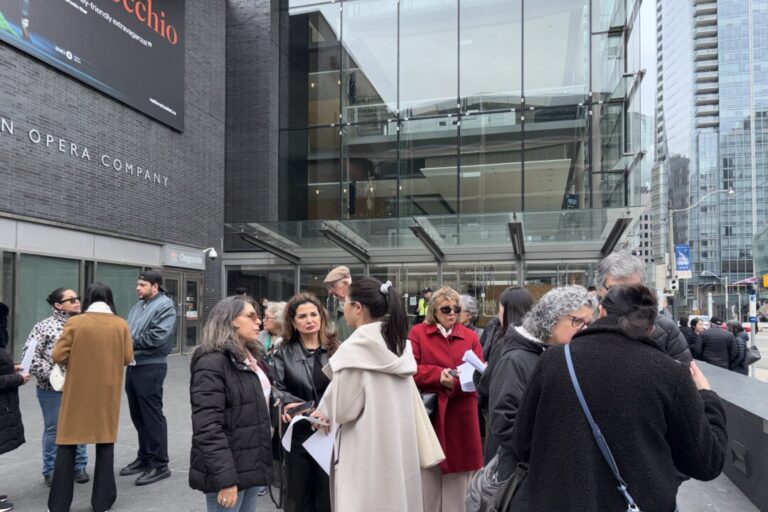
On Sunday, March 29, approximately an hour before showtime, emails written in Swedish were received by staff at the Four Seasons Centre claiming that “many explosive devices have been placed at the Four Seasons Theatre and Parliament Hill in Canada. If the Shen Yun performance is not cancelled and continues to be shown, explosions are planned at Parliament Hill and the Four Seasons Theater.” Local police bomb squads and K9 units arrived and searched the venue and subsequently declared the threat as being unfounded. Yet a decision was made not to let people back inside the theatre. A notice posted at the entrance said: “We regret to inform you that Today’s 2pm Performance of Shen Yun has been cancelled.”
Following Sunday’s cancelled show, it was said that more security and pre-emptive sweeps would be performed to ensure the venue remained safe for the five remaining performances. Yet a day later, the Four Seasons Centre extended the cancellation to all five remaining performances after reporting additional bomb threats—threats that Toronto police also investigated and deemed unfounded.
A similar threat took place in Australia in February. A bomb threat sent by email in Chinese to the venue hosting Shen Yun performances also threatened Australian Prime Minister Anthony Albanese if Shen Yun was not cancelled. The threats in Toronto targeted the Four Seasons Centre and Parliament Hill. By including both Parliament Hill and the theatre, the perpetrator intentionally split the threat across federal and local jurisdictions to amplify the psychological pressure on the venue and complicate the reaction.
The administrators of the Four Seasons Centre have a duty of care to patrons and staff. No one wants to be wrong about a threat. Ensuring that the venue is safe and avoiding liability is a perfectly rational instinct, which is exactly what police clearance addresses. If this is the first time the Four Seasons Centre has received such a threat, caution and vigilance are natural in weighing the risks. As the old saying goes, “It’s better to be safe than sorry.” But given the repeated pattern of threats targeting Shen Yun, an overabundance of caution is exactly the reaction the perpetrators are aiming for.
Independent institutions are what give us strength in a democracy. When a bomb threat targets artistic freedom of expression, it is the duty of the venue to cooperate with local police authorities to ensure safety. The Four Seasons was surely under intense pressure and experiencing fear. But that is where totalitarian regimes exploit fear and use safety concerns to squash freedom. The CCP has a long history and tremendous experience in destroying traditional art and culture. It understands and exploits the vulnerabilities and weaknesses of Western institutions through violent pressure tactics.
If Toronto police determined that the venue was safe and the threat was groundless—and the same pattern had happened repeatedly at other theatres—why would the Four Seasons Centre insist on cancelling all remaining shows, contrary to the assessment of public safety experts? It is understandable that officials would want to err on the side of caution. But ultimately, assessing a bomb threat is the duty and responsibility of local police authorities. Trust and cooperation between institutions is essential to a functioning democracy.
The reaction of the Four Seasons Centre sends the perpetrators a clear signal: If they send enough hoax threats, eventually one theatre or another will cancel the performances. The outcome in Toronto shows this tactic has now been elevated into a hostile weapon—one that can close the doors of a public venue and leave ticket holders standing outside in the cold.
The battle for free expression, which has always been fought in the public square, is now happening behind closed doors, shutting the public out by targeting institutions with sophisticated pressure tactics. This is straight from the CCP’s playbook: using corrosive intimidation to suppress traditional Chinese culture, which it has long sought to destroy.
Faced with these fake threats, venues should recognize them for what they are: fear and intimidation with the aim to cause disruption. In dealing with these cowardly threats, it is important to respond with calm resolve and support from local authorities. It is times like these that test our institutions’ courage and confidence. The authoritarian Chinese regime bent on stopping Shen Yun must not be allowed to succeed and its tactics must be exposed. Otherwise, it will only continue, refine its approach, and escalate the intimidation.
Venues facing fake bomb threats should stand with Shen Yun and the police to ensure the performances go forward, and that such beautiful and uplifting art can continue to be seen in these troubled times. If publicly funded Canadian institutions will not hold the line against the CCP’s transnational repression—even after police have deemed the threat as empty—who will be targeted next?
Views expressed in this article are opinions of the author and do not necessarily reflect the views of The Epoch Times.