Sales by German automakers in China plummeted in the second quarter, according to the latest data. Analysts told The Epoch Times that multiple factors were involved, including consumption downgrading in a slowing Chinese economy and the Chinese regime’s industrial policies and subsidies.
Data released last week show that sales of Volkswagen, Mercedes-Benz, and BMW in China all dropped by at least 30 percent year over year during the quarter from April to June.
BMW deliveries in China plummeted by about 30.2 percent year over year in the second quarter. In the first half of the year, BMW delivered approximately 1.15 million vehicles globally—a decline of more than 4 percent from last year.
Mercedes-Benz reported a 30 percent sales drop in China in the quarter. Mercedes-Benz Group sold 417,800 cars in the second quarter of 2026 globally, an 8 percent decline, as gains in Europe and North America failed to offset a 30 percent drop in China.
Volkswagen reported on July 10 the steepest decline, at 36.6 percent.
“The situation remains challenging in China, where we were unable to escape the overall market decline of around 20 percent, despite initial positive momentum from our newly launched, locally developed electric vehicles there,” Volkswagen sales executive Marco Schubert said.
Meanwhile, Porsche reported a 32 percent drop in China deliveries to 14,501 cars in the first half of 2026, while globally the company reported a 16 percent decline.
Volkswagen announced a massive restructuring plan that could result in the loss of up to 100,000 jobs. The overhaul includes cutting its model lineup by as much as 50 percent to address challenges such as its declining position in the Chinese market, rising costs, and sluggish electric-vehicle sales.
The significant decline of German car sales in China resulted from the combined pressure of “distortions caused by the politicization of industry” and a “macroeconomic stall,” with the deterioration of the macro environment in China serving as the fundamental trigger, Davy J. Wong, a U.S.-based independent political economist, told The Epoch Times.
“It is a direct manifestation of the bursting of asset bubbles among the wealthy class in China,” he said.
German luxury cars used to be a status symbol in China, he said.
“When the economy slowed down and assets shrank, the first thing the middle class would cut was non-essential consumption such as luxury cars,” he said.
The Chinese market has shifted from combustion engines, mechanical quality, and brand prestige toward electric vehicles, intelligent cockpits, software, driver-assistance systems, and rapid product renewal, Sun Kuo-hsiang, a professor of international affairs and business at Nanhua University in Taiwan, told The Epoch Times.
Affordable Chinese battery-electric and plug-in hybrid vehicles are increasingly attracting consumers who might previously have bought Volkswagen, BMW, or Mercedes-Benz models, Sun said.
German automakers are competing not merely against “cheap Chinese cars,” but against vehicles offering more digital features at lower prices, Sun said.
“China’s weak economy and greater consumer emphasis on value for money have further accelerated this shift,” he said.
“China’s slowdown has reduced the size of the market, while technological transition and stronger Chinese brands have magnified the decline of German automakers.”
The rapid expansion of China’s electric vehicles and plug-in hybrid vehicles sectors is by no means the result of normal market competition, Wong said; rather, it is “a political gamble—fueled by distorted tax policies and administrative interventions—in which the Chinese regime exploited the low barriers to entry in this field to achieve ‘overtaking on the curve’ through technological fraud and at the cost of safety.”
The Chinese regime’s institutional “stranglehold” on imported cars is that the “three major taxes” of tariffs, consumption tax, and value-added tax imposed by the ruling Chinese Communist Party (CCP) on imported fuel vehicles are “extremely harsh” and directly strangle the profit margins of imported car companies, Wong said.
The authorities have imposed strict administrative restrictions on the licensing of fuel vehicles in major Chinese cities, but have provided subsidies for domestic electric vehicles.
“It is not a choice driven by the free market, but rather a distorted prosperity resulting from the convergence of high-pressure policies and a trend of consumption downgrading,” Wong said of the Chinese EV sector.
Trade Frictions
The European Union (EU) imposed provisional tariffs of up to 35 percent in late 2024, in addition to the existing 10 percent, on electric vehicles imported from China, in response to the Chinese regime’s massive subsidies for the EV industry.
The EU’s imposition of anti-dumping duties on Chinese electric vehicles has triggered targeted administrative retaliation from Beijing, such as anti-dumping investigations into European large-engine internal combustion engine vehicles and pork.
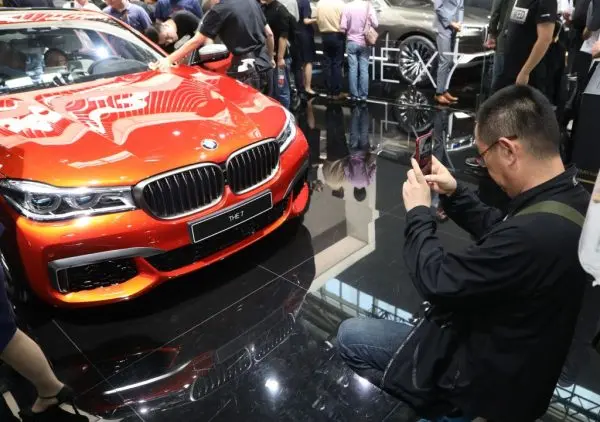
A man takes a photo of a BMW 7 at the Beijing auto show on April 27, 2018. AFP/Getty Images
This dealt a direct blow to Germany’s core interests—specifically, the large-displacement luxury vehicle lineups of brands such as Mercedes-Benz and BMW, Wong said.
“To circumvent trade barriers, however, German companies such as Volkswagen and BMW did not withdraw their capital; instead, they ramped up investment and joint ventures within China,” he said.
Therefore, the nature of Sino-German trade has shifted: It has evolved from the past model of “Germany exporting complete vehicles to China” to one where “German capital establishes closed-loop supply chains within China,” Wong said.
“While this model has secured the Chinese market, it no longer generates jobs or export revenue for Germany itself, leading to a further hollowing out of the domestic German economy,” he noted.
German–China Relations
China remains one of Germany’s largest trading partners, and approximately 5,000 German companies operate there.
During his February 2026 visit to China, German Chancellor Friedrich Merz called for deeper strategic cooperation while also raising concerns about Chinese overcapacity, unequal market access, subsidies, and supply-chain dependence.
Relations between Germany and the Chinese regime remain functional, but political and economic trust is considerably weaker than during the Angela Merkel era, Sun said.
“Between Washington and Beijing, Germany is clearly closer to the United States in security, political, and institutional terms, because the United States remains Germany’s NATO ally and a central pillar of European security,” he said.
Economically, Germany is pursuing de-risking rather than full decoupling, Sun noted.
“It seeks to reduce dependence on critical minerals, semiconductors, batteries, telecommunications, ports, and strategic infrastructure, while maintaining trade in automobiles, machinery, chemicals, and other commercial sectors,” he said.
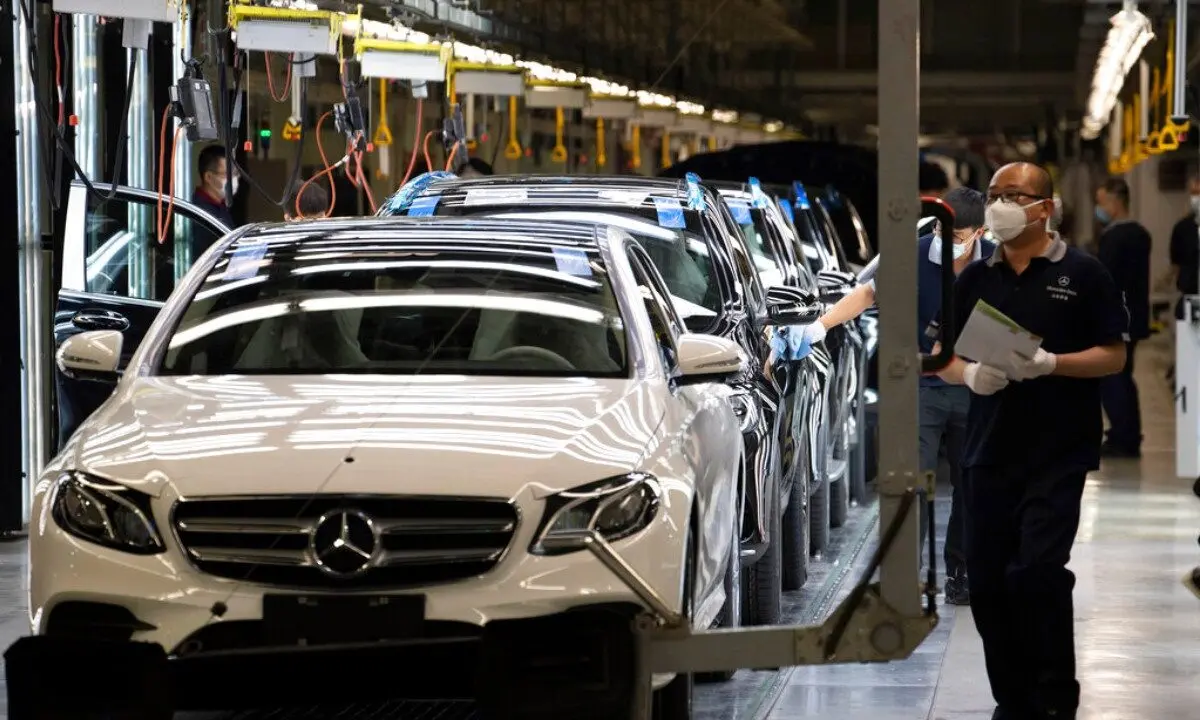
Workers inspect newly assembled cars at a Beijing Benz Automotive Co. factory, a German joint venture company for Mercedes-Benz, in Beijing on May 13, 2020. Ng Han Guan/AP Photo
In the future, Germany may adopt stronger trade defenses if Chinese subsidies, export restrictions, or support for Russia intensify, but comprehensive economic decoupling remains unlikely, Sun said.
Germany finds itself in a state of division, Wong said, “reluctantly realigning with the United States” politically while, economically, “painfully attempting to de-risk.”
“Politically, it follows Washington and Brussels in maintaining a stance of harsh criticism toward the CCP regarding issues such as the South China Sea and the Taiwan Strait,” he said. “Economically, it allows traditional giants in sectors like automotive and chemicals to sink or swim in the Chinese market, yet strictly restricts cooperation with China in core future technologies like semiconductors and AI.”
Luo Ya and Reuters contributed to this report.