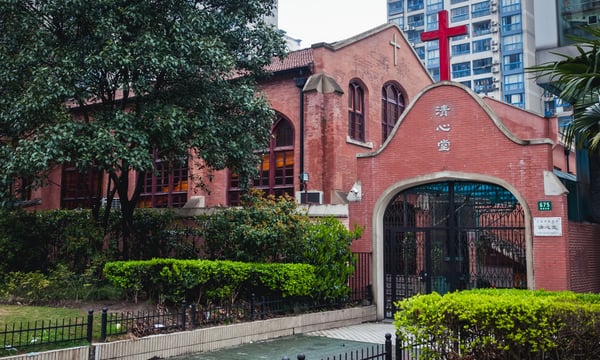
Over the past six months, Beijing has arrested hundreds of leaders and practitioners of Protestant “underground churches,” including Early Rain Covenant Church in Chengdu, Yayang Church in Wenzhou, and Beijing Zion Church, with arrests across several cities. Zion Church pastors have since been charged with “illegally using information networks” and the lawyers representing them are facing threats in a mounting pressure campaign.
The Chinese government has been targeting Protestant underground churches regularly, and yet this could be China’s harshest crackdown on Christianity in years. The current campaign signifies not only the legal vulnerability of these groups, but also the persistent social appeal of worshipping outside of state oversight and the expanding campaigns of state repression and assimilation.
While nine in ten, or about 1.3 billion, Chinese people say they are religiously unaffiliated, there are thought to be 40 million Protestants, forming the vast majority of China’s Christian population. According to estimates, followers of unofficial churches count in the hundreds of thousands, although their secret nature makes calculations difficult. Their organizing often happens in broad daylight, at unofficial spaces of prayer in Beijing and other cities – right under the nose of Chinese authorities.
The Chinese Communist Party (CCP) introduced official control of religion immediately after founding the People’s Republic, and since then it has repressed groups that refuse to compromise their faith by accepting state-approved forms of worship. This repression peaked during the Cultural Revolution and eased in the reform era of the 1980s and 1990s. Now efforts to exert political and ideological control over religious groups have intensified again under Xi Jinping.
Xi popularized the term “religious Sinicization” (宗教中国化) and mobilized official resources and state personnel to enforce it. Over the years, the CCP has regularly updated laws and regulations to codify repressive practices, providing a legal basis for persistent waves of incarcerations, disappearances, surveillance, threats and intimidation.
Perhaps the most brutal and best-known examples of crackdowns to eradicate religious practices have occurred in China’s border regions of Xinjiang and Tibet, homelands to the majority of Uyghur Muslims and Tibetan Buddhists who have long been suffering the CCP’s colonial rule and human rights abuses. Such state actions have led to social tensions and localized protests, including violent incidents, in China, as well as sparking international criticism.
From the CCP’s perspective, these efforts have been largely successful. Mainstream religious practices and leaders representing Buddhism, Taoism, Islam, and Protestant and Catholic Christianity have been co-opted under government-led supervisory organs. Xu Xiaohong, the chairman of the National Committee of Three-Self Patriotic Movement of the Protestant Churches in China, once described his oversight responsibility as “the indigenization and contextualization of Christianity in China” to make it “suitable for a socialist society” and purge any “Western influence.”
And yet, the popularity of underground churches is only the most recent example showing that the mission to either incorporate or eradicate – to bend or ban – religious practices that fall outside of party-sanctioned dogma will never be complete. An additional example is the Falun Gong, a spiritual practice that was banned in 1999 after a mass demonstration, and whose members were subjected to a nationwide crackdown. To this day, state authorities reportedly still arrest or harass hundreds of practitioners every year, while the practice has grown into an ultra-conservative movement abroad.
Across the country, between official and illegal practices, a religious gray area encompassing millions of citizens still survives in this repressive environment.
Unofficial religious groups are accustomed to cycles of repression. In 2017, China approved regulations to clamp down on “non-state sanctioned houses of worship.” A year later, the requirement for government approval for public worship reportedly saw a number of groups shut down and others switch to the internet.
Successive hardenings of legal texts culminated in the passing of the Ethnic Unity Law at National People’s Congress in March. Article 46 is dedicated to the role of religion in ethnic assimilation and stipulates that “Religious groups, religious schools and religious activity sites shall … persist in the direction of Sinicization of our nation’s religions, guide religions to adapt to socialist society, guide religious professionals and believers to carry forward the tradition of patriotism, and promote ethnic, religious, and social harmony.”
The CCP’s actions have caused tension with international governments, with the U.S. Senate condemning China’s religious persecution, and the U.S. Commission on International Religious Freedoms calling for China to be designated as a “country of particular concern” and subject to Magnitsky sanctions. International human rights and civil society groups have been equally vocal in calling for religious leaders’ immediate release.
European governments have been quiet on this issue, but recently at the Christian Democratic Union’s party congress, German Chancellor Friedrich Merz raised religious freedom as a core issue in the relationship with China, together with freedom of expression and press freedom. Vague statements, however, should be replaced with firm condemnation of the ongoing crackdown, and stronger pressure on China to abide by international law.