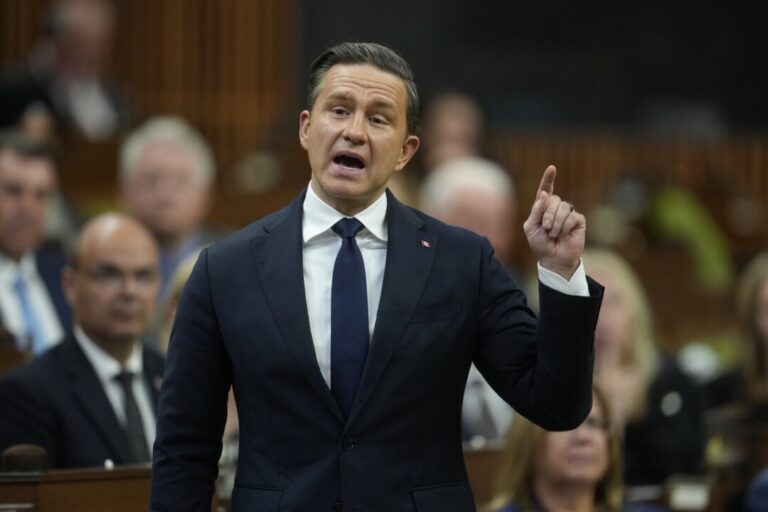

Conservative Leader Pierre Poilievre rises in the House of Commons in Ottawa on Sept. 22, 2026. The Canadian Press/Adrian Wyld
Conservative Leader Pierre Poilievre is proposing tax cuts on diesel, elimination of the industrial carbon tax and Clean Fuel Standard, and measures to expand domestic fuel infrastructure and reserves.
Poilievre said on Sept. 27 that his party’s plan to increase domestic production of diesel and other refined fuels includes emergency pre-permitting for diesel refineries, storage, and transportation; a 100 percent first-year tax deduction for fuel infrastructure investments; and establishment of a strategic refined petroleum reserve.
“The goals are simple: eliminate the price premium Canadians pay, boost diesel production to a million barrels a day and ensure Canadians everywhere have access to Canadian-made diesel,” Poilievre said.
Poilievre cited the average price of diesel on Sept. 21 of $2.74 per litre in Canada, which he said represents a nearly 80 percent year-over-year increase and is 32 cents more than the price in the United States and 41 cents more than the global average.
The current average diesel price means that farmers could pay $15,120 more for fuel for a single combine during this year’s harvest compared to last year, he said, citing an estimate by Grain Growers of Canada.
“When farmers and truckers pay more for diesel, Canadians pay more for groceries,” he said.
While outlining the proposal to reporters at an Ottawa gas station on Sept. 27, Poilievre said his party proposed pursuing national trucking regulations to facilitate fuel shipments between provinces and use federal constitutional powers to approve interprovincial pipelines should there be provincial opposition.
Poilievre also told reporters that Canada should have 18 liquified natural gas (LNG) terminals and called for completing “a dozen LNG facilities in the next five years.”
This was in response to a question about German Foreign Minister Johann Wadephul, during his visit to Canada on Sept. 24 and 25, indicating that Germany wants more Canadian LNG.
“The Germans have been very clear about that for the last decade. They’ve been begging for our natural gas,” Poilievre said.
“The problem is that we only have one LNG liquefaction and export terminal in all of Canada, and that’s on the West Coast, which means it would take about 27 days to get a tanker all the way down through the Panama Canal and all the way back up through the Atlantic to the North Sea and to Germany.”
The Liberal government has expanded its suspension of the excise tax on gasoline and diesel until early 2027.
“This means continued saving of 10 cents per litre on gasoline and unleaded aviation gasoline, and four cents per litre on diesel and aviation fuel,” Finance Minister François-Philippe Champagne said earlier this month, while adding that global conflicts have significantly increased the cost of energy.