
The Chinese communist regime said during its top political meetings—the Two Sessions—that it would build a “childbirth-friendly society” and develop a senior-powered “silver economy” in the next five years.
The Two Sessions refers to the annual plenary sessions of the Chinese People’s Political Consultative Conference and the National People’s Congress, the two houses of China’s rubber-stamp legislature. This year’s Two Sessions are held from March 4 to March 11.
Analysts told The Epoch Times that with the regime’s structural problems unaddressed, it remains impossible to achieve these goals.
In Chinese Premier Li Qiang’s government work report to the National People’s Congress, building a “childbirth-friendly society” was formally listed as an important goal for the next five years.
The National People’s Congress issued its 15th five-year plan as part of the Two Sessions. The plan outlines improving the maternity insurance and leave system, further developing pilot programs for child care service subsidies, and more comprehensive child care services.
Even though the ruling Chinese Communist Party (CCP) abandoned its draconian one-child policy that was forcefully implemented in the country from 1980 to 2015, China’s birth rates have continued to fall. Especially in recent years, China’s birth rate dropped to a record low of 5.63 per 1,000 people in 2025, the fourth consecutive year of population decline and the lowest level since 1949, when the Chinese communist regime was established in mainland China. China’s fertility rate also dropped to about 1.0 in 2025—the lowest in the world. Facing an aging society, the regime has adopted measures such as taxing condoms and birth control pills to encourage Chinese citizens to have children.
China’s population is aging very rapidly, U.S-based China affairs commentator Wang He told The Epoch Times.
“Western countries took 70 or 80 years to reach an aging society, but China has done so in 20 years, largely due to its one-child policy,“ Wang said. ”This has brought about a very serious consequence, which is a devastating blow and shock to all aspects of China.”
Meanwhile, the Chinese economy has been experiencing a prolonged slowdown as a result of its hard zero-COVID policies. During this year’s Two Sessions, the Chinese regime had to lower its gross domestic product target—a rare move.
“One of the problems facing China’s economy now is the accelerating aging population, and another is the declining birth rate, with people not getting married and unwilling to have children,” Wang said.
Under these circumstances, the CCP is pushing out policies to increase the birth rate.
China’s Two Sessions is emphasizing a “childbirth-friendly society” because Beijing now sees demography as an economic and strategic problem, not just a social one, Sun Kuo-hsiang, a professor of international affairs and business at Nanhua University in Taiwan, told The Epoch Times.
“The 2026 government work report links this directly to labor supply, long-term growth, social security pressure, and aging,” Sun said.
However, the policy is unlikely to produce a dramatic baby boom, Sun said. The core problem behind the low birth rate is structural, he said, which includes “weak income expectations, high housing and education costs, unstable employment, late marriage, fewer marriages, and changing social attitudes.”
“Even with subsidies, China’s fertility is around 1 birth per woman—far below replacement level,” he said.
The Chinese public has been very resistant to the CCP’s birth promotion policy, especially after experiencing the regime’s one-child policy, which encroached on citizens’ basic human rights and intruded on the private sphere of their lives, according to Wang.
“Its implementation would require many treaties and a lot of money, which the CCP is unwilling to spend,” he said.
The proposed cash subsidy is an annual subsidy of approximately 3,000 yuan ($435) for children under 3 years old, Wang said.
“In China, raising a child to 18 years old actually requires millions of yuan in living expenses, so this is just a drop in the bucket,“ he said. ”And expecting people to be willing to have children is unrealistic under these circumstances, so this policy will have little effect.”

Workers decorate a Christmas tree as children play in front of a church in Beijing on Nov. 28, 2025. Wang Zhao/AFP
Sun shared a similar assessment.
“The government still has fiscal capacity to fund selected benefits, but the weaker growth target, soft domestic demand, and employment pressure mean it cannot easily build a generous welfare state on the scale needed to transform fertility behavior,” he said. “In other words, Beijing wants more births, but its economic base for sustaining that policy is weaker than in the past.”
‘Silver Economy’
In this year’s government work report, the Chinese regime also pushed for developing a senior-powered “silver economy” by generating economic activity through “support policies for elderly products, elderly finance, senior living and tourism.”
Spending by China’s aged population is expected to reach 30 trillion yuan ($4.35 trillion) by 2035, making up 10 percent of gross domestic product, according to official estimates.
However, the reality is that many people do not receive their pensions or receive very low amounts.
China had about 310 million pensioners older than 60 in 2025, according to public data.
“Among these 310 million people, 180 million are rural residents, whose monthly pension income is about 200 yuan [$29],“ Wang said. ”Li Qiang has increased it by more than 20 yuan [$2.90] this time. This amount is not enough to live on even in rural areas, so they have no purchasing power.”
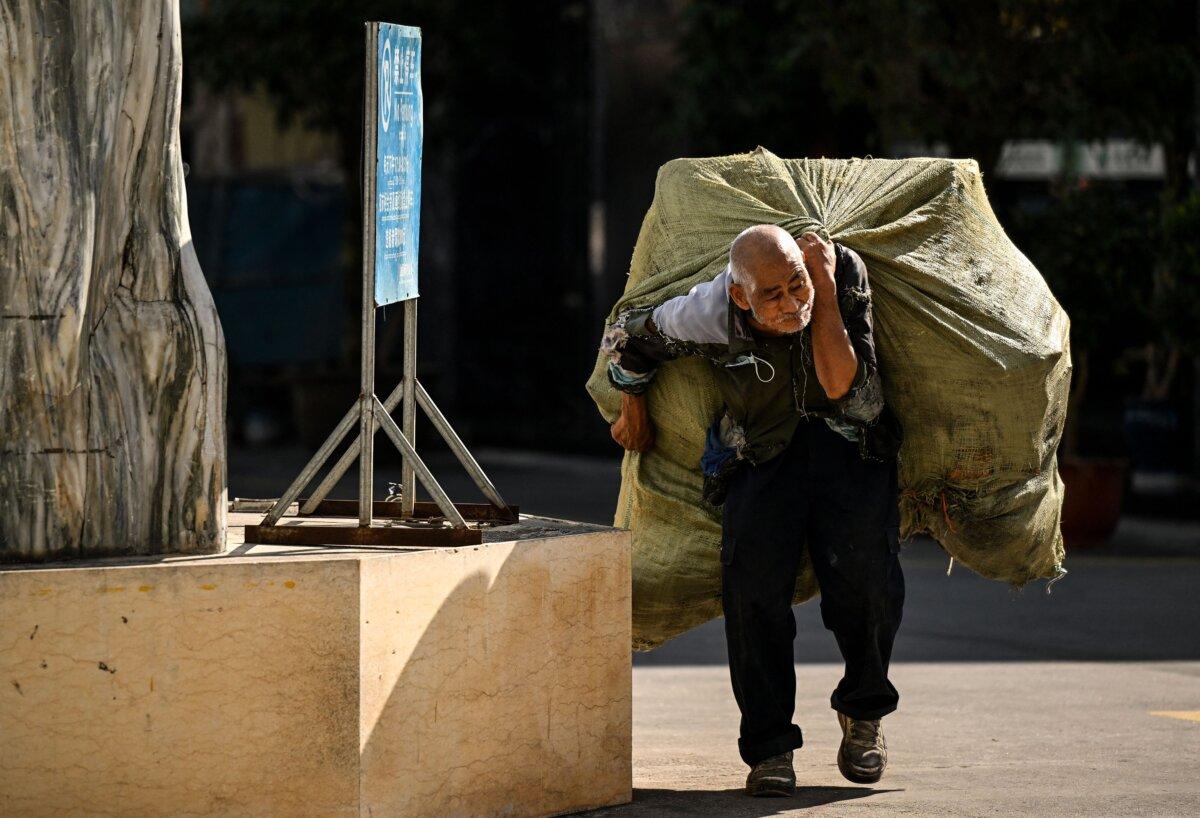
An elderly man carries a bag of recyclable materials on his back in Ruili, Yunnan Province, China on Jan. 13, 2023. Noel Celis/AFP via Getty Images
The remaining 130 million pensioners are urban residents who receive higher pensions, many of whom are enterprise employees, Wang said.
“These people receive about 3,000 yuan [$435] a month in pensions,“ he said. ”Under the current price level in China, as long as they are not in first-tier cities, they can still maintain certain living standards.”
However, if they have children who are unable to find work and financially depend on them, their pensions are just enough to keep their families afloat, he said.
Youth Unemployment, Deep Structural Problems
China has been experiencing high unemployment, especially youth unemployment. China’s youth unemployment rate was more than 16 percent at the end of 2025, according to official data, without counting students who are about to graduate. In recent years, college students in China have faced unemployment upon graduation.
Wang Xiaoping, China’s minister of human resources and social security, said at a press conference during the National People’s Congress on March 7 that the number of college graduates this year is expected to reach 12.7 million—an increase of 480,000 from 2025. Wang said that uncertainties and unpredictable factors have increased simultaneously and that “stabilizing employment” faces new changes and challenges.
Unemployment, especially for the younger generation, is the biggest weakness in the CCP’s policy wish for a “birth-friendly society,” Sun said.
“Beijing is hoping to mobilize the spending power of better-off seniors, but that cannot fully solve the wider problem of elderly insecurity,” he said.
The Chinese regime’s work report also mentioned other livelihood issues, including general unemployment, longevity, and education, while also emphasizing the strengthening of social security and services.
Beijing can still manage headline targets and selective improvements, but deep structural problems are harder to fix quickly, Sun said.
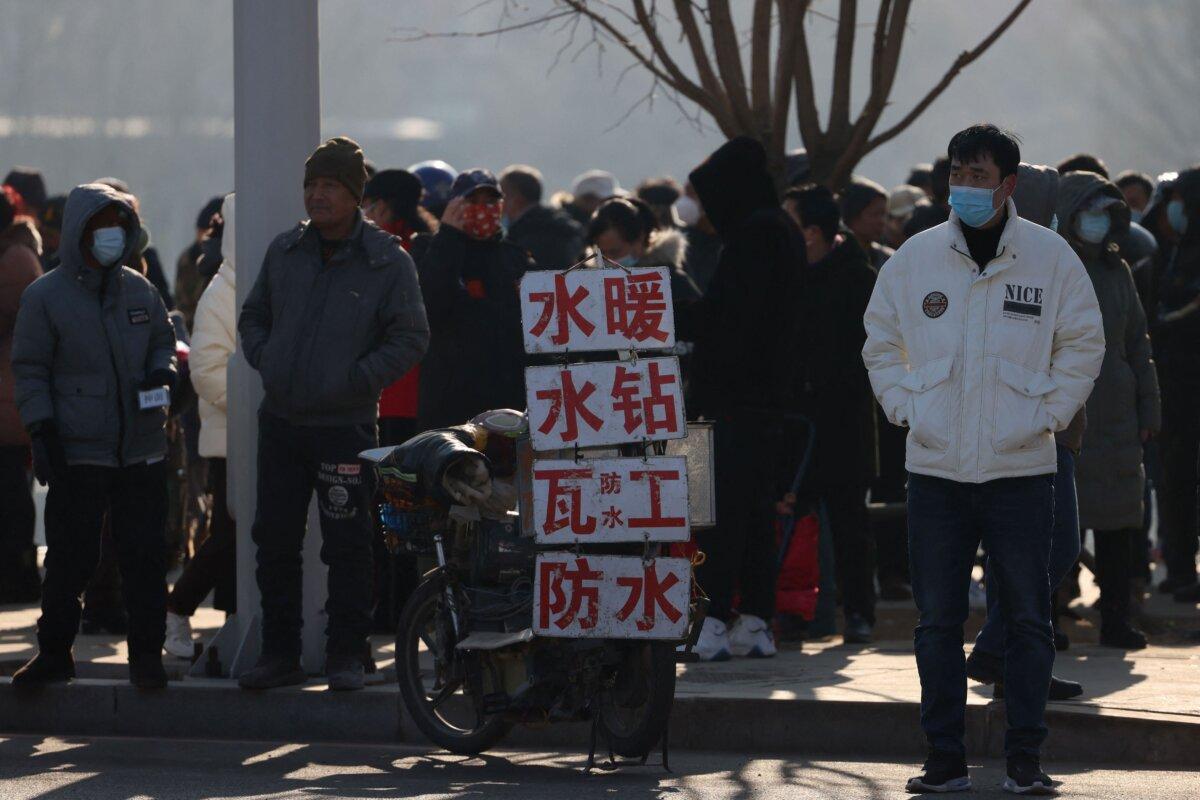
Migrant workers standing near signs advertising their skills as they wait by a street to be hired in Shenyang, in northeastern China’s Liaoning province, on Feb. 6, 2023. AFP via Getty Images
“Beijing is moving from expansion management to scarcity management: fewer young workers, more elderly dependents, slower growth, and rising pressure to extract demand from households that are already cautious,” Sun said. “That is a sign of strategic weakness and long-term strain, even if not immediate regime breakdown.”
Wang said he believes that the CCP has the financial resources if it really wants to solve these problems.
“China’s fiscal expenditure last year was 28 trillion yuan [$4 trillion],“ he said. ”Solving the Chinese people’s livelihood problems wouldn’t actually cost that much money—it wouldn’t account for a large proportion of that 28 trillion yuan. The problem is that fiscal policy has been monopolized by vested groups’ interests.”
“It’s impossible for [the regime] to directly use that money for the benefit of ordinary people,“ Wang said. ”Therefore, it would have to break down the existing interest structure and overthrow the existing system, which is something the CCP absolutely cannot do.”
Luo Ya and Reuters contributed to this report.