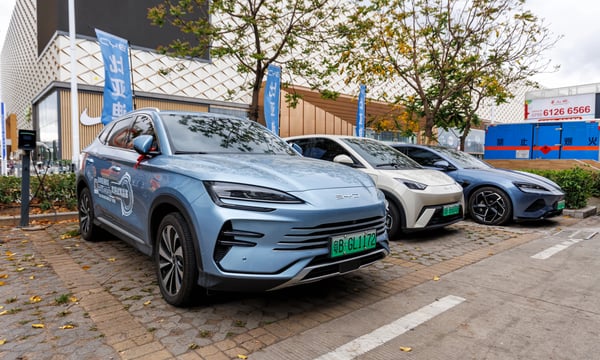
China has long identified specific sectors as future engines of growth and recipients of expansive state subsidies. Despite charges of economy-wide imbalance, overcapacity, and, most recently, involution, China has achieved impressive gains in its priority sectors, particularly electric vehicles (EVs). In 2024, Chinese EV production hit 12.4 million units, accounting for 70 percent of global output, and the country was home to five of the world’s 10 largest EV manufacturers.
In late October, Chinese leaders released the 15th Five-Year-Plan (2026-2030), notably omitting EVs from the official list of strategic industries for the first time in a decade. Without the strategic industry designation, analysts expect the end of EV subsidies and the return of market forces. As this sector transitions out of hyper-accelerated development and into maturity, U.S. policymakers should consider how China achieved global leadership in EVs, drawing lessons that can guide U.S. efforts to compete more effectively with China and mitigate its efforts to attain global leadership in industries of the future.
Imbalance, Overcapacity, and Involution
The economic conditions enabling what Beijing now calls “involution” is a long-standing reality in China’s economy that has also been labeled “imbalance” and “overcapacity”: investment is high, consumption is low. From 1990 to 2023, gross fixed capital formation as a percentage of GDP rose from 24 percent to 40 percent – well above the typical level in developing economies.
At the same time consumption as a share of GDP declined to less than 40 percent, 20 percentage points below the global average.
While other countries have achieved remarkable, investment-led growth, China’s imbalance between investment and consumption stands out. During their respective high-growth periods, South Korea and Singapore also sustained investment rates exceeding 40 percent of GDP, yet household consumption remained far higher by comparison. Between 1990 and 2023 – spanning China’s emergence and rise to global economic prominence – its average gap between consumption and investment was just 18.8 percentage points. In contrast, during their growth booms, consumption in South Korea and Singapore exceeded investment by roughly 45 to 55 percentage points, narrowing only as their economies matured.
Subsidies and industrial policies at the central and local government levels – with local governments accounting for 80 percent of such policies – have enforced this phenomenon, channeling vast sums of money to industrial capacity without comparable growth in domestic demand. Over the past decade, favored sectors including EVs have received fiscal support in the form of cash subsidies, tax benefits, and subsidized credit and land, amounting to 4 percent of GDP annually. The EV industry, specifically, received $230 billion worth of state support from 2009 to 2023, despite EV sales in China reaching just 500 units in 2009. Such expansive, forward-thinking financial support spurs investment and development, even in the face of muted demand.
But challenges arise when production far outstrips demand for too long. Subsidies and limited demand incentivize price cuts and, when paired with a lack of market consolidation, create hyper-competition. China is now in its longest deflationary stretch since the 1990s, and nearly every major sector is affected. As prices have fallen, profits have contracted. Nearly a quarter of industrial firms in China are loss-making, the highest share since 2001. In the EV sector, production capacity exceeds domestic demand by a factor of three and as of August 2025, only three companies – BYD, Li Auto, and Aito – are profitable. In a market economy, creditors and investors displeased with a firm’s performance would push for consolidation, liquidation, and bankruptcy.
However, firms in strategic sectors are insulated from investor pressure and receive preferential financing. Without financial push factors, firms can be unprofitable and stay alive. Indeed, firms in China sometimes face pressure to stay open despite being unprofitable.
Beijing prioritizes employment and growth targets over profitability which encourages firms to continue operations despite losses and incentivizes regional governments to shield local champions, protecting jobs and political standing. In one such instance, it was recently discovered that auto firms and officials in 20 provinces have been inflating sales numbers by exporting so called “zero-mileage” cars. An exporter buys the car — which has limited prospects of selling in China due to depressed demand — and then labels the car as used before eventually selling it abroad for cheap. This tactic inflates a local government’s economic metrics twice: once for the sale of the car to the exporter and again for the export of the car from the province to a foreign market.
A Release Valve
While China’s supply-side approach to developing strategic sectors presents clear challenges, so far, its benefits have outweighed the costs. Among the thirteen priority industries identified in the Made in China 2025 plan, China is now the global leader in five and rapidly closing the gap in seven others. Proponents of Chinese industrial policy view Beijing’s approach not as unfair or predatory but as a form of venture-capital statecraft that has accelerated technological diffusion worldwide. Several of China’s heavily subsidized industries, such as solar photovoltaics, electric vehicles, and batteries, are also critical to advancing the global green transition, where ample supply is needed to meet environmental goals.
Trade has been essential to making this model viable. China’s export machine has absorbed the excess capacity created by years of investment, and unilateral (U.S.) or plurilateral (EU) trade barriers have done little to stem the tide. In 2024, Beijing met its 5 percent growth target largely on the strength of a record $992 billion trade surplus. With domestic demand weak and production capacity abundant, overseas markets serve as a crucial release valve. The EV industry epitomizes this dynamic where China’s share of foreign EV markets has surged in recent years. Chinese exports account for over 80 percent of EV imports in countries such as Brazil, Mexico, Thailand, and Jordan, and in the first nine months of this year, China exported nearly $48 billion worth of EVs to more than 200 markets.
So, while Xi Jinping expresses his displeasure at excessive competition throughout China, his rebuke is not full-blooded. Removing EVs from China’s strategic industries list should not be read as a harsh vote of pessimism for the industry, but rather a signal that Chinese officials believe the industry has matured out of its “leap-frog” phase and the ruthlessness of market forces will reduce efficiencies without eroding China’s global lead. China’s supply-side strategy – build it and they will come – has worked.
Another Five-Year Plan
With the removal of electric vehicles comes new strategic industries aligned with broader tailwinds in the global economy: quantum technology, bio-manufacturing, hydrogen and fusion energy, 6G communications, embodied intelligence, and brain-computer interfaces.
Soon enough, these industries will receive the same preferential treatment and financing; local governments will rapidly deploy their workforces and capital to meet Beijing’s demands. While Beijing’s approach has not been without cost – its heavy-handed subsidies have created inefficiency and deflationary pressure – its results in scaling new industries are undeniable.
Before U.S. policymakers find themselves charging China with overcapacity in its next set of priority industries, there are tangible strategies the United States should consider that would enable it to mitigate and compete with China’s efforts.
Allied coordination is particularly important. Crafting industrial policy strategies in partnership with allies can accelerate development, guarantee demand, and stifle rival industrial policy. Knowledge sharing and joint ventures with trusted allies can support the development of industry best practices and encourage innovation. Committing to maintaining open markets or signing cross-border offtake agreements between a subset of allies will help nascent industries navigate the uncertain, early stages of development. Finally, China’s release valve in the face of excess production has long been exports. For certain products, particularly those for which higher-income customer bases are the target market, the United States should consider coordinated protectionism to shield its competing industries.
In addition, the United States shouldn’t forget the demand side. When crafting industrial policy, U.S. policymakers should ensure that supply-side policy incentives are matched with demand creation. China’s experience shows the pitfalls of expanding production faster than domestic or foreign markets can absorb it. To avoid a similar imbalance, U.S. efforts to scale up domestic manufacturing and mining capacity must be paired with reliable demand signals—public procurement, long-term tax incentives, and export facilitation—that provide stability for investors while expanding downstream markets.
Finally, Washington ought to leverage existing advantages. While China is channeling state resources toward quantum technology, bio-manufacturing, brain-computer interfaces, and other industries of the future, the United States should take advantage of its existing strengths in research and innovation. U.S. policymakers should prioritize connecting federally funded research, university labs, and commercialization pathways. Streamlined technology-transfer rules, greater support for scale-up capital, and procurement partnerships with innovative startups can help translate academic breakthroughs into industrial capability.
Looking closely at how China’s EV sector rose to global dominance offers the United States a chance to discern what to emulate, what to avoid, and how to compete. As Washington advances a new era of assertive industrial policy, it must steer clear of China’s supply-side excesses while capitalizing on the United States’ enduring strengths: its network of allies, research institutions, and innovative private sector.