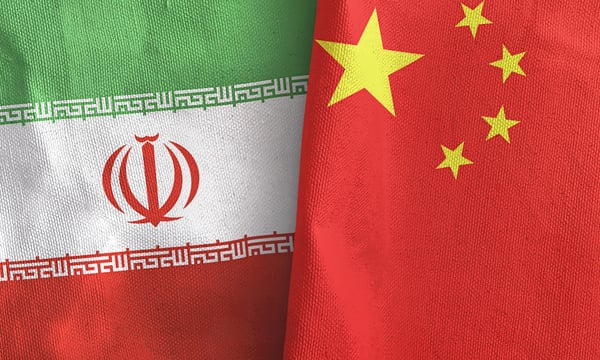
Amid the ongoing domestic tensions in Iran, the United States has imposed a fresh wave of sanctions on countries doing any business with Iran. This step tightens the grip around the already crumbling Iranian economy, but it is equally significant for countries relying on energy imports from Iran. Although there are many beneficiaries of cheap Iranian oil, China is at the forefront of the list.
China tops the list of those countries importing crude oil from Iran, accounting for 80 percent of Iranian seaborne oil exports. In 2025, China purchased 1.38 million barrels of Iranian oil per day, representing about 13.4 percent of China’s total oil imports. Apart from Iran, China continued to be the largest importer of Russian oil in 2025, which is another country heavily sanctioned by the United States.
There’s a clear benefit to China: buying Iranian oil saves it around $8-10 per barrel. But how can China sustain such large-scale imports of Iranian oil despite heavy sanctions imposed because of its potential nuclear program? The answer – a well-honed sanctions evasion scheme – also explains why China remains largely unbothered by the latest U.S. sanctions on countries importing oil from Iran.
On the high seas, a range of covert mechanisms enables the execution of illicit trade. Oil can be smuggled using a Ship-to-Ship transfer (STS), after which the receiving vessel becomes the official “source” of the oil while concealing the identity of the original carrier. Often, this involves also disabling the Automatic Identification System (AIS) signal, which makes it difficult to track the ship in international waters.
China has an entire “shadow fleet,” which is broadly used to ship sanctioned oil, especially from Iran. Such vessels avoid detection through falsifying their GPS coordinates, changing names, and duplicating transmissions to avoid detection. This “shadow fleet” now reportedly accounts for 17 percent of the tankers transporting oil by sea. The shadow fleet uses a “flag of convenience,” which is provided by smaller nations in return for financial compensation. Iran also has its own shadow fleet, the “Ghost Armada,” which complements the official National Iranian Tanker Company (NITC) in shipping millions of barrels of sanctioned oil. In 2025 alone, shadow tankers traveled from Iran to China over 1,500 times, second only to the number of trips made from Russia to India.
When the United States re-imposed sanctions on Iran in 2018, China avoided openly importing oil from Iran. Most of the oil shipments landing in Chinese ports claim to be from a third-country origin, like Malaysia and Indonesia. The largest concentration of these shadow tankers operate roughly 20 miles off the Malaysian coast, where ship-to-ship transfers take place before the cargoes move through the South China Sea toward China. A Bloomberg analysis of satellite imagery showed that the number of side-by-side ships – suggesting STS transfers – in this area has doubled from 2020 to the end of 2024.
Once this oil reaches Chinese ports, it heads to non-state, semi-government petrochemical refiners, which are also known as “teapot refineries.” These teapot refineries were authorized for oil imports on a quota basis after 2015, but this has changed in recent years. The National Development and Reform Commission (NDRC) of China has issued dozens of new licenses in recent years. Currently, around 150 such teapot refineries are operating, meeting one-fifth of China’s oil needs.
The reason why these small refineries, instead of bigger Chinese enterprises, are used is that they are less exposed to international scrutiny. These teapot refineries are very difficult to uncover, and they create breathing space for bigger enterprises to escape direct sanctions by the United States.
After processing, the sanctioned oil is rebranded by the teapot refineries as crude from another country – Oman, Russia, Iraq, or Malaysia – to conceal its origin. Then the payments are done through covert financial mechanisms. China has effectively connected infrastructure financing to oil payments. China has huge infrastructural investments inside Iran, which is public knowledge. In the case of oil payments, the Chinese buyer books Iranian crude, and then the funds are deposited into an unregistered financial vehicle. Those funds are subsequently used to pay Chinese contractors and firms engaged in Sinosure-insured infrastructure projects inside Iran, instead of being remitted as conventional cash payments.
In other words, the China-Iran oil trade relies on barter-style payments to avoid any sanctions. Although Chinese officials have never openly acknowledged the existence of such alternative mechanisms, many Western analysts have a different opinion.
In the short run, China will not face considerable disruptions from the increased sanctions on Iranian oil. China already has extensive mechanisms in place to diversify its payment systems and decentralize risks while delegitimizing unilateral U.S. sanctions. However, in the longer run, Beijing could face challenges as risks accumulate.
Over the past few years, the U.S. has moved targeted sanctions on specific entities and individuals carrying out illicit activities. With the improvement in technologies, satellite tracking and AIS analytics will also improve, narrowing the space for shadow fleets to operate in international waters. In the future, if China-U.S. competition intensifies, the scenario could change. The United States might pursue sanctions on core Chinese entities rather than peripheral actors, significantly increasing the costs.
For now, the tariffs that Trump has pledged to impose on Iran have not yet materialized. There is no clarity on how and when these tariffs will be imposed, and which countries doing business with Iran will be specifically targeted. After the announcement of these tariffs, China insisted it would do all it takes to “safeguard its legitimate rights and interests.”
China has already pushed back against U.S. tariffs, resulting in a deal between the United States and China over trade and economic relations in 2025. Introducing new tariffs over Iranian oil would be highly provocative for China. Therefore, any escalation could trigger broader economic disruption and a sharper deterioration in China-U.S. relations.