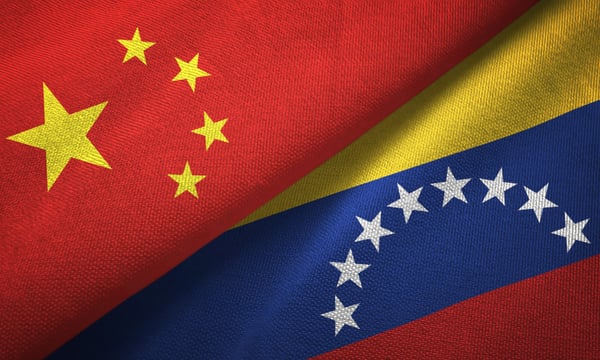
When U.S. forces seized Venezuelan President Nicolas Maduro, Beijing condemned the operation as illegal and expressed “deep shock” at what it called “hegemonic acts” that “violate international law and Venezuela’s sovereignty.”
The official Chinese narrative foregrounds international condemnation and positions Beijing as defender of the international order. It also casts the operation as vindication of its position that the West’s “rules-based order” serves U.S. interests. For example, Xinhua stated: “what the U.S. calls a ‘rules-based international order’ is actually just a ‘plundering order based on American interests.’”
But Chinese commentary strikes a different tone. Public intellectuals must toe the party line to some extent, yet studying their arguments – rather than just official statements – can help reveal the considerations, constraints, and strategic anxieties shaping Beijing’s positions.
Despite Venezuela’s status as an “all-weather strategic partner,” Chinese commentary on the capture of Maduro is surprisingly muted. A survey of over 60 analyses from mainland experts reveals discourse largely unmarked by the strident nationalism that sometimes characterizes China-U.S. relations.
Several other themes diverge from the official line. Many authors fault Chavismo’s economic mismanagement rather than U.S. imperialism. The Ukraine comparison surfaces more than expected, with some noting the awkward parallel between two “illegal” interventions. And where Beijing has emphasized international condemnation of Washington’s actions, commentators dwell on its absence – with some coming close to suggesting China’s own response was insufficient. Readings of the Monroe Doctrine, meanwhile, reveal Beijing’s anxieties: unlike in much Western commentary, it is read less as a U.S. retreat from hegemony and more as “strategic retrenchment” – a concentration of forces that presages drawn-out competition.
The Limits of China’s Response
China’s establishment intellectuals are forthright on the illegality of the operation, but thin on how China should respond. The overall impression is of Beijing treading carefully: on the question of what China can do to protect its interests, the answer appears to be “not much.” Chinese firms active in Venezuela are counseled to preserve original contracts and documentation and prepare for international arbitration.
Looking ahead, authors argue that Chinese businesses in Latin America must be more cautious, assess geopolitical conditions, avoid sensitive critical infrastructure, and focus on trade rather than investment. One recurrent suggestion is that China structure investments through multilateral bodies so as to avoid U.S. scrutiny.
Where broader strategic responses are discussed, suggestions remain cautious. One senior scholar contends that Beijing could take “economic countermeasures” – though not military ones – if U.S. actions harm Chinese loans. Jin Canrong, a prolific commentator popular with nationalist audiences, strikes a more assertive tone, arguing Beijing should warn Washington that interference with Chinese investments in Latin America will invite countermeasures in Asia. Jin also predicts that the United States will be unwilling or unable to exclude China from Latin America’s economic life.
Clearly Washington’s operation falls well short of Beijing’s red lines, raising the question: where do they actually lie?
Hypocrisy, Precedent, and Maduro’s Record
Many China watchers will have noted – and will be unsurprised by – the asymmetry between Beijing’s condemnation of U.S. actions and its silence on Russian aggression in Ukraine. A few authors do make explicit comparisons between U.S. actions and Russian aggression. One even writes, “Trump perfectly performed the script that Putin wanted to execute in 2022 but failed to accomplish.”
Zheng Ge, a prominent law professor at Shanghai Jiao Tong University, addresses the charge of hypocrisy head-on. He defends his position with what amounts to the standard Russian propaganda line: that the invasion of Ukraine was a self-defense maneuver and therefore incomparable to U.S. actions in Venezuela.
On the suggestion circulating in Western media that the operation sets a precedent for China to take action on Taiwan, most scholars follow the official line in studiously avoiding the parallel. Only one nationalist commentator, Fudan University’s Chen Ping, raises the suggestion that “the next one to be arrested should be Lai Ching-te,” Taiwan’s current president.
Although not monolithic in its condemnation, the commentary is surprisingly critical of Maduro and of the impact of Chavismo on the Venezuelan economy. The most sustained argument comes from Tsinghua political scientist and liberal commentator Liu Yu, who treats Venezuela as a case in which dirigiste economics, combined with oil dependence, turned a wealthy petro-state into a basket case.
The take many liberal Western readers will probably find most intuitive comes from Zhang Qianfan, a controversial Peking University law professor whose constitutional law textbook was pulled from shelves in early 2019. Zhang is surprisingly blunt about Maduro’s illegitimacy and even concedes that regime change may have been justified. However, he warns that a Trump-led America is no longer a credible “democracy lighthouse,” and that post-invasion chaos may prove worse than what came before.
The Myth of International Condemnation
Many pieces echo the official narrative of widespread international condemnation. But a more interesting line runs through these responses: that condemnation has been neither strong enough nor consequential. Prominent public intellectual Zheng Yongnian is blunt: “The volume of international condemnation is not loud enough,” he writes.
The sharpest critique comes from Pan Yue. She is a relatively junior scholar at Jinan University, but her comments are interesting because they skirt dangerously close to criticism of Beijing, describing “72 hours of collective silence” from the Global South. She briefly praises China’s response, but the section feels performative, and her real point is that the operation exposes “where the role of a ‘leader of the Global South’ ultimately runs up against its limits.” A couple of other scholars warn, “if China’s response is insufficient, it will weaken its moral appeal among developing countries.”
Killing the Chicken to Scare the Monkey
Chinese commentary spends considerable time analyzing motivations. Most authors mention Venezuela’s oil wealth, but the majority ascribe it secondary importance – the operation is primarily a signal to both domestic and international audiences.
Domestically, it is cast as “political theater” for Trump: a quick win on immigration and drugs that satisfies his base. In the hierarchy of goals defined in the commentary, this is the minimum objective.
The medium goal is regional deterrence – the international dimension to this political signaling. The idiom “killing the chicken to scare the monkey” recurs throughout these responses: a violent demonstration of U.S. power meant to discipline neighbors.
The maximum goal is strategic control: reasserting U.S. dominance over hemispheric resources and excluding China and Russia from Venezuela. Many doubt Trump will pursue this objective to its conclusion, but several warn that even partial success would constrain Chinese economic engagement across Latin America for years to come.
Most see the raid as accelerating the collapse of the “rules-based order” and having “dragged the world back to the era of jungle politics.” Yet commentators also stress continuity: “In America’s mouth, ‘rules’ have never been universally applicable international law.”
Peking University legal historian Zhang Yongle reads the raid through the longer history of the Monroe Doctrine, arguing that Trump’s version marks a pullback from “global Monroeism” toward a re-privileging of the Western Hemisphere – redrawing the boundary of U.S. power rather than extending it. This decline narrative is not cause for celebration but caution. It is read as “retreating to advance” – the U.S. tightening fronts to recuperate strength, while attempting to keep longer-term superiority intact.
For Beijing, the Maduro raid is less a crisis than a clarifying signal. It underscores how limited China’s ability is to shield even an “all-weather” partner when Washington decides to act. That’s why the most practical advice in the Chinese commentary is not geopolitical: it is legalistic and commercial, aimed at preserving claims rather than changing outcomes.
The deeper anxiety is strategic. Chinese writers do not read a revived Monroe Doctrine as simple U.S. decline, but as a form of retrenchment designed to restore leverage for a long contest – a United States narrowing its focus in order to remain competitive.
This article is adapted from an analysis published by Sinification, a newsletter translating and analysing Chinese public intellectual commentary for policymakers and researchers.