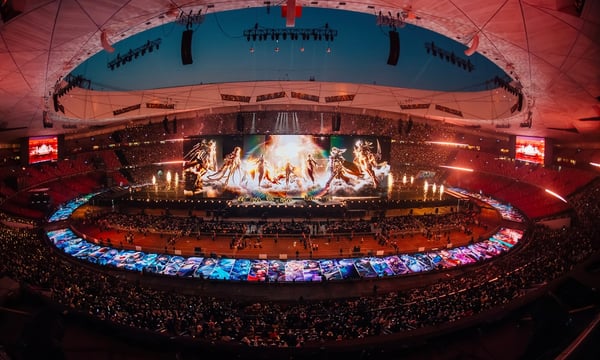
On November 8, a phone game achieved something only the largest sports leagues can manage: tens of thousands of spectators in a single national venue.
Tencent’s Honor of Kings staged its King Pro League (KPL) Grand Final inside Beijing’s National Stadium – the Bird’s Nest – certified at 62,196 paying attendees, a new record for a video game match.
Tickets disappeared in roughly the time it takes to refresh a screen: 12 seconds, according to event organizers and coverage at the time. The headline detail that matters even more than the number is what it implies about cultural gravity. A mobile game – long treated in the West as a casual substitute for “real” gaming – is now big enough in China to justify an Olympic venue, a ticketing rush, and the kind of pilgrimage behavior normally associated with sports finals or pop megatours.
It is tempting to treat the Bird’s Nest spectacle as a novelty – a one-off Guinness gimmick. That would miss the point. What happened in Beijing is better understood as the visible capstone of a decade-long strategy in which Chinese firms and regulators helped make the smartphone the country’s default entertainment device, and then treated mobile games as a flagship cultural industry: something to be built, optimized, broadcast, toured, and exported. Beyond that, it points to the global future of games.
A Phone-first Ecosystem, Built on Hardware and Bandwidth
Hongyu Chen, co-founder of The Esports Advocate, an expert on China’s esports and games industry for 18 years, described how earlier waves of Chinese gaming grew out of the constraints of a developing economy.
“Twenty years ago, China was a developing country. Most families couldn’t afford a PC or laptop,” he told me.
That gap helped build China’s internet café culture – the crucible for early PC esports – but it also left a structural opening for the device that eventually became both cheaper and more ubiquitous than the café seat: the smartphone.
“After 2008, the iPhone changed everything,” Chen said. “Then Chinese smartphone brands like Xiaomi and Huawei came out… Smartphones also became much cheaper… In China, you can get a very good smartphone for 1,000 to 2,000 yuan – around $300… So smartphones lowered the barrier to entry.”
And as the user base exploded, smartphones – and associated apps – went from a hobby practiced on a scarce device in a specific location to a mass behavior carried in the pocket.
The second key to a mobile gaming market is connectivity. Competitive games are intolerant of lag; live-service business models are intolerant of downtime. China’s rapid buildout of 5G and related network infrastructure has helped make always-on, low-latency play normal rather than exceptional. Recent official data points to over 1.19 billion 5G mobile users and 4.83 million 5G base stations by late 2025.
“The infrastructure for Chinese public transport and 5G internet has been rapidly growing in the past 15 years, Chen said. “You can easily play Honor of Kings or PUBG Mobile on the metro or high-speed train.”
With China’s cheap capable handsets and dense networks, mobile gaming has become a mainstream infrastructure layer, like video streaming or mobile payments. Games are no longer simply software products in China; they are increasingly integrated with distribution platforms, social graphs, advertising systems, and offline venues.
Mobile as Flagship Entertainment, Not a Sideshow
The next layer is where China differs most sharply from the Western stereotype of phone games. Mobile in China is not merely a supplementary format; it is a platform strategy pursued by the country’s largest tech firms, such as Tencent, NetEase, and ByteDance – and, increasingly, by the broader ecosystem of content platforms that can turn play into culture.
“Honor of Kings is different,” Chen told me. “Its top players can compete with movie stars or singers in terms of popularity within Chinese entertainment.” He pointed to a demographic lever Western esports has often struggled to capture at scale as well: “Most Honor of Kings players have a fanbase that’s largely female… Female audiences bring high commercial value.”
In early 2025, Honor of Kings’ King Pro League (KPL) announced a partnership with Xiaohongshu (RedNote) – a platform better known internationally as a lifestyle and social-commerce hub than as an esports destination – making RedNote an official streaming and community platform for the league.
Notably, RedNote’s user base skews heavily toward young urban women; one analysis of the platform’s 260 million monthly active users put women at around 70 percent. Reuters, describing RedNote’s commerce push, similarly framed its core appeal around financially independent urban women and aspirational lifestyle content.
The anecdote is useful because it captures how Tencent, which owns Honor of Kings, treats a top mobile title: not only as a competitive product, but as a celebrity system that can be merchandised across the same platforms that drive beauty, fashion, and consumer-brand spending. When a video game league is positioned inside a lifestyle app – rather than confined to game-first streaming – it’s a signal that the audience is being cultivated as a mainstream consumer bloc, not just a niche fandom.
The market data reflects the outcome. China’s gaming industry reached 325.8 billion yuan (about $44.8 billion) in 2024, according to figures attributed to an industry association, boosted by blockbuster releases and a loosening regulatory environment compared to the crackdown years. In the first half of 2025, China’s domestic games market reportedly grew to 168 billion yuan (about $23.4 billion) for the period, again a record.
Of course, one of the biggest reasons for the growth is the improvement of the games themselves. A persistent Western misconception is that mobile games mean basic play. That is true in some genres, but it’s increasingly incomplete as an explanation for the biggest titles.
Developers at NetEase, discussing Dunk City Dynasty, offered a clean definition of what “hardcore” means on phones: a hardcore game is “a system that you have to learn,” with deep stats, strategy, and a high skill ceiling. The trick, they argued, is designing for mobile constraints without collapsing depth: “This creates a ‘low floor, high ceiling’ experience: beginners can pick it up easily, but mastery requires deep knowledge of skills and timing.”
NetEase’s answer to mobile life was not simplification, but compression. They capped matches at three minutes, explicitly designed for “fragmented time” – commutes, breaks, the in-between parts of a day – while keeping advanced mechanics for players who want mastery.
What the Bird’s Nest Really Signals
Global capital now recognizes the phone as the main battlefield for growth – and reads Asia’s mobile ecosystem as the template.
Activision announced a partnership with Tencent to bring a new Call of Duty mobile title to China, working with Tencent’s TiMi studio – a reminder that even the biggest Western shooter IP needed a China-native mobile route to reach that audience at scale. Blizzard took a similar path with Diablo Immortal, co-developed with NetEase and formally launched on iOS and Android in China in 2022 – essentially using mobile as the vehicle to extend a legacy PC franchise into the country’s dominant gaming format. And Electronic Arts has leaned into China-specific mobile distribution as well: in 2024, Tencent announced a partnership with EA (and Mercedes-Benz) to bring a new Need for Speed mobile game to the Chinese market. As in all these examples, Western IP increasingly arrives in China via local platform alliances.
Mass entertainment, in the world’s largest digital market, is now phone-first by default – and the biggest companies are organizing around that fact. The next set of global “must-win” entertainment markets will be decided on the small screen.
If the West still wants to treat mobile as the casual corner of gaming, Beijing’s Bird’s Nest just offered a counterargument – one that more than 60,000 people paid to make in person.