The rupture in Japan-China relations in the wake of Japanese Prime Minister Takaichi Sanae’s remark that if China were to employ military force against Taiwan, it may have a serious impact on Japanese security, has not been without consequence for Germany. Berlin has enjoyed good ties with Beijing for many years thanks to close economic links, but the relationship has become increasingly tense in recent years. Meanwhile, Germany has been forging closer links with Japan, in security among other areas, a development that has also likely irritated China.
German Foreign Minister Johann Wadephul made reference to Taiwan in the context of Chinese military expansion and the stability of surrounding waters when he visited Japan for the Japan-Germany Foreign Ministerial Strategic Dialogue in August 2025, and then again as part of his remarks on the 40th anniversary of the founding of the Japanese-German Center Berlin in October. He even went as far as to call Japan a “premium partner.”
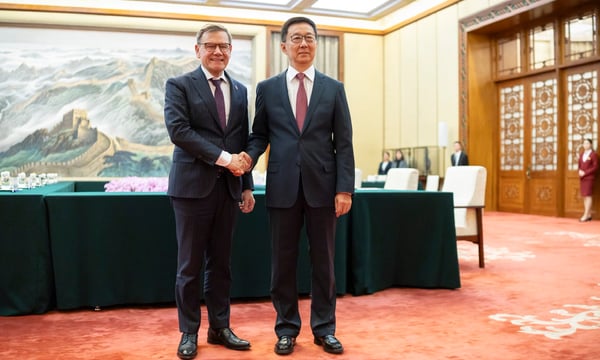
The mention of Taiwan drew a rebuke from Beijing. A visit to China that Wadephul had scheduled for the end of October was canceled after nearly all meetings become difficult to plan. Subsequently, German Finance Minister Lars Klingbeil was able to become the first member of the new German government to travel to China, while plans are underway for Chancellor Friedrich Merz to make his first visit early in 2026. Wadephul was also able to reschedule his own trip and attend several meetings in December, mending relations to some degree.
Still, it is evident that China-Germany relations have become strained in recent years. This has accompanied greater German involvement in Asia, not only economically but also in the diplomatic and security realms, as Berlin has recognized the challenging international situation in light of Chinese military expansion and high-pressure diplomacy. German diplomacy has traditionally valued respect for international law and the rule of law as well as the peaceful resolution of disputes through diplomacy, so Berlin has always been critical of rapid Chinese military expansion and coercion. At the same time, despite having enjoyed strong economic ties with China, Germany has recognized the importance of de-risking, namely reducing its excessive dependence on China for its own economic security. European companies have seen how Chinese export restrictions on critical components and resources can cause major hurdles to production, while there are also growing calls to review Chinese acquisitions of European companies from a security perspective.
After developing its Indo-Pacific Guidelines in 2020, Germany has subsequently dispatched frigates and Eurofighters from the Bundeswehr to Japan and other destinations, rapidly stepping up its involvement in the Asian security. This is emblematic of a new German diplomacy, one that now focuses not only on de-escalation and confidence-building through diplomacy, but also on strengthening deterrence through deeper defense cooperation and closer collaboration with countries that share German values. At the same time, it is a manifestation of Berlin’s growing ambition to fulfill its responsibilities to the international order in a way that befits its status as the EU’s preeminent power. Amid the geopolitical threat from Russia’s invasion of Ukraine, this German thinking is also encompassing a reconsideration of relations with China, which has been supporting Russia behind the scenes.
However, Wadephul’s frank rhetoric about China, along with the country’s principled and values-based diplomatic stance, are at odds with the interests of the many German companies that have already invested heavily in China and that depend on the Chinese market. With an eye to the potential economic repercussions, Wadephul kept his remarks measured during his visit to China in December.
Achieving economic security through de-risking takes time. It is a complex strategy that requires maintaining economic relations, or even deepening them in some areas, while reducing security vulnerabilities. In the Trump era, Europe also has the task of moving away from an over-reliance on the United States, bolstering its own defense capabilities to address the growing security threat represented by Russia.
This move toward EU strategic autonomy is taking place amid a challenging international environment. As such, it is only natural for Germany to opt for a strategy that involves solidifying relations with a trusted partner like Japan, which shares its values. China’s aggressive response to Takaichi’s remarks has included urging both Wadephul and French President Emmanuel Macron to express agreement with its condemnation of Japan during their recent visits to China. But Beijing’s efforts in this regard will not alter the German government’s policy of strengthening relations with Japan. Nonetheless, Merz’s visit to China next year may not turn out to be as predictable as such visits were during the Merkel era.
The Merz administration, which has expressed staunch support for Ukraine, is not focusing only on its immediate interests. But as it pursues a strategy of maximizing economic benefits while both sticking to its principles and achieving economic security, German diplomacy has a particularly tricky path to walk.