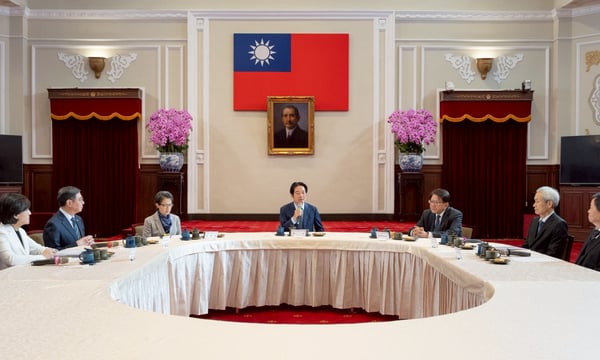
Without much warning at all, Taiwan has found itself in the middle of a constitutional crisis. Although the public reaction has been curiously muted so far, the Kuomintang (KMT) has already declared that it will seek to impeach both President Lai Ching-te and Premier Cho Jung-tai.
The trigger for the constitutional crisis came when Cho Jung-tai – who as premier heads the Executive Yuan, Taiwan’s executive branch of government – refused to countersign legislation that would increase revenue allocated from the central government to local governments. Taiwan’s Executive Yuan is controlled by the Democratic Progressive Party (DPP), given the election of Lai Ching-te as president in 2024. By contrast, the legislature is controlled by the KMT through a slim majority along with its ally, the Taiwan People’s Party (TPP).
Cho has justified the refusal on the basis that the increase in subsidies would push government borrowing to 17.1 percent of the national budget. This amount exceeds the statutory debt ceiling of 15 percent.
Likewise, Cho has argued that the KMT and the TPP pushed the legislation through without any form of negotiation with the DPP. In this sense, Cho has suggested that the legislation is “undemocratic.” As passing the legislation would exceed the statutory debt ceiling, Cho has also suggested that the legislation is unconstitutional.
Cho’s refusal to countersign has been endorsed by the DPP and by Lai. In a public statement, the DPP challenged the KMT to call for a vote of no-confidence in Cho as premier if they disagree with his actions. Cho has himself stated that he would welcome such a vote.
Cho’s actions are, in effect, a bid to appropriate veto power over bills passed by the Legislative Yuan. The Executive Yuan does not have such a power under Taiwan’s system, unlike executive branches in other countries like the United States and South Korea.
There is no precedent for this: the premier of the Executive Yuan has never before in Taiwan’s history refused to sign legislation passed by the Legislative Yuan. The closest precedent is Hau Pei-tsun as premier refusing to counter-sign the promotion of Gen. Chiang Chung-ling by Lee Teng-hui in 1992, leading Lee to withdraw the promotion. That this precedent involved a KMT politician has been cited by the DPP to justify its own move.
While the latest crisis emerged suddenly, it’s related to a larger conflict that has been simmering between the DPP-controlled executive and KMT-controlled legislative branches of government since the Lai administration took power. When the KMT drastically cut government spending earlier this year in the largest series of budget cuts in Taiwanese history, a core issue at hand was that the legislature sought to claim authority over the national budget from the executive branch.
Last year, when the KMT and TPP sought to pass legislation that would empower legislators with new powers of investigation, this was sometimes understood as an attempt to shift powers of investigation from the executive and judiciary branches of government to the legislative.
In another move, the KMT proposed shifting authority over Taiwan’s media regulatory body, the National Communications Commission, to legislative control. The KMT also called for the Special Investigation Division – which had been used to investigate political corruption in the past and which played a major role in the downfall of DPP president Chen Shui-bian on graft charges – to be revived and placed under legislative control, rather than under the judiciary. Likewise, KMT legislator Chen Yeong-kang has advanced proposals to shift authority over designating restricted waters from the Ministry of National Defense to the Ocean Affairs Council, potentially allowing KMT-controlled local governments to control such designations.
In going after the KMT’s revenue allocation proposal, the DPP would be targeting low-hanging fruit. The KMT has opened itself up to political attacks because of the fact that revenue allocation from the central government to local governments was impacted by the budget cuts pushed for by the KMT. Moreover, though the KMT justified the cuts in the name of fiscal balance, the revenue allocation bill would increase statutory debt beyond the statutory debt ceiling.
There are two separate questions at hand: whether the allocation is unconstitutional, and whether Cho’s actions are constitutional. Normally, the Constitutional Court would be called on to adjudicate such matters. However, at present, Taiwan’s Constitutional Court is frozen.
Legislation passed by the KMT-controlled legislature requires a minimum of 10 justices to sit on the bench for constitutional interpretations to be made. However, the KMT has refused to approve any of the Lai administration’s appointments to the Constitutional Court. As a result, the number of serving justices is less than 10, and the court is functionally banned from issuing any rulings.
If the KMT does successfully file for a motion of no-confidence in Cho Jung-tai, and if the motion passes, as president, Lai Ching-te has the authority to dissolve the legislature and call new elections. The KMT recently survived the historic Great Recall Movement, in which outrage against the KMT’s budget cuts boiled over into efforts to recall all KMT legislators. None of the recalls met the numbers needed to be successful. But the pan-Blue camp as a whole probably does not hope for a new set of elections in which the outcome could potentially be different.
For one, the KMT’s ally, the TPP, could potentially be wiped out by a new set of elections, giving them incentive not to side with the KMT on a vote of no-confidence. And then there’s the chance that some electoral districts may flip to the DPP.
In this sense, the DPP’s actions have been perceived by some analysts as a high-stakes gambit aimed at forcing the KMT to back down over its current freeze of the Constitutional Court, seeing as the Constitutional Court could resolve the matter, and the DPP is actively calling for the KMT to file for no-confidence in Cho.
Cho’s appropriation for the Executive Yuan of a new veto power, then, is framed as a proximate reaction to the fact that the KMT-controlled legislature has sought to appropriate new powers for itself and to limit the powers of other branches of government so that none of them can check the legislature in the balance of powers. And if the KMT does not relent on the matter of the Constitutional Court, the Executive Yuan can continue to exercise the new veto power it has claimed for itself against the legislature.
For its part, the KMT has mostly hit out at Lai and Cho as undemocratic. The KMT held a press conference on December 18, stating that it would pursue impeachment against both Lai and Cho for what is framed as a power grab. The TPP has suggested that Lai’s actions are a de facto declaration of martial law.
The KMT’s reactions, however, may actually indicate a somewhat weak hand. If the KMT genuinely wishes to impeach Lai, it would need a two-third majority vote in the legislature, which it does not currently have, even alongside the TPP. Furthermore, for an impeachment to be successful, the Constitutional Court – which is currently frozen – would need to preside over the impeachment case. As such, the KMT’s call for Lai’s impeachment is mostly a political stunt.
The KMT has also called for Cho’s impeachment, proposing that the Control Yuan should move on this. The Control Yuan is an oversight body that exists in Taiwan’s unique five-fold division of powers, though the Control Yuan and Examination Yuan play an auxiliary role to the more familiar primary three branches of government consisting of the executive, legislature, and judiciary.
But it was not long ago that the KMT was calling for the Control Yuan to be eliminated and for its powers to be transferred to the legislature, advancing such a proposal in June. In the course of the budget cuts pushed for by the KMT earlier this year, the Control Yuan’s budget was significantly decreased. Meanwhile, it’s likely that the Control Yuan would side with the executive. The executive branch of government nominates Control Yuan members, who are then approved by the legislature.
Constitutional crises in Taiwan – more common in the turbulent days of Taiwan’s democratic transition – have typically been periods of social upheaval that saw the outbreak of large public protests. The Sunflower Movement of 2014, Taiwan’s most notable social movement in recent memory, occurred during what was often seen as a constitutional crisis over the means by which the Ma administration circumvented legislative oversight measures to pass the Cross-Strait Services Trade Agreement that it hoped to sign with China.
Nevertheless, last year saw the outbreak of the Bluebird Movement – the largest social movement in the decade since the Sunflower Movement – against the pan-Blue camp’s efforts to grant the legislature investigative powers. The Great Recall Movement earlier this year against the KMT-led budget cuts, too, was the first time in Taiwanese history that any concerted attempt was made to recall all legislators of a specific political camp. At the time, there were already warnings that the KMT’s actions were risking a constitutional crisis.
Even if the public has been slow to react, the placidity of the present moment may be simply the calm before the storm as Taiwan enters the first major constitutional crisis in a decade – one shaped by the upheavals of the preceding two years.