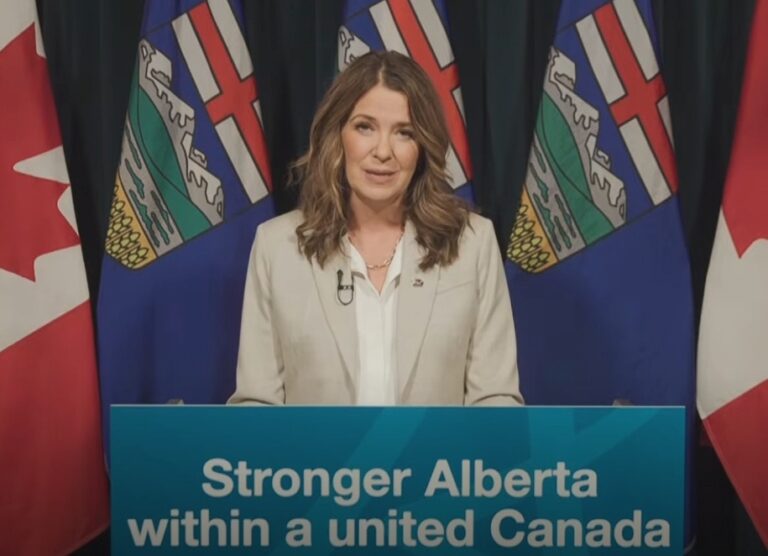
Alberta Premier Danielle Smith says the Oct. 19 referendum results have given her government a mandate to work towards giving Alberta more control over immigration and public services, as well as pursuing constitutional reforms.
Preliminary results indicate that a majority of Albertans voted “Yes” on eight of the nine referendum questions unrelated to separation, while about three-quarters voted “No” on Question 10, which asked whether to hold a separation referendum.
Smith celebrated Albertans’ decision to keep the province part of Canada and said she would not hold another separation referendum.
“Albertans will continue to be Canadians,” Smith said in a televised address on Oct. 20.
She added that her government will seek to make the changes Albertans voted for through the other referendum questions.
“We will be pursuing the reforms approved by Albertans through this referendum in the coming months and years ahead,” she said.
Preliminary results as of the evening of Oct. 20 showed 54 percent voted “Yes” to the first question, which asked whether Alberta should have more control in setting levels of immigration levels into the province, giving economic migrants priority in moving to Alberta, and giving Albertans priority in the workforce.
“It appears that Albertans have directed the provincial government to take greater control over immigration, so we can moderate the extraordinary population growth our province has experienced and prioritize jobs and opportunities for Albertans and Canadians,” she said.

A polling station in Alberta’s referendum in Calgary on Oct. 19, 2026. Carlos Herrera for The Epoch Times
Question two, on restricting provincially funded services to those without “Alberta-approved immigration status,” received 55 percent “Yes” in preliminary results. Question three, on requiring permanent residents to have resided in Alberta for at least a year before being allowed to access social assistance programs in the province, saw 58 percent vote “Yes.”
Question four, on charging temporary residents in Alberta a “reasonable fee or premium” for accessing publicly funded education and healthcare services in the province, saw preliminary results of 57 percent voting “Yes.” Question five, requiring proof of Canadian citizenship to vote, saw 64 percent vote “Yes” in preliminary results.
Constitutional Reform
Questions six to nine concerned Canadian constitutional reform, specifically on giving provinces a greater role in appointing judges, abolishing the Senate, allowing provinces to opt out of federal programs while retaining federal funding to create their own education, healthcare, and social services programs, and boosting provincial rights in areas where authority overlaps and conflicts with Ottawa.
All received varying small majority “Yes” votes except the question on allowing provinces to opt out of federal programs, for which 51 percent voted “No” in preliminary results.
Smith said her government is awaiting final results before working to pursue the changes.
Constitutional reforms require seven of 10 provinces representing at least 50 percent of Canada’s population to come together, along with passage by the federal parliament. Abolishing the Senate requires federal parliamentary approval and the consensus of all 10 provinces.
Smith has said that abolishing the Senate would be the most difficult of the other proposed changes, but she believes many of the reforms are possible.
“I think that one is probably the least likely to get that level of success. But I think it would be important for us to gauge where other provinces are,” she told The Epoch Times on Oct. 16 in Calgary. On some of the other questions, “we’re at a moment in time where we probably could get constitutional change in a way that we haven’t been able to,” she said.
In her Oct. 20 remarks, Smith said Alberta would also keep seeking changes to the federal equalization program. In a 2021 referendum under former Premier Jason Kenney, 61 percent of Albertans voted to make it optional to participate in the program. No such constitutional changes have been made since that vote.
In seeking greater autonomy and authority for Alberta, Smith said any conflicts with Ottawa will be handled within Confederation.
“When Ottawa interferes with those rights, we will be unrelenting in our response,” Smith said. “But those disputes will be settled within the political and legal institutions of our nation, rather than pursuing the option of separation.”

Alberta referendum mail-in special ballots are seen in Calgary, on Sept. 24, 2026. The Canadian Press/Jeff McIntosh
“Make no mistake, our government will continue to boldly assert our province’s autonomy by exercising the provincial rights guaranteed to us under Canada’s constitution. We will use every legal and political tool at our disposal to protect and advance the interests of Albertans,” she added.
Prime Minister Mark Carney said earlier on Oct. 20 that he’s “thrilled” that Albertans have chosen for the province to remain a part of Canada, and repeated his opposition to the changes sought through the other referendum questions.
Constitutional changes are difficult, he said, adding that he prefers pursuing “common solutions” with the provinces on issues that fall under federal jurisdiction.
Alberta NDP Leader Naheed Nenshi, whose party has been opposed to the UCP government holding a referendum, said the exercise was a waste of taxpayer funds.
“She spent $4 million of taxpayer money — more than ten times what anyone else did — trying to convince voters to vote for horribly torqued questions and barely eked out a win on any question,” he said on social media on Oct. 20.