China Power | Society
In niche corners of the Chinese internet, discussions of the very first dynasty stand in for critiques of today’s China.

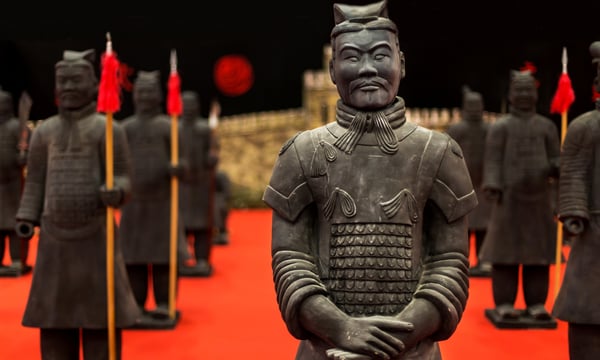
Replicas of the terracotta soldiers made to fill the mausoleum of Qin Shi Huang, China’s first emperor.
Credit: Shutterstock
In some historically minded and politically skeptical corners of China’s internet, an old imperial governing order has become shorthand for very modern discontent. On Zhihu, a Chinese question-and-answer site known for long-form discussions, one representative question asked: “What exactly does historian Qin Hui mean by the ‘Qin system’?” The thread that followed was less interested in settling questions of ancient history than in turning Qin – China’s first unified empire – into a political vocabulary for the present. The discussion moved quickly from Legalism, bureaucratic registration, and imperial rule to more immediate anxieties: the feeling of being constantly ranked, disciplined, and exhausted by large systems that demand compliance while leaving little room to bargain, exit, or organize outside them.
Unlike “lying flat” or “involution,” the Qin system debate has not become a mainstream youth slogan. It circulates instead as a more niche form of historically literate social criticism, among users who translate frustrations with schools, workplaces, platforms, and bureaucracies into a theory of state and society. For its more theoretically minded participants, those everyday frustrations point to a deeper diagnosis: a system that strengthens centralized authority by weakening society, dissolving intermediate communities, and making individuals legible and manageable to large institutions.
Its importance lies not in scale, but in what its recent visibility suggests about how discontent in China is changing. Unlike mainstream youth slogans, this is a smaller and more politically charged vocabulary, used to give systemic meaning to frustrations that might otherwise appear as separate complaints.
The Qin dynasty occupies a distinctive place in Chinese historical imagination. It was the first empire to unify China under a centralized imperial order, and it is remembered not only for standardizing writing, weights, measures, and administration, but also for harsh laws, bureaucratic registration, forced labor, and political control. Qin Shi Huang, the First Emperor, became a symbol of unification and tyranny at once. Shang Yang, the Legalist reformer whose policies helped transform Qin into a powerful state, is often associated with the logic of rewards and punishments, household registration, military mobilization, and the subordination of society to state power.
That historical image gives the online metaphor its raw material. But the “Qin system” invoked in these debates is not simply the Qin of schoolbook history. It is filtered through a modern political-historical critique most closely associated with historian Qin Hui. The older idea that later Chinese dynasties inherited Qin’s political framework had long existed, but Qin Hui gave it a sharper meaning: for him, the Qin system was not only a centralized bureaucracy, but a model of rule in which the imperial state overwhelmed smaller forms of social autonomy and incorporated individuals directly into its administrative order.
In this reading, the problem of the Qin system was not merely tyranny from above, but the destruction or weakening of intermediate communities that might otherwise have given ordinary people forms of protection, solidarity, and social autonomy outside the state. Qin Hui also described imperial rule as Confucian in moral language but Legalist in administrative practice: a system that spoke of ethics while governing through registration, assessment, punishment, and mobilization.
Online, Qin Hui’s framework rarely travels intact. It is compressed, emotionalized, and turned into a portable vocabulary for everyday frustration.
The abstraction became harder to dismiss during the years of “dynamic zero-COVID.” In online criticism, lockdowns were often treated not as isolated public-health measures, but as proof of how quickly administrative power could reorganize everyday life: mobilizing neighborhoods, work units, volunteers, apps, checkpoints, and local officials with extraordinary speed, while leaving ordinary people little room to assert their own needs, grievances, or rights. In this reading, the problem was not only coercion from above. It was the way society itself seemed to be reorganized into administratively usable units: compounds, grids, health codes, neighborhood committees, delivery lists, quarantine categories.
The vocabulary also migrated into more ordinary frustrations: why labor protections remain difficult to enforce, why workers have little collective bargaining power, why students and employees are constantly ranked and assessed, and why safety often seems to come through officially recognized channels – a degree, a civil service position, a platform score, a permit, an institutional approval.
What links these examples is the sense that rights, security, and advancement often seem less like claims individuals can make directly than benefits routed through institutions that decide who is compliant and useful enough to receive them. Labor protections, credentials, permits, platform rankings, and public-sector positions therefore appear not as separate issues, but as parts of a social order in which survival depends on being recognized and sorted by large systems.
The critique becomes sharper in discussions of whether China has been reduced to what Chinese commentators often call “a plate of loose sand” – and whether that condition is an unintended side effect of the Qin system or one of its intended results. The question pushes the debate beyond complaints about pressure or bureaucratic control. It asks whether social fragmentation itself is part of the design: whether a system of rule benefits from people who can be registered, mobilized, assessed, and disciplined as individuals, but who struggle to form durable horizontal ties among themselves.
In this reading, the weakness of labor organizing, neighborhood self-governance, homeowners’ committees, or other forms of collective action is not treated as an accidental failure of modernization. It becomes evidence of a deeper political logic: society is not simply ruled from above; it is kept scattered below.
This is where the Qin system discourse differs from the better-known languages of “lying flat” and “involution.” All three express exhaustion and disillusionment, but they point in different directions. “Lying flat” is about withdrawal; “involution” gives a name to exhausting competition without meaningful progress. The Qin system metaphor turns that exhaustion into a political diagnosis: it asks why withdrawal is difficult, why competition feels compulsory, and why alternatives outside the recognized system seem so scarce. That sharper political edge helps explain why it remains more niche, circulating largely among more historically literate and politically engaged online communities rather than becoming a mainstream youth slogan.
The appeal of the Qin system metaphor lies partly in its promise of historical explanation. Pressure, dependence, and social weakness become symptoms of a larger story about power and society. But this clarity also carries a risk. When contemporary problems are traced back to Qin Shi Huang, Shang Yang, or Legalism as the original source of China’s political order, a structural critique can slide into a form of historical blame. The result is emotionally powerful, but it can obscure the more complicated ways in which Chinese social control evolved across different dynasties, institutions, ideologies, and modern state-building projects.
Ancient history provides a language that is indirect enough to circulate, but suggestive enough for readers to recognize its contemporary implications. Qin Shi Huang and Shang Yang are useful figures in this discourse not only because they belong to the distant past, but because they give a name and a face to forms of power that are otherwise difficult to name directly. Blaming the First Emperor is safer than asking who is responsible for the systems of control people encounter today; denouncing Legalism is easier than identifying the bureaucratic, institutional, and political mechanisms that make ordinary life feel so tightly governed.
Modern social control has no single author. It is dispersed across bureaucratic agencies, workplaces, platforms, local authorities, performance targets, and administrative procedures. That is why the online return to Qin is so revealing. It is not simply a historical misunderstanding, nor only an act of emotional release. The blame placed on the First Emperor may say less about ancient China than about the difficulty of naming power in the present.