Taiwan is one of the hardest places on Earth to invade. Its mountains, the seas that surround it, and its few usable landing beaches have defeated the plans of great powers before. But according to a Taiwanese security scholar, the island’s gravest danger is not the one that would arrive by sea—it is the quieter campaign already under way to wear down the public’s will to resist until the threat no longer feels real.
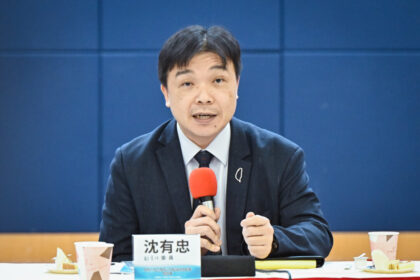
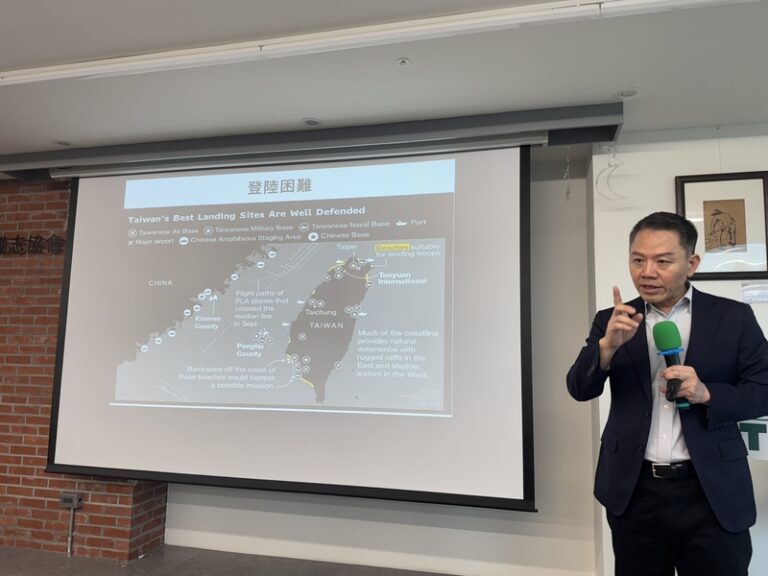
Kuo Yu-jen, vice president of the Institute for National Policy Research, Taiwan’s oldest private think tank, on July 4 delivered that assessment at a recent forum hosted by the Taiwan Inspiration Association.
The Chinese Communist Party’s (CCP) cognitive warfare—its campaign to shape opinion and sap morale—is more dangerous than any warplane or warship, he said, because it erodes trust, breeds helplessness, and gradually numbs Taiwanese people to the danger they face.
Geography alone makes Taiwan a forbidding target, Kuo said. The terrain is rugged, few beaches can support an amphibious landing, and an attacker must first cross roughly 100 miles of open water.
History backs him up. In 1944, U.S. planners drew up Operation Causeway, an invasion of what was then Japanese-held Taiwan, but shelved it after concluding that seizing and holding the island would take more than half a million American troops.
A CCP invasion force today would face the same punishing arithmetic, Kuo said.
Nor would a war over Taiwan stay local. The island anchors the first island chain—the arc running from Japan through Taiwan and the Philippines toward Southeast Asia—and sits astride major shipping lanes and undersea data cables.
A war over Taiwan, Kuo said, would inevitably spill into Japan and the Philippines and draw in the United States.
That warning is behind a famous line Kuo helped bring into the world. In December 2021, he hosted a video address at his institute, during which former Japanese Prime Minister Shinzo Abe declared for the first time that “a Taiwan emergency is a Japanese emergency, and therefore an emergency for the Japan–U.S. alliance.”
Philippine President Ferdinand Marcos Jr. has drawn the same conclusion for his country, Kuo noted.
“In the Philippines, we do not have a choice, because Taiwan is so close to the Philippines, and we have almost 200,000 Filipino nationals who are living and working in Taiwan,” Marcos said in a roundtable with Japanese media on May 18.
‘The Anaconda Strategy’
Because a head-on invasion is so costly, Kuo said, Beijing has chosen to squeeze Taiwan rather than storm it—a multilayered “anaconda strategy,” as Taiwan’s navy commander has called it, built on military drills, aircraft carrier patrols, coast guard “law enforcement” in the gray zone just below the threshold of war, and rehearsals for sea and air blockades.
The squeeze is measurable: Chinese military aircraft flew a record 3,764 sorties into Taiwan’s air defense identification zone in 2025—up 22 percent from 2024, itself a record year—according to Taiwanese Ministry of National Defense data compiled by the Center for Strategic and International Studies.
The goal, Kuo said, is to turn the strait into a closed battlefield—and, by dominating the Taiwan Strait along with the East and South China Seas, to keep American forces from reaching the fight.
Taiwan has adjusted accordingly. With no ambition to retake mainland China, Kuo said, its military has stopped trying to match Beijing plane for plane. It focuses instead on keeping an invader at arm’s length with cheap, mobile, hard-to-target, “asymmetric” weapons—anti-ship missiles, air defenses, and U.S.-made HIMARS rocket launchers—that make any landing prohibitively expensive.
Washington is reinforcing that approach. Kuo noted the $11.1 billion arms package the Trump administration approved for Taiwan in 2025—the largest package on record, weighted toward asymmetric systems—and allies increasingly treating the region as a single theater, from the Korean Peninsula through Okinawa and Taiwan to the South China Sea.
Japan’s longer-range anti-ship missiles, U.S. Typhon missile launchers in the Philippines, and Taiwan’s Hsiung Feng III missiles, he said, now form a web of firepower along the first island chain.
‘Taiwan’s Real Crisis’
Yet for all the hardware, Kuo kept returning to what he called Taiwan’s real crisis, and it lies within: CCP infiltration that deepens political division, hidden agents, and a public not alert enough to the threat. The problem is not hypothetical.
Taiwan prosecuted 64 people in 2024 for spying for China—triple the number from 2021 and the most in a decade—most of them current or former soldiers. The punishments are hardening too: Taiwan’s National Security Bureau chief said in May that the average prison term in Chinese espionage cases climbed from about one year in 2020 to more than six years in 2025.
The island’s lifelines are exposed too, Kuo said, citing vulnerable shipping lanes, power grids, and undersea cables, along with government procurement that reveals too much. Taiwan depends on just 24 undersea cables to stay connected to the world, and Chinese-linked ships were implicated in a string of cable cuts in early 2025—one captain became the first person convicted under Taiwan’s toughened sabotage law.
Still, the threat Kuo stressed most is aimed at minds, not infrastructure. Cognitive warfare outranks the warplanes and ships circling the island, he said, because it works on people—corroding trust, spreading futility, and dulling vigilance until the danger stops feeling real.
His prescription is psychological resilience: civil defense groups trained under realistic conditions, backups for critical infrastructure, alternative communication networks for a crisis, and leaders who stay visible and speak steadily when disinformation surges.
In the end, Kuo said, everything turns on a single question—whether the Taiwanese people keep the will to resist at all.
Chung Yuan contributed to this report.