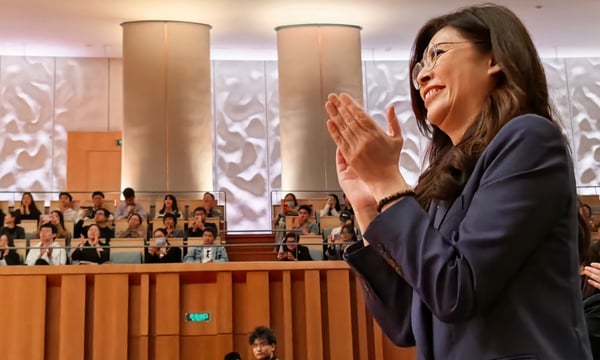
Cheng Li-wun, the chair of Taiwan’s Kuomintang (KMT), visited China from April 7 to April 12 as part of a six-day trip during which she met with Chinese President Xi Jinping. The trip is expected to make the domestic politics of the pan-Blue camp more contentious going forward.
Cheng’s rise to become KMT chair was relatively unexpected. Although not new to the political stage, Cheng was mostly a marginal figure, and it was expected that former Taipei mayor Hau Lung-bin would handily win the chair race.
Cheng won as a dark horse candidate who expressed hardline views in support of unification. She said she hoped to one day see “Taiwanese proud to be Chinese,” and framed Russia’s invasion of Ukraine as a defensive war provoked by Ukraine becoming too close to NATO. The implication was that Taiwan might see a similar fate if it became too close to the United States. As chair of the KMT, Cheng further stoked controversy by attending a memorial ceremony for a spy executed by the KMT government for spying for the Chinese Communist Party (CCP) during the Cold War.
Cheng also made her desire to visit China to meet with Xi known while campaigning in the chair race.
It is not unusual for KMT chairs to meet with Xi Jinping. During Xi’s 13 years in office as Chinese president, the KMT has rotated through six chairs (not counting temporary acting chairs). Cheng is the fourth of those six KMT chairs to meet with Xi. Of the two chairs that did not meet with Xi – Wun Den-yih and Johnny Chiang – Chiang expressed a willingness to meet with Xi, even if Chiang is generally considered a moderate on cross-strait relations and may not have actually wanted to meet with Xi.
Over the course of her trip to China, Cheng made two major policy addresses. The first address took place at the Sun Yat-Sen Mausoleum in Nanjing, Cheng’s first destination on her travels, while the second was during her meeting with Xi. During her speech, Cheng drew on the history of Sun Yat-sen as a figure who unites the Republic of China and the People’s Republic of China, in that both polities consider him to be their founding father. Cheng discussed the history of shared culture between Taiwan and China in civilizational terms.
However, Cheng was notably aggressive in her comments toward what she termed “Western despotic culture” (西方的霸道文化) juxtaposing this to the peaceful Asian civilization that embodied Sun Yat-sen’s “Kingly Way” (東方的王道文化). Cheng referenced the history of the Sino-Japanese War, suggesting that the war occurred, this occurred because Japan had strayed and internalized Western influences.
Cheng was wading into a charged debate in Taiwan about World War II. Taiwan has a complicated history with the Sino-Japanese War, during which Taiwan was a Japanese colony. Accordingly, Taiwanese troops fought on the side of Japan.
President Lai Ching-te of the Democratic Progressive Party (DPP) commemorated the 70th anniversary of the end of the Pacific War last year by stating that the outcome of the war showed the fate of powers bent on annexation – a jab at China. The KMT accused Lai of failing to call out the Japanese Empire.
Cheng’s comments at the Sun Yat-Sen Mausoleum were also notable because of how she framed the 1992 Consensus. The 1992 Consensus has historically been referred to as the consensus that there is “One China,” with “different interpretations” of that “One China” between the ROC and PRC. In past years, the CCP has been criticized for dropping the “different interpretations” aspect of the 1992 Consensus, to only emphasize “One China.”
Cheng, however, phrased the 1992 Consensus as “One China, oppose Taiwanese independence.” This phrasing was notably echoed by Xi Jinping when he and Cheng met. This has been interpreted as Cheng calling for a United Front between the CCP and KMT to combat the DPP. Both the CCP and KMT have depicted the DPP as dead-set on an ideological agenda of independence, even if the party currently claims to uphold the status quo.
Cheng’s meeting with Xi mostly took place behind closed doors. Media heard Xi’s opening remarks – which included framing the 1992 Consensus as “One China, oppose Taiwanese independence” – but were asked to leave midway through Cheng’s comments. The KMT later released Cheng’s remarks, and Cheng herself recapped some of what Xi said in a press conference held after the meeting. Nevertheless, pan-Green critics have suggested that Xi may have said something different than what Cheng recounted, as well as pointing out that she may not have read the version of her remarks that was released to the Taiwanese public during the actual meeting.
Cheng’s released comments referenced framings used in past years to depict Taiwan as being part of China, including referring to both sides of the Taiwan Strait as a “community of common destiny,” “one family,” and “descendants of the Yellow and Yan Emperors.” Cheng also stated that Taiwan should contribute to the “great rejuvenation of the Chinese nation,” a phrase commonly used by Xi Jinping to refer to a project of national revival (and which, notably, includes the project of cross-strait unification).
Cheng called for the 1992 Consensus to serve as the bedrock of exchanges between both sides. She also praised China for its poverty alleviation and having achieved a “moderately prosperous society” through its five-year plans, echoing language commonly used by the CCP to describe its domestic achievements.
Cheng outlined several avenues for cooperation between Taiwan and China, including AI, sustainable development, disaster prevention, medical care, and carbon reduction. To win over young people born after 1992, there would be an emphasis on youth exchanges. She also stated that Xi had suggested energy as a potential field of cooperation. After the outbreak of the Iran War, China made an offer to guarantee Taiwan’s energy security if Taiwan agreed to accept Chinese sovereignty.
Cheng called for institutional mechanisms to hold dialogue between the CCP and KMT on the basis of the 1992 Consensus. She also urged Taiwan’s inclusion in international organizations from which it is currently excluded due to Chinese pressure, such as the World Health Organization and the International Civil Aviation Organization, and accession to regional trade blocs where Chinese pressure currently poses an obstacle to Taiwan’s participation, such as RCEP and the CPTPP. That being said, pan-Green critics noted that Cheng’s call for Taiwan’s inclusion in such bodies was not in the portion of her speech heard by the media before being asked to leave.
Most notably, Cheng closed her remarks by inviting Xi Jinping to travel to Taiwan. In the press conference after her meeting with Xi, Cheng stated that she hoped to see this take place with the KMT as a ruling party, suggesting that this meeting would be contingent on the KMT retaking political power.
Also in the press conference, Cheng claimed that Xi had expressed respect for Taiwan’s political system and hoped to see Taiwan similarly respect China, so long as both sides contributed to the “rejuvenation of the Chinese nation.” Cheng claimed that Xi’s views were in line with Sun Yat-sen’s “Three Principles of the People.”
When questioned as to whether she had shifted the meaning of the 1992 Consensus to “One China, oppose Taiwanese independence,” Cheng denied this, stating that the meaning of the 1992 Consensus was self-apparent. Nevertheless, she claimed that “enemies of peace” were seeking to change the meaning of the 1992 Consensus.
It remains to be seen if other KMT politicians will take up the new framing of the 1992 Consensus as “One China, oppose Taiwanese independence.” Cheng is not the only KMT chair to have sought to redefine the 1992 Consensus – but she is perhaps the only one who was successful in having Xi Jinping echo her language.
Past KMT politicians who have managed to control the party’s relationship with China, such as Lien Chan and Ma Ying-jeou, were historically dominant in the party and served as its presidential candidate. Speculation is increasingly in Taiwan that Cheng will seek to challenge other, more moderate presidential KMT frontrunners – such as Taichung mayor Lu Shiow-yen and Taipei mayor Chiang Wan-an – for the KMT’s presidential nomination in 2028.
Cheng’s trip to China makes for an interesting juxtaposition: Lu and Chiang have sought to pad out their diplomatic portfolios by visiting the United States to meet with mayors of American cities. Notably, when Cheng was seen off by Taiwan Affairs Office director Song Tao, Song stated that they would “meet again,” leaving the door for future meetings open.
Certainly, Cheng’s profile has seen a boost in Taiwan as a result of her trip. But not all publicity was positive. She came under additional scrutiny for her apparent political U-turn: Cheng began her political career as a DPP member who advocated Taiwanese independence and was critical of KMT authoritarianism. Reports have since emerged that Cheng’s husband, Luo Wu-chang, may have helped spy on student activist groups for the KMT during the authoritarian period, with speculation that their marriage changed Cheng’s political views. Such allegations are not new in Taiwanese politics, with former president Ma Ying-jeou having faced allegations that he spied on student groups in the US.
In the meantime, it is to be questioned to what extent Cheng’s China trip was advisable for the KMT. The party’s electoral defeats in past years have often occurred because of the perception from the public that the KMT is too pro-China.
The DPP may have been unwittingly given a great deal of political ammunition through Cheng’s China visit. For example, the DPP pointed out that China continued to declare military exercises throughout the course of Cheng’s trip, seemingly casting doubt on her ability to dial back cross-strait tensions.
The People’s Liberation Army announced live-fire exercises in the Yellow Sea in the middle of the trip and continued to carry out air incursions into Taiwan’s Air Defense Identification Zone (ADIZ). In fact, the number of planes intruding into the ADIZ actually increased in the period leading up to the Cheng-Xi meeting. Likewise, the PLA has reserved five zones of airspace stretching 340 miles from the Yellow Sea to Shanghai, indicating plans for prolonged military activity.
Meanwhile, comments by national security officials suggested that there was coordination between the KMT and CCP ahead of the meeting, given the high degree of overlap between Cheng’s comments and CCP messaging when it came to preferred terminology and nomenclature.
The Lai administration has linked Cheng’s trip to the KMT’s continual blocking of defense expenditure in the legislature. During the trip, the KMT did not appear during a committee meeting on defense spending, but submitted a proposal that would subject future arms purchases to approval by the legislature. The KMT and its ally, the Taiwan People’s Party (TPP), have submitted proposals to delay the discussion of defense expenditure. Critics have suggested the pan-Blue camp is stalling talk on defense spending until after the expected meeting between U.S. President Donald Trump and Xi Jinping in May, perhaps as a way to give Xi more negotiating power.
After Cheng’s trip ended, China announced 10 measures for Taiwan that would be incentives for strengthening ties – presumably a means of showing that Cheng’s trip had dividends for the Taiwanese public. The 10 measures largely follow Cheng’s suggestions or previous measures announced in the past by the Chinese government. China will allow individual travel from Shanghai and Fujian to Taiwan, and flights to Taiwan from Chinese cities such as Harbin, Lanzhou, Kunming, Urumqi, and Xi’an will be allowed to resume. Efforts will be made to develop institutionalized communication between the KMT and CCP on the basis of the 1992 Consensus, while youth exchanges for the two parties are to also take place. Taiwanese cultural content that accords with the “correct orientation” will also be allowed into the Chinese market, perhaps continuing efforts to facilitate the integration of Taiwan and China’s cultural industries so as to influence viewpoints in Taiwanese society.
Most notably, however, Taiwanese agricultural, fishery, and food products will be allowed access to the Chinese market so long as they come from groups that oppose independence. China has periodically banned various Taiwanese agricultural, fishery, and food products to show displeasure with the Lai administration in past years. Beijing has also suggested that it would seek to create a list of “pro-independence” companies that it would ban from the Chinese market. In the past, however, when China fined or carried out other legal measures against Taiwanese companies for being “pro-independence,” that did not always accord to companies that were close to the DPP.