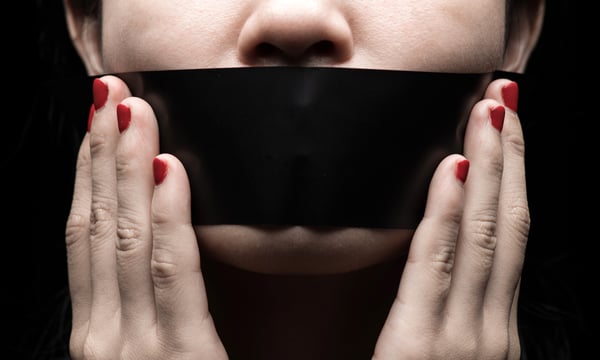
Recently, a Chinese stand-up comedian, Xiao Pa, was temporarily banned from posting on Weibo after sharing a brief personal reflection. Sick with a fever and lying in bed for two days, she wrote that a thought suddenly crossed her mind: if she had a husband and child, she might still have to get up and cook for them even while ill. The comment was quickly removed, and the comedian was accused of “stoking gender conflict” and “creating anxiety about marriage and childbirth.” Yet screenshots of the post continued circulating widely online.
Such moments have become increasingly familiar in China’s digital landscape. A WeChat article I once saved to read later, titled “Behind a Wife-Killing Case: A Marriage She Could Not Leave,” was replaced within hours by a familiar warning: “This article has been reported and, upon verification, violates the People’s Republic of China’s Internet Regulations.” For many Chinese women, reading, screenshotting, and sharing quickly has become routine, a quiet survival strategy under constant digital surveillance.
This environment has produced what might be called “post-censorship feminism” – a form of activism shaped as much by repression as by choice. While these strategies are rooted in China’s tightly controlled digital environment, they also offer insight into how activism adapts when public speech becomes risky.
Earlier waves of feminist discourse in China sought visibility. Women posted openly about harassment, discrimination, and domestic violence, hoping to spark public debate and pressure institutions to respond. But with online speech tightly controlled, visibility can quickly become vulnerability. Posts are deleted, accounts suspended, and outspoken women often face waves of online harassment or coordinated reporting campaigns accusing them of undermining social stability.
In response, feminist expression has adapted. Instead of relying on public campaigns, discussions increasingly circulate through coded language and informal networks. Emojis, homophones, classical quotations, and inside jokes allow messages to travel without immediately triggering censorship. Private chat groups preserve screenshots of deleted articles or posts before they disappear. Visibility is no longer the goal; persistence is.
The limits of visibility became clear during China’s #MeToo movement. At the time, women publicly exposed sexual harassment and sought accountability through hashtags, open letters, and online testimonies. But this online exposure carried along risks. Posts were deleted, accounts were suspended, and many women faced intense backlash: harassment from strangers online, criticism from colleagues, and moral judgment from peers and even family members.
Over time, these strategies evolved further. Humor, coded language, and private networks became safer ways to share experiences and support one another. Across platforms such as RedNote, Douyin, and Bilibili, women exchange stories and practical advice about everyday struggles. Some posts circulate concrete information: how to document abuse, navigate China’s mandatory divorce “cooling-off period,” or recognize patterns of coercive control in relationships. Others introduce concepts that help women reinterpret their experiences, from discussions of emotional labor to critiques of gender expectations in marriage.
Even when original posts disappear, their traces often remain. Screenshots circulate through private chats or shared documents, preserving stories that would otherwise vanish. These digital webs function less like formal organizations and more like loosely connected communities built on trust and shared experience. In a society where official feminism, promoted by the All-China Women’s Federation, emphasizes women’s roles as mothers and caregivers, these informal networks document everyday forms of frustration, resistance, and nonconformity that rarely appear in official narratives.
The importance of these networks is amplified by broader social conditions. China’s Supreme People’s Procuratorate reported just over 3,400 prosecutions in domestic violence cases over the past five years, a strikingly small number given surveys suggesting that roughly 39 percent of ever-partnered women have experienced physical or sexual abuse. Regional prevalence ranges from about one-third to over half of women, highlighting stark inequalities in access to protection. At the same time, a 2025 Human Rights in China report warned that pronatalist policies risk further encroaching on women’s autonomy.
Within this context, online feminist communities function as informal spaces of learning and mutual support. Women exchange knowledge about legal rights, reproductive health, and relationship dynamics while also sharing stories that challenge dominant expectations about marriage, motherhood, and gender roles. Preserving this knowledge, particularly knowledge about alternative ways of living or resisting social pressure, can itself become a form of resistance in an environment where deviation from social norms is often discouraged.
Creative formats often carry these conversations in indirect ways. On RedNote, hashtags such as #我值得拥有 (“I am worthy”) encourage reflections on independence and self-worth. On Bilibili, anime edits and pop-culture remixes parody sexist tropes, allowing humor to double as social critique. On Douyin, lip-sync videos sometimes borrow lines from television dramas – phrases about refusal, independence, or self-determination – to convey messages about consent and autonomy through performance and irony.
These strategies come with limitations. Decentralized networks are fragile and rarely capable of large-scale mobilization. Conversations often remain small and private, relying on trust built slowly through personal connections. Yet even in this constrained form, they produce meaningful effects. Women share information, offer comfort, and remind one another that experiences of discrimination or abuse are not individual failures but part of broader social patterns.
What is emerging in China may also foreshadow the future of digital activism elsewhere. Across the world, political pressure and algorithmic moderation increasingly shape what can be said on online platforms. The Chinese example shows that repression does not eliminate political consciousness; instead, movements adapt. Memory circulates in coded ways, and a sense of shared commitment to social change persists. In an era when visibility itself can be risky, the simple acts of connecting, sharing, and remembering can become quietly radical.