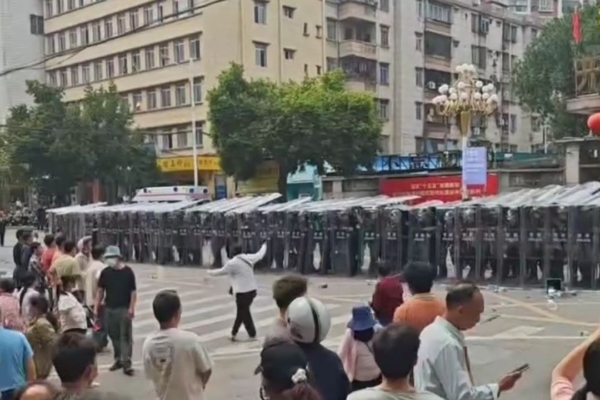
Hundreds of residents in the southern Chinese city of Maoming clashed with riot police on March 17 and 19, after protesting the construction of a cremation facility near their community, according to residents and videos from the scene.
The unrest unfolded over three consecutive days, and the authorities deployed large numbers of officers equipped with batons and shields to disperse demonstrators, resulting in injuries and arrests, according to residents who spoke to The Epoch Times on the condition of anonymity or of using only their surnames out of fear of reprisal.
The protests were triggered by a notice issued by local authorities on March 16 announcing plans for the new cremation funeral facility. Officials said the project would be built on suburban land with no population within a 500-meter (approximately 1,640-foot) radius and would cost about 145 million yuan ($20 million). Construction was scheduled from March through December.
In China, cremation is the most common means of handling human remains, and such facilities are usually located outside of population centers because of pollution and cultural stigma.
Local residents, however, alleged that the authorities had lied, as they had not been informed of the project in advance. Originally, the state’s land acquisitions were carried out under the pretext of road construction, according to a local resident.
“We only found out after the public notice was released,” the resident told The Epoch Times. “By then, the foundation had already been built.”
Protests and Censorship
Protests began on March 17, when several hundred locals gathered outside a local committee office. Police were deployed in similar numbers, and physical confrontations broke out, leaving at least one person injured and others detained, according to the resident.
Video footage circulating online shows rows of riot police forming shield lines as residents confronted them. Officers were seen pushing into crowds and striking individuals with batons as clashes intensified.
On March 18, residents took their protest to the city officials’ offices, but they said their demands went unanswered.
By March 19, hundreds again gathered outside a regime compound, where riot police blocked access with shield formations. Videos show protesters throwing umbrellas and stones toward officers, while police advanced on the crowd. In the ensuing chaos, officers used batons to disperse demonstrators, and some protesters were injured.
Residents said authorities imposed tight controls as the protests continued. Roads leading into the area were blocked, and checkpoints that required identification for entry were set up, according to a local resident surnamed Fang, who was not in the area but remained in contact with family members.
“Electricity was also cut to at least two nearby villages for extended periods,” Fang said, and local officials were warned not to participate in the protests.
Information about the clashes has been restricted, residents said; videos and messages from the scene are no longer able to circulate on China’s state-censored social media platforms.
Concerns Over Location
Local residents said their opposition stems from both environmental concerns and cultural sensitivities. The planned site lies close to residential areas, an elementary school, and local water sources, they said.
“People are worried not just about pollution, but also the psychological impact of having a [cremation] funeral facility so close to where they live,” Fang said.
Fang said that local authorities had previously considered multiple locations for the project, each of which faced strong local opposition.
Disputes over funeral and cremation facilities have sparked unrest in the region before.
In 2019, plans to build a crematorium in nearby Huazhou led to large-scale clashes between residents and police. Demonstrators overturned government vehicles and damaged police cars, while authorities responded with tear gas and water cannons.
The project was later suspended and ultimately canceled following continued protests.
Gu Xiaohua contributed to this report.