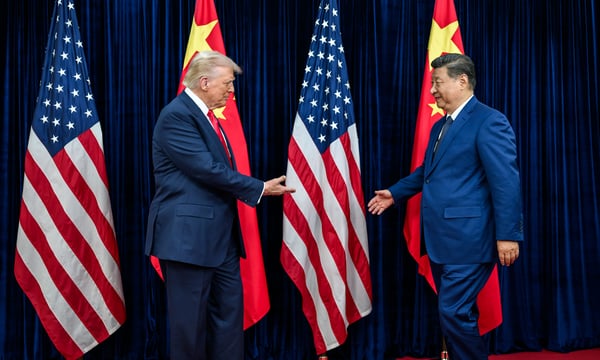
Within hours of the United States and Israel launching “Operation Epic Fury” against Iran on February 28, timelines across the Washington policy world and the China-watching community converged on a single question: is U.S. President Donald Trump’s planned visit to Beijing, confirmed by the White House for March 31 to April 2, now dead?
The surface logic seemed persuasive. China’s Foreign Minister Wang Yi called the strikes “unacceptable,” condemning the killing of a sovereign leader and the incitement of regime change. Foreign Ministry Spokesperson Mao Ning stated the operation “tramples on the purposes and principles of the U.N. Charter.”
External analysts extrapolated from there: CNBC asked whether a protracted Iran war might postpone the China visit. George Chen of the Asia Group questioned how China’s Xi Jinping could welcome Trump in a cheerful mood while the U.S. is actively at war with Iran.
However, the speculation reveals more about how the Western analytical community imagines Chinese decision-making than about how it actually works. The institutional logic that governs how Beijing processes external shocks and manages its diplomatic calendar signals that the summit will probably proceed. Not because Iran does not matter to Beijing, but because the machinery driving this visit operates on a fundamentally different track, one that external disruptions bend but rarely break.
The Institutional Conveyor Belt Is Already Moving
Those who have never worked inside the Chinese policy system tend to underestimate one of its most powerful features: institutional stickiness. A state visit of this magnitude is not a calendar entry that gets casually erased. It is the product of months of cross-ministry coordination involving the Ministry of Foreign Affairs, the Ministry of Commerce, the National Development and Reform Commission, protocol offices, and embassies on both sides.
On February 27, it was reported that Beijing had declared “all hands on deck,” with multiple departments tasked with researching Trump’s likely demands and formulating possible concessions. Agreements were already being mapped out across energy, aviation, and agricultural purchases.
The Chinese embassy in Washington was activated as a channel; academics and former officials were tapped to gauge Trump’s thinking. A senior delegation led by Wu Ken, president of the Chinese People’s Institute of Foreign Affairs, traveled to the United States in early February to meet American counterparts – including Evan Greenberg, executive vice chairman of the National Committee on U.S.-China Relations, an interlocutor Trump himself appointed to a White House trade advisory committee during his first term.
Chinese policy voices reinforce this reading. Henry Wang, president of the Center for China and Globalization, argued on Bloomberg that the Iran crisis makes the summit more urgent, not less – that the two countries “should really talk to each other and find a way to stabilize the global situation.”
Wu Xinbo at Fudan University has been publicly flagging the prospect of a “grand deal” in domestic-facing commentary. It is the kind of language a senior Chinese policy-scholar deploys only when he senses the leadership is thinking in those terms.
Wang Jisi of Peking University co-published a major Foreign Affairs article with an American counterpart, a move that in China’s academic-diplomatic ecosystem functions less as independent commentary than as carefully calibrated track-two groundwork laid with leadership awareness.
This is what institutional pre-loading looks like in the Chinese system. The entire bureaucratic ecosystem is already in motion, with ministries, think tanks, and academics close to ministries competing to place deliverables on the summit table, and individuals staking access and reputation on outcomes. Shutting this machinery down would require an affirmative decision at the very top and would send precisely the signal of strategic indecision the system is designed to avoid.
The most telling evidence that the institutional track remains intact came on March 3, when Bloomberg reported that Treasury Secretary Scott Bessent and Vice Premier He Lifeng are slated to meet in Paris around mid-March to prepare summit deliverables. Bloomberg explicitly framed this as a signal that the planned summit “is pushing ahead despite American strikes against Iran.” Those who understand the Chinese system know the Bessent-He meeting is a waypoint on a carefully sequenced path leading to the summit itself.
The Top-Down System Absorbs Shocks
When an external shock like Operation Epic Fury hits, it is processed by China’s bureaucratic apparatus as operational input. The system extracts lessons, calibrates messaging, and makes targeted amendments to the existing plan. Think of a large vessel adjusting course by a few degrees in response to a crosswind, not executing a U-turn.
History confirms this pattern with striking consistency. After the 1999 Belgrade embassy bombing, China’s then-leader Jiang Zemin refused U.S. President Bill Clinton’s calls for a week, but both leaders met at APEC Auckland four months later and relaunched WTO negotiations. After the 2001 EP-3 incident, Bush and Jiang met at APEC Shanghai six months later. During the 2018–2019 trade war, Trump-Xi bilaterals proceeded at G-20 Buenos Aires and Osaka despite active tariff escalation. The February 2023 spy balloon incident forced then-U.S. Secretary of State Antony Blinken to postpone his Beijing trip, but he traveled months later and met Xi at the Great Hall of the People.
Beijing’s public rhetoric and its operational posture are different registers. The condemnations serve domestic nationalist audiences and diplomatic signaling. They should not be read as evidence that the summit track is in jeopardy. Experienced observers of this system know to separate them. As the Carnegie Endowment’s Evan Feigenbaum argued on March 2, it is a “fundamental conceptual error” to project Western alliance logic onto Chinese foreign policy and assume Beijing feels treaty-bound solidarity with Tehran.
The United States’ pluralist system, buffeted by domestic opinion, congressional grandstanding, and media cycles, is the one that makes quick adjustments to external shocks. China’s centralized, elite-led apparatus does the opposite. It absorbs, recalibrates, and holds course. Those predicting cancellation are projecting the reflexes of the U.S. foreign policy system onto a Chinese one that simply does not operate that way.
It is worth asking who in China is calling for cancellation. The answer is nationalist netizens, not the elites who shape decisions. The voices that matter in this system are doing the opposite. Western analysts who sample the former and mistake it for the latter are reading the wrong signal from the wrong layer of a system they claim to understand.
Iran Reshapes What Is on the Table
However, Operation Epic Fury is not irrelevant to the coming China-U.S. talks. It has reshaped their economic center of gravity. Iran supplies approximately 1.38 million barrels of oil per day to Chinese refineries, and roughly 40 percent of China’s crude imports transit the Strait of Hormuz. Qatar’s force majeure on its two main LNG facilities has knocked out one-fifth of global LNG export capacity. This is the most severe energy supply disruption since the 1973 oil embargo.
Yet China’s exposure is asymmetric relative to its regional peers. Combined reserves cover 96 to 121 days of imports; Russian and Central Asian pipeline flows are immune to maritime disruption; domestic crude production hit a record 4.32 million barrels per day in 2025. Among Asian buyers, China alone possesses both the time buffer and the bargaining leverage that buffer confers.
China can also credibly frame the United States as the party responsible for triggering an international energy shock affecting not just Chinese markets but the entire Global South. This allows Beijing to enter negotiations from a position of moral grievance, casting itself as the stabilizing power managing U.S. unilateralism’s fallout, strengthening its hand on energy trade terms, LNG pricing, and sanctions relief.
The leverage cuts both ways. By disrupting Iran’s supply, Washington has manufactured demand that U.S. LNG can fill. With the Supreme Court’s February 20 ruling striking down IEEPA-based tariffs and the Busan framework’s November sunset clause approaching, Trump needs quantifiable energy commitments as summit deliverables before the 2026 midterms. The crisis has vaulted energy from a mid-tier agenda item to the summit’s centerpiece.
Here lies the paradox undermining the derailment thesis: the very disruption commentators cite as a reason to cancel the summit has increased the stakes of holding it.
The Discipline of Long-Range Reasoning
This episode deserves a final reflection that extends beyond the specific case. In an era of AI-accelerated content production, scarce attention, and the flood-the-zone information environment, the incentive structure for policy commentators overwhelmingly rewards speed and dramatic conclusions over careful reasoning. Every breaking news event becomes a prompt to generate hot takes that sever long-range logical threads.
This is a form of intellectual indiscipline, and it carries real costs. When analysts reflexively treat every shock as a system-resetting event, they lose sight of the structural and bureaucratic forces that drive outcomes. They mistake noise for signal.
The policy community, especially those of us who study China, ought to resist this temptation. The value of serious analysis lies in the ability to hold a long-range thesis steady against short-term turbulence, to distinguish between what is disruptive and what merely appears so, and to understand that the systems we study possess their own deep logic that does not bend to our news cycles.
Will Operation Epic Fury influence the Trump-Xi summit? Almost certainly – in substance, in tone, and in bargaining dynamics. Will it cancel it? No. The machine is already in motion. And in Beijing, machines like this do not stop easily.