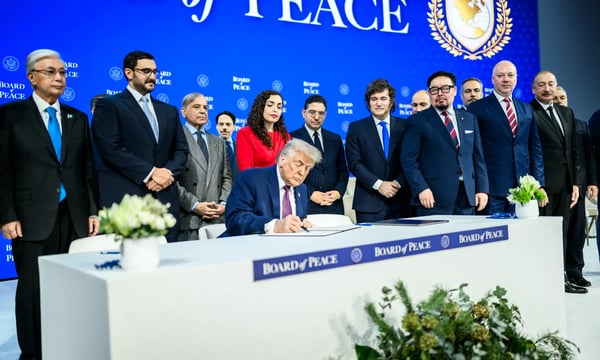
The launch of the so-called “Board of Peace” by the United States under President Donald Trump on January 22 immediately generated considerable controversy across the international community. Critics in Western Europe and elsewhere have raised concerns that the mechanism – originally limited to Gaza, but seemingly keen to expand its ambit – may undermine the authority of the United Nations, concentrate excessive power in the hands of the United States, or introduce new uncertainties into an already chaotic and fragile contemporary international order.
Yet for China, the question of whether to join the Board of Peace should not be approached through a purely ideological lens. Instead, it deserves sober, strategic, and interest-based analysis.
On January 20, at the Ministry of Foreign Affairs’ spokesperson’s regular press conference, China officially acknowledged receiving an invitation to join the Board of Peace. MOFA spokesperson Guo Jiakun elaborated on the Chinese stance on January 21. “China always practices true multilateralism. No matter how the international landscape may evolve, China will stay firmly committed to safeguarding the international system with the U.N. at its core,” Guo said.
At this moment, keeping silent may seem to be a safe option. However, non-participation also carries costs, both for China’s influence in the Middle East and for its broader role in shaping an emerging mechanism of global governance.
China should seriously consider joining the Board of Peace – not as an endorsement of U.S. unilateralism, but as a pragmatic decision consistent with China’s long-standing diplomatic principles, its expanding global responsibilities, and its strategic interests in the Middle East and beyond.
The Middle East and China’s Growing Stake
Over the years, the Middle East has become increasingly important to China’s energy security, trade routes, overseas investments, and political partnerships. According to Chinese state media CGTN, trade volumes between China and the Arab League set a new record in the first seven months of 2025, though the statistics for the whole year have not yet been released
The ongoing Gaza conflict, while geographically limited, carries systemic implications for regional stability, radicalization, humanitarian issues, and the credibility of contemporary international conflict-management mechanisms.
From the Chinese perspective, prolonged instability in the Middle East threatens several Chinese interests. First, it undermines regional security in a region central to China’s energy imports. Second, it fuels humanitarian crises that damage the legitimacy of the U.N. Charter-based international system China endeavors to uphold. Third, it exacerbates geopolitical competition among major powers in ways that may marginalize China if it remains absent from key decision-making platforms.
Concerning the Israel-Palestine issue, China has consistently supported a comprehensive ceasefire, humanitarian access, and a political solution based on the two-state framework. However, diplomatic statements alone are no longer sufficient to demonstrate leadership. As China’s international status rises, so too do expectations, especially from the Global South. Pressure is growing for China to move beyond principled positions toward constructive participation in conflict resolution and post-conflict reconstruction.
Trump’s Board of Peace: Risks, Limitations, and Realities
There is no denying that the Trump-invented Board of Peace is a highly unconventional mechanism. The leaked draft version of the Charter grants the United States andTrump himself extreme authority, including veto power and the ability to appoint leadership. The requirement that permanent seats must be purchased through large financial contributions further complicates perceptions of legitimacy.
Moreover, the board’s ambiguous relationship with the United Nations and other regional mechanisms has raised legitimate concerns. China has repeatedly emphasized that the U.N. Security Council is the only body with primary responsibility for maintaining international peace and security. Any structure that appears to sideline or even replace the United Nations must therefore be approached with extreme caution.
At the same time, it is important to recognize political reality. Even before its official launch on January 22, the Board of Peace had already received authorization through a U.N. Security Council resolution, giving it at least provisional international legitimacy through 2027. At least 26 countries have confirmed their willingness to join the board; 20 sent top leaders to the launch ceremony in Davos.
It is worth noting that multiple regional powers, including key Arab and Muslim-majority states such as Turkiye, Saudi Arabia, and Pakistan, have chosen to participate, not because the mechanism is ideal, but because it offers a platform to influence outcomes that will shape Gaza’s future. It was reported on January 22 that Russia is also considering joining.
From the Chinese perspective, the core question is not whether the Board of Peace is perfect, but whether China’s absence would improve or worsen the present situation.
Participation as Influence, Not as Endorsement
In the first place, joining the board does not necessarily require China to abandon its principles. On the contrary, participation provides an opportunity for China to inject those principles into a flawed mechanism.
China has long advocated consultation, inclusiveness, respect for territorial sovereignty, and opposition to power politics, epitomized in its new “Global Governance Initiative.” These values carry little weight if China is not present where decisions are debated and implemented. If China remains outside the board, it forfeits the opportunity to shape its operational norms, constrain unilateral impulses, and advocate for closer coordination with the U.N. Charter-based system.
In the past, when emerging governance mechanisms were created without China’s involvement, rules and practices often solidified in ways that disadvantaged Chinese interests. Early engagement allows China to influence agendas, promote balance, and prevent the institutionalization of norms that contradict multilateralism. Participation in the board, therefore, should be interpreted not as legitimizing U.S. dominance, but as exercising strategic agency within an imperfect structure.
Admittedly, it can be expected that the majority of Chinese domestic scholars and analysts would worry that joining the Board of Peace could contradict China’s stated commitment to the U.N. Charter-based international order. Nonetheless, China can explicitly frame its participation as conditional and complementary.
By emphasizing that the Board of Peace operates under a U.N. Security Council mandate and that its legitimacy ultimately derives from international law, China can reinforce the central role of the United Nations. Chinese representatives can consistently advocate for transparency, accountability, and coordination with existing U.N. agencies on humanitarian assistance and reconstruction by actively participating in the operation of the board. In this way, China’s presence could act as a stabilizing force, preventing the Board of Peace from drifting further toward U.S.-dominated unilateralism.
Strategic Signaling to the Global South and the Arab World
Traditionally, China’s credibility in the Arab world rests on its image as a fair-minded, non-colonial power that respects regional voices. As mentioned earlier, several key Arab states have already decided to join the board, viewing participation as the best available means to influence Gaza’s reconstruction and political trajectory.
If China remains absent, it risks being perceived as rhetorically supportive but operationally disengaged. This would weaken China’s soft power precisely at a time when many developing countries are looking to Beijing for leadership in reforming global governance. By contrast, China’s participation would send a powerful signal: that China is willing to shoulder responsibility, engage pragmatically, and work alongside regional actors to pursue stability and humanitarian relief, even within imperfect frameworks.
Managing China-U.S. Competition through Engagement
The Board of Peace also intersects with broader China-U.S. relations. While competition between China and the United States is structural, selective cooperation remains possible and, in some cases, desirable. Joining the board will also be welcomed by Trump before his scheduled state visit to China this coming April.
Engaging within the Board of Peace arguably also offers China a controlled environment to test limited cooperation on humanitarian and peace-building issues without compromising core interests. It also reduces the risk that the U.S. monopolizes credit for Gaza’s future.
More importantly, participation does not imply strategic alignment with U.S. Middle East policy. Rather, it allows China to demonstrate that major power competition need not preclude cooperation on urgent global challenges.
For China, joining the Board of Peace is not about endorsing U.S. leadership or abandoning multilateralism. It is about safeguarding China’s own national interests, supporting regional stability, and demonstrating responsible major power behavior. By participating with clarity, caution, and confidence, China can help steer the board toward greater balance, legitimacy, and effectiveness, while reinforcing its own role as a constructive force in an uncertain world.