Between 2019 and 2021, the world witnessed a barrage of shrill and belligerent public outbursts by China’s diplomats. This wave of loud and combative Chinese diplomats assailing individuals and governments in public settings, as well as in the traditional media and on social media, was dubbed “wolf warrior diplomacy.”
The label was drawn from two popular jingoistic action films both titled “Wolf Warrior.” It was the sequel that became a box office smash hit. This 2017 action film tells the story of a lone wolf soldier battling foreign mercenaries in a fictional African country to protect Chinese civilians and confront China’s enemies. It popularized the term, making “wolf warrior” synonymous with heroic Chinese patriot.
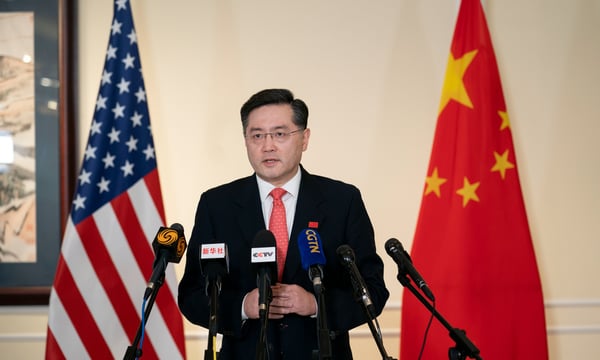
Where did wolf warrior diplomacy come from and where did it go? The fates of prominent Ministry of Foreign Affairs (MFA) wolf warriors may provide some insights. Two of the most high-profile diplomats were Qin Gang, who served as China’s vice minister of foreign affairs, then Beijing’s ambassador to Washington before becoming foreign minister, and Zhao Lijian, a minister-counselor in China’s embassy in Pakistan who was subsequently promoted to MFA spokesperson.
There are various explanations for the wolf warrior phenomenon. Some say the term is best understood as the moniker for a younger generation of aggressive Chinese diplomats. Another explanation is that it’s the label for a distinct Xi Jinping brand of diplomacy; conversely, it can also be understood as a long-standing tactic drawn from a dog-eared MFA diplomatic playbook.
Moniker for a New Generation?
Available evidence suggests that wolf warrior is not the descriptor of a rising generation of rabid or belligerent firebrand Chinese nationalists. The current crop – or fifth generation – of Chinese diplomats, including Qin Gang and Zhao Lijian, joined the MFA in the 1990s in their 20s, many straight out of college. This generation embarked upon decades-long careers with extensive experience accumulated from multiple overseas postings and homefront office assignments. They are consummate cosmopolitan professionals, many of them proficient in one or more foreign languages.
Zhao earned a degree in foreign language studies from a second-tier provincial university and acquired fluency in English. He entered the MFA in 1996 at age 24, advancing steadily albeit unremarkably over the next 20 years, including postings in the United States (once) and Pakistan (twice).
Qin, meanwhile, graduated from university in 1988, worked as an interpreter for several years, and then entered the MFA in 1992 at age 26. Over the next 20 years he held a series of postings in the Department of Western Europe and Information Department in Beijing and China’s embassy in London (twice). In 2005, Qin was appointed deputy director of the Information Department and concurrently served as MFA spokesperson.
In 2017, Qin was promoted to assistant minister while also serving as director of the MFA’s Protocol Department – a post that made Qin responsible for organizing international travel for Xi and other top leaders. Then, a year later, he was promoted to vice minister. Qin’s rise to the top echelon of the ministry was reaffirmed in mid-2021 by his appointment as China’s ambassador to the United States.
Xi Jinping Style Diplomacy?
Under Xi, MFA officials have been exhorted to stand up for China and not shy away from confrontation. This is in contrast to instructions from earlier paramount leaders, notably Deng Xiaoping, to keep a low profile and avoid controversy. Almost certainly, Xi’s forthright foreign policy tone emboldened diplomats to act out and speak out. Indeed, many MFA personnel seek Beijing’s attention to enhance their promotion prospects.
During his second tour in Pakistan, Zhao began routinely sending provocative English language tweets vigorously attacking China’s perceived adversaries. This was unprecedented for a Chinese diplomat. In July 2019, an inflammatory Zhao tweet about race relations in Washington, D.C. prompted the former U.S. ambassador to the United Nations, Susan Rice, to condemn Zhao as “a racist disgrace.”
Zhao’s combative style and high-profile antics also captured the attention of MFA leaders and Chinese netizens. Within a month of his controversial Twitter exchange with Rice, in August 2019, Zhao was promoted to deputy director of the MFA’s Information Department. Then, six months later, in February 2020, Zhao was appointed to the prominent post of MFA spokesperson. Zhao’s sudden rise was remarkable for a once obscure mid-career diplomat.
Meanwhile, Qin Gang’s rollercoaster career trajectory underscores that China’s diplomats operate within a volatile, capricious, and opaque political environment answerable to a ruthless leader who demands “absolute loyalty.” Qin seems to have first won Xi Jinping’s favor and then suddenly fallen out of favor – reportedly over a long-term extra-marital affair.
Qin’s “meteoric rise” to the top is highly unusual and almost certainly owes itself to Qin embracing an assertive and combative persona. Presiding over the MFA’s weekly press conferences, Qin developed a reputation for combative rhetoric and confrontational style – what would later be dubbed “wolf warrior diplomacy” – becoming a celebrity inside China. Then, during his 18-month tour as ambassador in Washington, Qin’s abrasive manner made him a controversial and polarizing figure.
In December 2022, Qin was appointed China’s foreign minister. Less than three months later, he was appointed to the post of state councilor. However, three months later he abruptly disappeared and was subsequently removed from the posts of foreign minister (July 2023) and state councilor (October 2023). Qin now holds the double distinction of having both the shortest posting in Washington of any People’s Republic of China ambassador – 18 months (July 2021 to January 2023) – as well as the shortest tenure as MFA chief – 207 days (December 2022 to July 2023). His last official public appearance was in June 2023.
A Long-standing MFA Tactic?
Since the founding of the MFA, China’s diplomats have been admonished to think of themselves as soldiers in civilian clothes and observe military-like discipline. MFA personnel are urged to be tough and uncompromising to advance China’s national interests and observe ironclad loyalty to the Chinese Communist Party just as their uniformed counterparts in the People’s Liberation Army (PLA).
Indeed, being tough as nails and possessing military-like discipline are cultivated traits for China’s diplomats, instilled through MFA training. These characteristics are core to pre-1949 CCP political culture and were instilled in MFA organizational culture from its earliest days. None other than Zhou Enlai, the CCP’s legendary statesman and founding father of the MFA, exhorted the inaugural class of China’s diplomats to emulate their counterparts in the PLA.
Contemporary MFA personnel hear similar speeches from their current leaders. Indeed, in recent years both Xi Jinping and Foreign Minister Wang Yi have admonished China’s diplomats to uphold these traditions. Diplomats are trained to ooze charm and flattery or be combative and insolent, depending on what circumstances require. In short, MFA personnel must be disciplined as well as flexible and adaptive to a playbook of different diplomatic strategies and tactics.
Zhao’s repeated use of English language social media posts attacking other countries and foreign officials and former officials epitomized this combative style of diplomacy, encouraged by Xi Jinping. Zhao’s jarring tweets over the course of many months earned him international notoriety, domestic adulation, and brought him to the attention of senior MFA and Chinese leaders, propelling his rise first to the rank of Information Department deputy director and then MFA spokesperson.
Yet Zhao seemed unable to adapt or pivot away from wolf warrior antics, and within three years, Zhao’s meteoric career flatlined. Zhao was transferred to the position of deputy director of MFA’s Department of Boundary and Ocean Affairs. While technically a lateral shift – at the same rank as his vacated posts – the new post was neither in the public eye nor as influential. It seems that Zhao’s wolf warrior persona and celebrated antics had outlived their usefulness.
Wolf Warrior: Generation Moniker, Xi Initiative, or Diplomatic Tactic?
What explains the rapid rise and apparent fall of wolf warrior diplomacy? The dizzying career advancements and subsequent sudden disappearance or sidelining of prominent wolf warrior diplomats, such as Qin Gang and Zhao Lijian, parallel the fate of wolf warrior diplomacy under Xi Jinping. Their fates also underscore that while successive generations of PRC diplomats have featured increasing levels of professionalism, the system in which they operate is prone to upheaval depending upon the demands of fealty to and whims of the paramount leader.
In this context, being a “wolf warrior” is best understood as a long-standing CCP diplomatic tactic rather than a descriptor for Xi era diplomacy, or a label for a rising generation of Chinese foreign policy professionals.
Indeed, the tactic is still being employed today albeit more sparingly. China’s diplomats continue to draw from a well-worn playbook to execute over-the-top defense of putative national interests and vociferously condemn perceived anti-China rhetoric or actions. A prime recent example was the crude November 2025 verbiage in a social media post by China’s consul general in Osaka targeting Japanese Prime Minister Takaichi Sanae for a remark she made about Taiwan. That was followed by a “fiery rebuke” of Takaichi by Foreign Minister Wang Yi at the Munich Security Conference in February 2026.