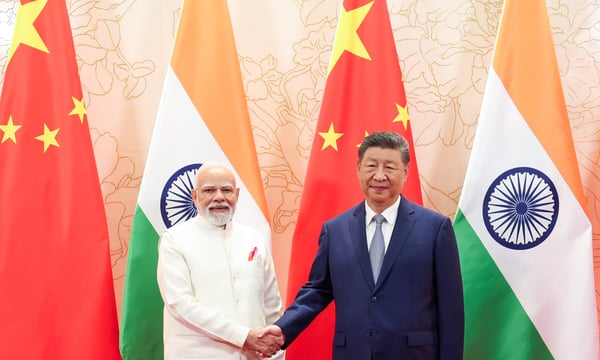
Xi Jinping’s New Year address for 2026 was not meant to reassure China’s neighbors or signal diplomatic accommodation. Instead, it projected a China increasingly certain of its place in the global hierarchy, confident enough to speak less about partnership and more about power. Delivered amid global economic uncertainty, intensifying China-U.S. rivalry, and unresolved regional disputes, the speech avoided naming adversaries or outlining conciliatory pathways.
For India, however, the message lay as much in what was left unsaid as in what was articulated; the silence was strategic. A China that feels no need to reference India directly is a China that believes the balance of momentum has tilted decisively in its favor.
Throughout the address, Xi framed China’s trajectory as one of cumulative ascent, economic resilience, technological self-reliance, and military modernization, reinforcing one another. He declared that China’s “economic strength, scientific and technological abilities, defense capabilities, and composite national strength all reached new heights.”
The line was a summary of Beijing’s self-image: China has entered a phase where power consolidation, not reassurance, defines its external posture. Innovation is no longer just economic; it is strategic to China. Military capability serves as political signaling with power projection. And global governance, in Xi’s framing, is not about participation alone but leadership.
For India, Xi’s speech raises deeper questions. As China’s technological and military power continues to grow, the central issue is whether Beijing can accommodate a stable coexistence with India as an autonomous Asian power, or whether strategic asymmetry is becoming structurally entrenched. Can economic pragmatism still act as a stabilizing force in China–India relations at a time when strategic distrust is deepening under the shadow of China-U.S. rivalry? And how should India position itself within an emerging China-India-United States triangle, in which Beijing has long viewed Washington as the principal disruptor, while increasingly treating New Delhi as the pivotal variable?
The answers to these questions will shape the contours of the Asian order in 2026 and beyond, determining whether competitive coexistence between China and India remains possible or whether sharper strategic alignment and rivalry become unavoidable in the years ahead.
Competition Turns Structural
The most consequential element of Xi’s speech lies in its emphasis on technology and innovation as the foundation of national power. This framing reflects a core belief of the Chinese Communist Party: that technological supremacy determines strategic autonomy, military capability, and long-term global influence. Innovation, in Xi’s China, is not market-driven experimentation; it is state-orchestrated, mission-oriented, and increasingly securitized.
For India, this matters because competition with China is becoming structural. China’s advances in semiconductors, artificial intelligence, advanced manufacturing, space technologies, and dual-use systems are reshaping the balance of power in ways that cannot be offset by incremental policy responses. Nowhere is this more evident than in electronics and semiconductors.
Despite the U.S.-led export controls, China has made steady progress in legacy chips, packaging technologies, and equipment substitution. India’s semiconductor ambitions under its Production-Linked Incentive schemes remain nascent and heavily dependent on foreign capital and know-how. The result is not merely a gap, but an asymmetry that risks locking India into lower tiers of the electronics value chain. No wonder, recently, India entered into a trilateral technology and innovation accord with Canada and Australia, signaling a deliberate effort to counter China’s entrenched dominance across critical technology supply chains and innovation ecosystems.
In artificial intelligence, China’s advantage lies not only in algorithms but in scale: access to vast datasets, state-backed computing infrastructure, and military-civil fusion. India’s democratic governance model, while normatively superior, constrains the speed and centralization with which AI can be deployed for strategic purposes. This creates a widening gap in surveillance capabilities, cyber operations, and battlefield awareness.
Similarly, in advanced manufacturing and robotics, China’s rapid adoption of Industry 4.0 challenges India’s labor-intensive industrial model. Beijing’s ambition to dominate industrial standards risks marginalizing India unless New Delhi accelerates industrial upgrading at scale.
Xi’s innovation narrative, therefore, answers the first question starkly: coexistence is no longer about parity. It is about whether India can prevent asymmetry from becoming permanent.
Limited Convergence in a Competitive Landscape
Yet structural asymmetry does not eliminate all space for cooperation. Xi’s emphasis on technological self-reliance also reveals China’s growing anxiety about isolation, particularly under sustained Western pressure that is only growing under U.S. President Donald Trump. This creates limited but meaningful areas where India and China can act as pragmatic partners rather than adversaries.
Climate and green technologies are one such domain. China’s dominance in solar panels, batteries, and electric vehicles intersects with India’s massive market demand and manufacturing ambitions. Cooperation here could accelerate decarbonization while serving Global South interests, provided India avoids dependency and insists on local value addition.
Pharmaceuticals and healthcare offer another opening. India’s strength in generic drugs and China’s dominance in active pharmaceutical ingredients exposed dangerous interdependencies during the pandemic. A rebalanced partnership could enhance resilience without strategic compromise.
Finally, digital public infrastructure presents a subtler opportunity. India’s success with open, population-scale digital platforms contrasts with China’s surveillance-centric model. Yet cooperation in setting digital standards for developing economies could allow both countries to shape non-Western governance norms.
These areas suggest that coexistence remains possible, but only through selective engagement. Partnership, in this context for China and India, is not trust-based; it is interest-based.
Economic Pragmatism Under Strategic Strain
If strategic trust is eroding, can economic pragmatism still act as ballast in China-India relations? China remains one of India’s largest trading partners. Bilateral trade crossed $210 billion in 2025, with India running a trade deficit of around $106 billion. This imbalance has continuously been widening despite a rise in exports; the asymmetry has long been a source of India’s concern. Moreover, Xi’s confidence in China’s economic resilience suggests Beijing views economic ties not as vulnerability but as leverage.
At the same time, China has reasons to stabilize economic relations with India. U.S.-led decoupling pressures are intensifying. Beijing needs large, fast-growing markets that are not fully aligned with Washington’s containment strategies. India fits this profile. Moreover, as global supply chains diversify, China recognizes that India’s manufacturing push could complement, rather than replace, Chinese production networks.
For India, the lesson is clear. Economic engagement with China is neither avoidable nor sufficient. Trade can stabilize relations only if India reshapes its terms – pushing for market access, reducing non-tariff barriers, and strengthening domestic capacity. Otherwise, economic pragmatism risks reinforcing strategic dependence rather than mitigating it.
A calibrated strategy is already working in India’s favor, as reflected in the recent free trade agreement with New Zealand. The deal leaves India with preferential trade access to every Regional Comprehensive Economic Partnership (RCEP) economy except China, enabling New Delhi to expand market access while avoiding the loss of tariff autonomy vis-à-vis Beijing.
Military Power Without Reassurance
Xi’s reference to China’s rising defense capabilities, delivered without naming adversaries, was a classic exercise in implicit deterrence. It signals strength without escalation. For India, however, the message is unsettling. China’s military modernization has tangible implications along the Line of Actual Control, in the Indian Ocean Region, and in space and cyber domains. The pointed reference to the mega-dam on the Yarlung Tsangpo (Brahmaputra in India) was an arrogant dismissal of concerns over China’s Himalayan hegemonic ambitions. As noted in an earlier article, it is important to connect the human rights violations on the Tibetan Plateau to China’s broader geopolitical agenda.
The absence of conciliatory language in Xi’s speech suggests that Beijing is comfortable managing disputes indefinitely under conditions of asymmetry. Dialogue becomes optional when deterrence feels sufficient. For India, this reinforces the reality that coexistence is being redefined not through negotiated equilibrium, but through managed imbalance.
The danger lies in misreading restraint as reassurance, a tendency often reinforced by the Chinese president’s statements on Taiwan. Xi’s speech normalizes a status quo where disputes remain unresolved, and power differentials discourage challenge. Notably, China’s assertion that questions of sovereignty (read Taiwan) are settled and non-negotiable does not extend to its conduct elsewhere, as seen in its persistent efforts to reopen and redefine boundaries with India, particularly in Arunachal Pradesh. India must therefore invest not only in deterrence but also in strategic signaling, making it clear that stability cannot rest on unilateral confidence alone. Strengthening border security to offset China’s infrastructure and military superiority, along with a firm national resolve to counter China’s narrative on Arunachal Pradesh, are the immediate tasks that New Delhi should not overlook.
The United States and the Logic of Triangularity
The most important subtext of Xi’s New Year speech was the United States. Although unnamed, Washington loomed behind every reference to technology, innovation, and power in Xi’s advocacy. In fact, Chinese officials increasingly argue that the U.S. is “spoiling” China-India relations by drawing New Delhi into containment frameworks. This narrative is revealing. China recognizes that India’s strategic value has risen sharply in the U.S. Indo-Pacific strategy – from defense cooperation and technology partnerships to supply-chain initiatives. Improving ties with India serves Beijing’s interest in blunting U.S. influence while preserving strategic ambiguity.
For India, this triangular dynamic is unavoidable. Strategic partnership with the United States enhances leverage vis-à-vis China, but excessive alignment risks narrowing diplomatic space. Xi’s speech suggests Beijing prefers an India that is economically engaged, strategically cautious, and autonomous, rather than ideologically aligned with Washington. Navigating this triangle will define the next phase of China-India relations.
Looking ahead to 2026 and beyond, India’s policy challenge will be to pursue calibrated deterrence along the border, selectively re-engage China where economic and regional interests converge, and simultaneously deepen strategic partnerships, especially with the United States, without foreclosing diplomatic space with Beijing. Managing this balance, rather than choosing alignment or accommodation alone, is likely to determine whether competitive coexistence remains viable in the coming decade.
In sum, Xi Jinping’s New Year speech offers India no comfort, but it offers strategic clarity. To China and Xi Jinping in particular, asymmetry is becoming structural. Economic pragmatism is conditional. Strategic triangularity is unavoidable.
Speeches will not shape the future of China-India relations, but Xi has made one thing clear: China believes history is on its side. Therefore, India’s task is not to seek reassurance where none is offered, but to manage power with strategy – investing in technology, recalibrating economic engagement, strengthening deterrence, and preserving autonomy in a polarized world.