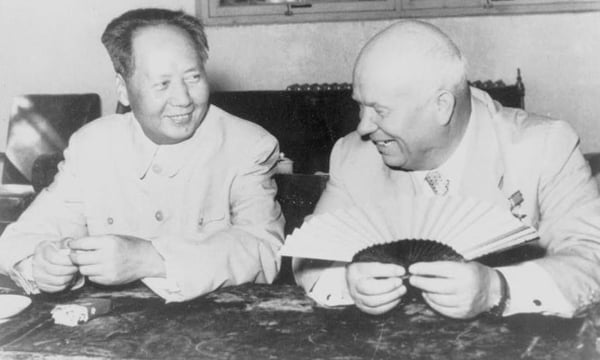
At a time when China and Russia are increasingly declaring a durable, even “no-limits” partnership, it may be tempting to interpret their relations as marked by friendship and strategic trust. This assumption appears logical given their shared and long-standing opposition to the West (especially the United States) across economic, military, and ideological domains. Such a perception is particularly common among European observers and media outlets, some of whom tend to interpret international and bilateral relations through liberal and normative lenses, assuming that all around the world they function in ways comparable to those within the European Union and broader West. Yet this assumption significantly understates the complexity of China-Russia relations, especially from Beijing’s historical point of view.
In China’s case, history is not an academic backdrop but a practical guide to strategic planning, especially regarding foreign policy. Xi Jinping himself explicitly highlights the importance of “macro-historical perspectives” (大历史观), while the Chinese political discourse and public perceptions are shaped by selective readings of the past that emphasize vulnerability, exploitation, and dangers of establishing unequal partnerships. These historical lessons are not confined to textbooks or museums. They are being actively reproduced in official narratives, elite debates, and popular education, serving as warnings against strategic complacency and lack of vigilance.
Few historical frameworks and narratives are as influential in this regard as the “century of humiliation.” It frames a period roughly between the beginning of the first Opium War (1839) and the foundation of the People’s Republic of China (1949), when China suffered significant military defeats, lost sovereign territories, and was forced into unequal treaties by foreign powers. The notion of “century of humiliation” remains central to how Chinese leaders and society conceptualize sovereignty, security, and international cooperation.
While the Western records of the “century of humiliation,” for very good reasons, focus primarily on the actions of European powers (e.g., Great Britain or France) and Japan, Russia’s role in this traumatic historical experience is often treated as secondary or overlooked altogether. A closer examination, however, suggests that this view deserves reconsideration.
Unequal Beginnings
As Sarah Paine, a U.S. Naval War College professor specializing in military history, noted, China and Russia fully discovered one another relatively late in their histories, around the mid-19th century, while operating from very different positions of strength. It was the Tsarist Russia that had a clear upper hand over its underdeveloped and internally divided neighbor.
The crucial event in that period was the Second Opium War (1856-1860). As the Qing dynasty struggled to cope with simultaneous internal rebellions (predominantly the Taiping Rebellion) and growing Western military pressure, Tsarist Russia came to the “rescue” and presented itself as a diplomatic intermediary offering to help China with the European imperial powers. However, in practice, Russia de facto supported the U.K. and France in forcing the Qing dynasty to make significant concessions culminating in the “unequal” Treaties of Aigun (1858) and Peking (1860). Under these documents, vast parts of the Chinese Manchuria were transferred to Tsarist Russia, effectively securing Russian access to the Pacific coastline.
In the same year, 1860, Russian authorities established a military outpost on these newly acquired lands. That outpost would gradually evolve into the city now known as Vladivostok – a name that translates literally as the “ruler of the East.” The message could not have been clearer: at a moment when China was weakened by internal divisions and foreign conquests, Tsarist Russia literally inscribed its claim to regional dominance directly onto the map, signaling its arrival as the leading continental power of the East.
These episodes remain central to current Chinese narratives concerning sovereignty, territorial integrity, and international cooperation. They may also serve as a broader strategic lesson that recurs in China’s political and historical assessments of Russia: any restraint toward foreign interventions in China should not be confused with Russian friendship or respect for Chinese sovereignty – in other words, the enemy of my enemy does not necessarily need to be my friend. Tsarist Russia’s blindsiding actions during the Opium Wars period thus laid the groundwork for a perception of Russia as a power willing to exploit China’s vulnerability while simultaneously portraying itself as a friendly, stabilizing, or even protective force.
This logic was also reinforced by the events at the turn of the 20th century. After China’s defeat in the First Sino-Japanese War (1894-1895), Russia played a significant role in the 1895 Triple Intervention (along with France and Germany) that forced Japan to relinquish its territorial gains on China’s Liaodong Peninsula. From Beijing’s perspective, this initially appeared as diplomatic support against Japanese expansion. However, as compensation for their intervention, Western powers quickly demanded concessions in other parts of China’s territory (e.g., Jiaozhou Bay, Guangzhou Bay, Weihaiwei). Russia managed to obtain a lease of the Liaodong Peninsula, not only securing further territory, but also the privileges to build the Chinese Eastern Railway, thus deepening its strategic influence in the region.
In Chinese historical interpretations, the key takeaway is that Russia’s alleged support for China in this case was in reality aimed at preventing Japan, a growing rival power, from consolidating continental influence, thereby advancing and solidifying Russia’s own strategic position at China’s expense – again.
Bolshevik Promises and Their Reality
The Bolshevik Revolution (1917-1922) initially promised a break with this pattern. Its rhetoric explicitly rejected the concept of imperialism and appealed to Chinese elites searching for alternatives to Western (and Tsarist Russian) conquests and exploitations. As a sign of this, the deputy commissioner for foreign affairs for Soviet Russia, Lev Karakhan, issued the first Karakhan Manifesto (1919). It pledged to renounce past unequal treaties and return territories and the Eastern Railway seized previously from China by the Tsar.
However, as the civil war went on between the Reds and Whites in Russia, and the tide started to turn for the benefit of the Bolsheviks, they decided to revise the document. Thus, the so-called second Karakhan Manifesto, presented to the Chinese side in 1920, did not include the generous renouncements promised previously, especially regarding the Eastern Railway. Two years after this, in 1922, the Bolsheviks finally emerged victorious from the revolution and managed to consolidate their power in Moscow, Soviet Russia’s new capital. As the situation stabilized internally, they started thinking more geopolitically than ideologically, and previous promises to China were further diluted, delayed, or reframed. The promised Bolshevik concessions in China remained largely intact until the mid-20th century, years after Western powers had begun dismantling theirs.
In Chinese historical memory, the two Karakhan Manifestoes may highlight the gap between revolutionary rhetoric and strategic behavior. While Soviet Russia’s actions remained largely driven by similar geopolitical interests as the Tsarist Russia, the narrative of Sino-Soviet friendship nonetheless took off and was sustained in the official discourse of both states. This early myth of fraternal relations, despite its largely transactional reality, shaped how cooperation between the two nations was later framed – but it would prove far less durable than its language suggested.
The Sino-Soviet Split
The assumption that shared ideology and fraternity could permanently bind China and Soviet Russia collapsed after Stalin’s death in 1953. The PRC’s founder and leader at that time, Mao Zedong, increasingly concluded that Moscow did not truly want a strong, independent China – one capable of challenging Soviet Russia’s leadership – within the socialist camp. Disputes over ideology, nuclear cooperation, and foreign policy priorities escalated, transforming proclaimed ideological alignment into a semi-open rivalry.
By the 1960s, the Sino-Soviet split had shattered the illusion of fraternal unity altogether. Armed clashes along the Ussuri River in 1969 between two socialist, nuclear-armed nations stand as a clear demonstration of how quickly proclaimed brotherhood can give way to confrontation once ideologies differ and mistrust deepens. For Chinese strategists, this episode became a lasting warning that neither shared ideology nor formal alliance commitments are sufficient to prevent conflict when core interests diverge.
This rupture had enduring consequences for China’s strategic outlook. It reinforced the primacy of autonomy, flexibility, and economic development over bloc politics, allowing China to open up to the Western world. It also shaped China’s later approach to great power relations and underpinned its long-standing reluctance to enter binding alliances – visible today in China’s “sovereign nationalist“ approach to international cooperation. In this sense, the collapse of the Sino-Soviet “brotherhood” did not merely end a single partnership, but helped define the strategic principles that continue to inform China’s foreign policy today.
What This History Means Today
Taken together, these historical events point to a consistent logic in China-Russia relations. Cooperation between them emerges repeatedly, but almost always under narrow and temporary conditions shaped by short-term strategic alignment. In spite of this, each phase of cooperation is accompanied by exalted narratives – ones of imperial diplomatic support, socialist brotherhood, or today’s “no-limits” friendship – only to weaken or collapse once interests start diverging. From Beijing’s historical experience, this may be seen not as a collection of isolated episodes, but a recurring, logical pattern of Russia’s behavior vis-à-vis China.
This may help understand China’s approach to Russia today. Beijing has clear incentives to cooperate with Moscow, particularly in balancing and countering the U.S. influence and challenging aspects of the existing Western-led international order. Yet this cooperation remains cautious and carefully calibrated. Russia’s growing economic dependence on China, its weakened strategic and diplomatic position due to the war in Ukraine, and the long-term structural imbalance between the two further reinforces Beijing’s restraints. China’s engagement with Russia, in spite of its lofty narrative, may therefore be understood simply as hedging – cooperation without commitment, alignment without trust.
China-Russia relations therefore cannot be seen through the normative lens of how partnerships or bilateral cooperation function in the West. As China’s history shows, no matter if it is Tsarist, Bolshevik, Soviet, or “democratic,” Russia’s strategic and geopolitical logic guiding its behavior remain unchanged. Similar to the past, today’s China-Russia relations are also built predominantly on interests that happen to align at this point in time, even if they are surrounded by exalted narratives of long-term friendship and cooperation.
History shows, however, that alliances built solely on interests are fragile by definition – in the end, interests may change, even overnight. In the case of China-Russia relations, the question is not whether such a change will occur, but rather when. Although the timing is uncertain, one thing seems clear: the “no-limits” partnership does have its limits, even if they have yet to fully reveal themselves.