President Donald Trump said on Aug. 25 that all Iranian mines in the international waters of the Strait of Hormuz had been removed and that the United States was enforcing a “zero tolerance” policy on the placement of additional mines.
“I have just been informed by the United States Navy that all mines have been removed and/or detonated from within the International Waters of the Strait of Hormuz,” Trump wrote in a Truth Social post on Aug. 25.
Iran was also informed that any vessels placing new mines in the strait would be “immediately and systematically destroyed,” he said.
“There is a Zero Tolerance policy on mine placement in full force and effect,” he said.
Trump’s announcement of the mine removal operation in the key waterway comes as the United States has continued to impose a blockade on Iranian ports. The Trump administration also announced new sanctions against Tehran on Aug. 24 as part of Operation Economic Outcast.
Trump said the Space Force was watching “every square inch” of the Strait of Hormuz, as well as Iran’s Pickaxe Mountain and the regime’s three other nuclear sites that were targeted by U.S. strikes in June 2025.
The United States and Iran paused strikes on military targets last month after exchanging strikes following the breakdown of a temporary ceasefire and memorandum of understanding. Despite the pause in military strikes, Iran has continued to target commercial vessels passing through the strait.
On Aug. 23, the Persian Gulf Strait Authority, a newly established Iranian agency for regulating traffic in the strait, warned that ships violating Iran’s rules for navigating the Strait of Hormuz could be fined, seized, or confiscated.
Trump confirmed on Aug. 18 that there were no ongoing or scheduled peace talks with Iran. The president said the U.S. naval blockade of Iranian ports remained in full force and the strait was open and operational.
Iranian officials, however, have maintained that the Strait of Hormuz remains closed. Mohammad Bagher Ghalibaf, Iran’s parliamentary speaker, said last week that the strait would not be reopened unless the United States ended the naval blockade of Iranian ports, removed oil sanctions, released frozen assets, and ended military operations in Iran.
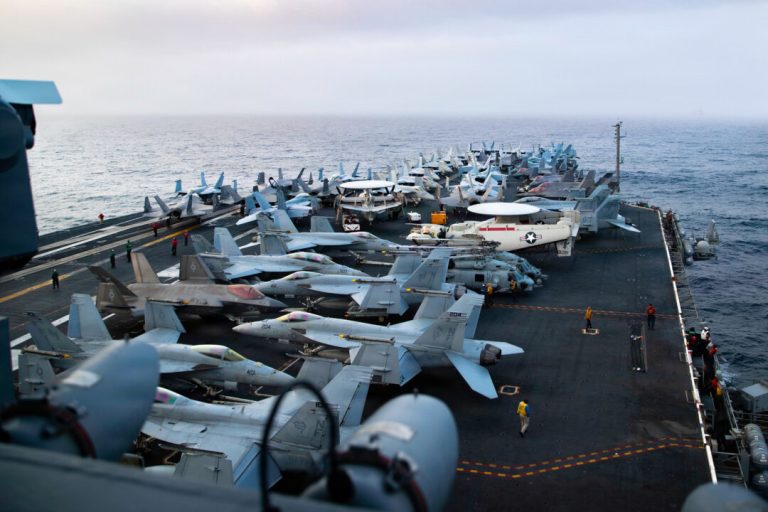
The U.S. military reinstated its naval blockade of Iranian ports on July 14 in response to multiple Iranian attacks against commercial ships in the strait in early July.
U.S. forces had redirected 71 commercial vessels, disabled three ships, and boarded two others to ensure compliance with the blockade as of Aug. 24, according to U.S. Central Command. The command noted that U.S. forces had allowed more than 40 vessels supporting humanitarian aid to pass through the blockade.
In addition to imposing a naval blockade on Iranian ports, Trump also announced earlier this month that he intended to declare the strait a U.S. territory after the war with Iran was concluded.
As of Aug. 24, about 5 million barrels of oil were being transported through the strait, according to provisional data from Vortexa, a ship-tracking firm. Prior to the war between the United States and Iran, more than 20 million barrels of oil were shipped through the strait each day.
On Aug. 23, Mohsen Rezaei, Iran’s top security official, threatened to implement further restrictions on oil exports in retaliation against economic sanctions. He also warned that support for increased U.S. sanctions against the regime would be viewed as an act of war.
“If the economic war continues, not a single drop of oil will be exported, neither through the Strait of Hormuz nor from anywhere in the Persian Gulf,” Rezaei wrote in a post on social media.
Trump’s warning to Iran on Aug. 25 came after he had previously said the United States had the “greatest cameras in the world” monitoring Pickaxe Mountain thanks to the Space Force’s advanced technology. U.S. officials have said that Iran may have stored nuclear centrifuges at the suspected nuclear site, which is fortified beneath a mountain.
“We took out their nuclear sites, and we’ll have to take out Pickaxe if we don’t make a deal,” Trump said in July.
U.S. forces launched strikes against Iran’s nuclear facilities at Fordow, Isfahan, and Natanz in June 2025 as part of Operation Midnight Hammer.
After Treasury Secretary Scott Bessent announced economic measures targeting nearly 60 individuals, firms, and vessels associated with Iran’s oil, missile, nuclear, and cyber networks on Aug. 24, Trump said the regime was “failing” and was “not paying large segments of their military.”
Reuters contributed to this report.