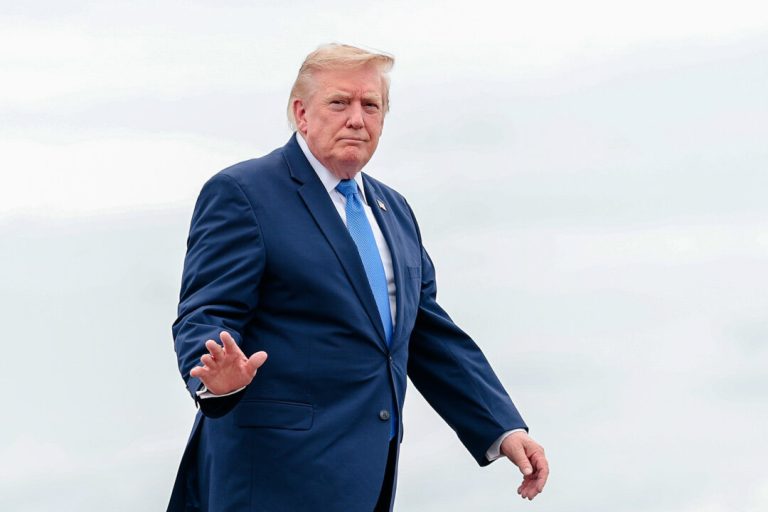

President Donald Trump prepares to board Air Force One at Morristown Municipal Airport in Morristown, N.J., on Aug. 2, 2026. Anna Moneymaker/Getty Images
President Donald Trump told reporters Aug. 2 that he called off planned military strikes on Iran the night before at the urging of regional allies and that negotiations with Iran will begin on Monday.
“I was asked to by Saudi Arabia, by UAE, and by Qatar, and by Iran,” Trump said aboard Air Force One on Sunday. “We were all set to go.”
Trump initially announced the pause in an Aug. 1 Truth Social post, writing that he had agreed to cancel the attack “subject to being able to rapidly make a deal.”
The president said some parties, including Saudi Arabia, believe a deal is imminent involving the Strait of Hormuz, to be followed by what he called “the denuclearization of Iran.”
“Now what we’re doing is we’re talking to them in the form of a negotiation,” he said. “It begins tomorrow afternoon and we’ll see.”
Trump said the planned strike “would have been by far the biggest attack since World War II” and that the United States remains ready to execute the military option if diplomacy fails again. “We’re ready to go any time we want,” he said.
When asked if there was a deadline for Iran to come to an agreement, Trump declined to give a timeline.
“We’ll just see how it is. We’re ready to go anytime we want. Would I rather make a deal? I’m not looking to kill people,” he said. “A lot of people die, and we don’t want that.”
Iran has not publicly commented on Trump’s remarks.
Iranian Foreign Ministry spokesman Esmail Baghaei said on Aug. 2 that Tehran would continue to act “based on what serves the country’s interests,” rejecting claims that Tehran has asked Washington to stop attacks, according to state-run IRNA news agency.
Baghaei warned that any country involved in military attacks against Iran, including those hosting U.S. military bases or providing logistical support to the United States, will face consequences.
Iran’s Foreign Ministry said the United Kingdom, Bulgaria, and Ukraine had contacted the regime over the past 24 hours to say they will not take part in any attacks against Tehran, according to Fars News Agency, which is closely aligned with the Islamic Revolutionary Guard Corps (IRGC).
“All friends and neighbors must know that the consequences of any attack by America on Iran’s infrastructure will engulf everyone,” the ministry was quoted as saying.
Tehran signed a memorandum of understanding with the United States in June to halt the war that began in late February when the United States and Israel launched attacks on Iran to dismantle its nuclear program.
On July 7, Trump
the ceasefire with Iran over and resumed attacks after Tehran attacked ships in the Strait of Hormuz. Iran’s armed forces retaliated by targeting U.S. military bases in Middle Eastern nations.
The attacks lasted for 13 consecutive days before Trump ordered a pause to allow negotiations. The U.S. military later resumed strikes on July 29 after Tehran attempted more missile attacks on U.S. forces stationed in the Middle East.
Trump has
that any deal reached with Iran must guarantee that Tehran cannot develop nuclear weapons and ensure freedom of navigation in the Strait of Hormuz, a vital international route for global oil and gas shipments.
Meanwhile, Iranian Foreign Minister Abbas Araghchi said on Aug. 2 that negotiations with Oman on the Strait of Hormuz have entered their “final phase” but did not elaborate, IRNA reported.