On April 17, 1895, the Qing dynasty signed the Treaty of Shimonoseki (also known as the Treaty of Maguan) with Japan, ending the First Sino-Japanese War and dethroning the “Middle Kingdom.” More than a century later, on the same date, a Japanese Maritime Self-Defense Force (MSDF) vessel passed through the Taiwan Strait. On Weibo, a Chinese version of Twitter, a hashtag “China is no longer the China of 131 years ago” accused Japan of provocative action, attracting over 14 million views.
The current Sino-Japanese tension began long before the April 17 MSDF transit, however. It started with Japanese Prime Minister Takaichi Sanae’s remarks in early November 2025 that a Chinese attack on Taiwan could become “a situation threatening Japan’s survival.”
A rapid escalatory spiral followed, including a radar incident, Chinese economic coercion, an intrusion in the Chinese Embassy in Tokyo, Japan’s deployment of new long-range missiles, and Japan’s lifting of its ban on lethal weapons exports. After the Japanese vessel transited through the Taiwan Strait, China responded with military exercises in waters near Japan. The center of the deteriorated bilateral relations has expanded from the Taiwan issue to regional security in general.
Meanwhile, Chinese authoritative outlets, such as People’s Daily, have continuously published articles almost on a weekly basis over the past seven months alleging the rise of Japanese right-wing forces and the resurgence of Japanese militarism under the Takaichi government.
While China pressures Japan on both economic and propaganda fronts, Takaichi’s overwhelming victory during the February election suggests China’s approach might be counterproductive. Then, one must ask why Beijing persists with this strategy despite its apparent failure.
Some argue that Beijing, believing it possesses superior military and economic strengths, might be using aggressive moves to test Japan’s boundaries. Others argue that Beijing wants to “kill the chicken to scare the monkey,” punishing Japan to warn other countries that might be considering closer alignment with Taiwan or security cooperation with the United States.
However, these arguments fall short of offering a full explanation for why these counterproductive approaches persist as China tries to position itself as a defender of global stability amid instability. The discrepancy implies that there is greater complexity underlying Beijing’s strategy toward Tokyo: China is playing a trilateral game.
Historically, the Sino-Japanese bilateral relationship has been strained by factors such as territorial disputes, nationalism, and competition for regional leadership. Yet beyond this dimension, the Japan-U.S. alliance has also played a critical role in shaping Sino-Japanese dynamics.
During the Occupation of Japan, the United States adopted a “dual containment” strategy, aimed both at deterring communist aggression in the region and at controlling Japan’s postwar trajectory, including restraining Japanese remilitarization under Article 9 of the 1947 U.S.-imposed pacifist constitution.
The security framework was further solidified through the 1951 Security Treaty, allowing U.S. military bases to be stationed in Japan, and was revised in 1960 as the Mutual Cooperation and Security Treaty to include the U.S. commitment to defend Japan.
However, Japan, beginning with the Abe government, has begun to reinterpret Article 9 of the constitution to grow its military and strengthen the Japan-U.S. alliance and partnerships with other like-minded countries. Citing the external environment, including the rise of China and nuclear threats from North Korea, late Prime Minister Abe Shinzo, a staunch Japanese nationalist, had leveraged these threats to advance the right-wing agenda of transforming Japan into a “normal” nation. Nevertheless, the scale of the Chinese military expansion has left even moderate Japanese leaders feeling the need to respond. The Japanese ambition to up its defense capabilities aligned with the U.S. strategy toward Asia, namely, containing China. In response, China has repeatedly condemned the Cold War mentality of the U.S.-led alliance.
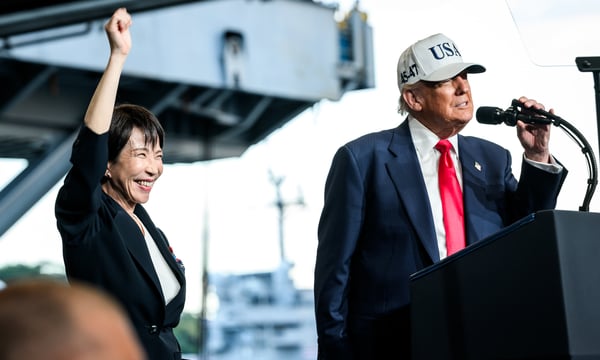
Positioning herself as the successor to Abe, Takaichi is following her mentor’s line to strengthen the Japan-U.S. alliance. However, Takaichi is facing a different Trump administration from the one that overlapped with Abe’s tenure.
The second Trump administration has adopted a more transactional approach toward Japan, not only pressuring on the economic front but also demanding that it shoulder greater defense burdens. What makes things more complicated is President Donald Trump’s unpredictable approach toward China.
Japan’s recent developments of its defense capabilities align with the U.S. National Security Strategy. But Japan’s strategy toward China remains deeply contingent upon China-U.S. relations. U.S. President Richard Nixon’s visit to the People’s Republic of China caused what became known as “Nixon Shock” in Japan, forcing Tokyo to rework its own China policy nearly overnight. If Trump decides to improve relations with China profoundly, in line with the newly agreed-upon framing of “constructive strategic stability,” Japan might need to re-evaluate its posture toward China.
When Takaichi visited Washington in March, her original plan was to get reassurance from Trump before his trip to China, which was then planned for later that same month. However, the U.S. and Israeli war against Iran sidetracked the meeting; Trump did not visit Beijing until mid-May.
Additionally, right before her meeting with Trump, the U.S. Intelligence Community issued its annual threat assessment, stating that Chinese leaders do not plan to invade Taiwan in 2027 and that Takaichi’s comments on Taiwan represented “a significant shift.” Japan rejected the latter assessment.
The timing matters. A Chinese scholar cited this episode as evidence, suggesting that the United States was signaling a warning to Japan. In this reading, Washington was implying that Japan should not out-hawk its ally. The same scholar further noted that China’s emphasis on guarding against the resurgence of Japanese militarism is not an empty slogan, and that the United States shares a certain degree of consensus with China on upholding the postwar international order.
Liu Pengyu, the spokesman of the Chinese Embassy in the U.S., further called on the United States to cooperate to “thwart any plot to revive the specter of militarism.” It is not a coincidence that Chinese articles mention the attack on Pearl Harbor in their condemnation of the resurgence of Japanese militarism.
So, it seems that China’s current strategy toward Japan aims not only to test Japanese boundaries but also to test the Japan-U.S. alliance, with the United States serving as the intended audience for these approaches.
This underlying calculus was made clear in a recent article in Qiushi, the official magazine of the Chinese Communist Party. While asserting that the Japanese right-wing forces are driving Japanese politics toward extremism, the article also pointed out that the postwar U.S. policy toward Japan has undergone a fundamental shift from pushing Japanese demilitarization to supporting rearmament, and failing to root out the remnants of Japanese militarism. The rhetoric reflected an uncomfortable dilemma Beijing has faced since the post-war era: while Beijing wants an Asia for Asians, it paradoxically relies on Washington to check Tokyo.
Therefore, rather than testing the overall U.S. security commitment to Japan, China is testing the extent to which the United States is willing to restrain Japanese rearmament efforts. However, the outcome of this strategy is structurally ambiguous. Even if Xi successfully persuades Trump that there is no imminent threat to Taiwan or urges Trump to constrain Tokyo, it will likely – and counterproductively – trigger fears of alliance abandonment within the Japanese policy community. Rather than checking Japanese militarism, a perceived U.S. step-back would incentivize the Takaichi government to double down on rearmament and seek security alliances with other “like-minded” countries.
Conversely, if Trump resists Beijing’s pressure and stands firm, China might perceive that a U.S.-backed Takaichi government would be bolder, or at least unlikely to retract Takaichi’s comment on Taiwan.
This paradox was on full display during the recent Trump-Xi meeting. According to news sources, Xi urged Trump not to support Takaichi, but Trump insisted that “Takaichi is a leader undeserving of criticism.” Although the Chinese side repudiated this report, Trump did call Takaichi right after his trip and reaffirmed the Japan-U.S. alliance.
While Sino-Japanese relations remain intense, with no easy solution, the danger is that tensions have escalated to the military front. There is a real risk of miscalculation and inadvertent crisis, raising questions about the adequacy of existing bilateral crisis management mechanisms.
In 2023, China and Japan established a hotline, aiming to play an important role in “fostering trust between Japanese and Chinese defense authorities as well as avoiding contingencies.” But during the radar incident in December 2025, the Japanese side said China did not answer the hotline, highlighting its operational limitation. The removal of multiple top Chinese military leaders over the past few years could further introduce uncertainties over points of contact. Taken together, the lack of bilateral communication makes tensions particularly dangerous.
Yet, the diplomatic maneuvers will continue. The APEC leaders’ summit in China later this year might offer a window for Beijing and Tokyo to ease their tension – the breakthrough meeting between Xi and Abe in 2014, following the intense territorial disputes, serves as a compelling precedent. Ultimately, whether both sides can successfully leverage the APEC summit to ease tensions will depend on the urgency of crisis management, long-term economic interests, and complex bilateral and trilateral dynamics with the United States.
Achieving a stabilized Asia-Pacific will require China, Japan, and the United States to work toward a shared commitment to end the regional arms race.